
Claude for marketers is Robert Gillespie’s online masterclass for practitioners who want an AI assistant embedded in recurring team workflows instead of treated as a blank chat box. The Claude For Marketers Masterclass is aimed at people responsible for research, content, prospecting, reporting and design who can supervise the output. Before deciding, it helps to separate durable operating principles from feature names that may change.
The advertised office-hours coaching call depends on active enrolment with Robert Gillespie and should not be assumed to accompany the learning materials elsewhere. Any one-to-one help, weekly calls, community participation or feedback also depends on the original provider unless expressly supplied. What transfers is the recorded framework and supplied templates.
Persistent context removes the briefing tax
Repeated prompting feels productive because every conversation starts clean, but it makes the marketer reconstruct the same audience, positioning, terminology, examples, exclusions and approval rules. Persistent project context moves those stable facts into a controlled source that can be corrected once and reused. It is not memory in the human sense. It is maintained operational context, so outdated claims and contradictory files still need an owner. Because capability boundaries change, check the official model documentation before designing a process around them.
A calendar can trigger work but cannot own judgment
Good scheduled jobs have a stable trigger, bounded inputs, a repeatable output and low-cost failure: a weekly competitor digest, an inventory of unanswered comments or a draft performance summary. Positioning, sensitive claims, final publication, budget changes and outreach decisions remain human decisions because they depend on risk and context. The useful pattern is prepare, inspect, approve, then act. Scheduling removes waiting; it does not remove accountability or the human review step.
From saved prompts to scheduled operations, control moves outward
Prompt libraries preserve useful wording but rely on the operator to supply the right context each time. Persistent project workspaces keep source material and standing instructions together, although they can preserve stale information just as efficiently as current information. Reusable instruction packages standardise a process, but weak processes become repeatable too. Connector-based orchestration reduces copying between systems while increasing permission and data-exposure risk. Scheduled automation suits predictable monitoring and drafting, not ambiguous decisions. API-driven agent workflows offer greater control and observability, with more engineering and maintenance. The strongest evidence belongs to the underlying practices: written procedures, controlled sources, repeatable automation and human quality assurance, not to a branded arrangement of them.
Workflow quality becomes visible at the handoff
Before buying any program in this category, ask to see one complete job from intake to approved output. The demonstration should identify its source files, standing instructions, tool permissions, trigger, output format, error path and named approver. Check whether examples use realistic brand constraints rather than a clean demo, whether edits improve future runs, and whether the process can be exported or documented. Then ask which lessons depend on current interface labels, which account plan is required, how changes are handled, and what data should never enter the system. A serious curriculum teaches stopping conditions as clearly as shortcuts.
Adopt, Automate, Integrate follows an operator’s learning curve
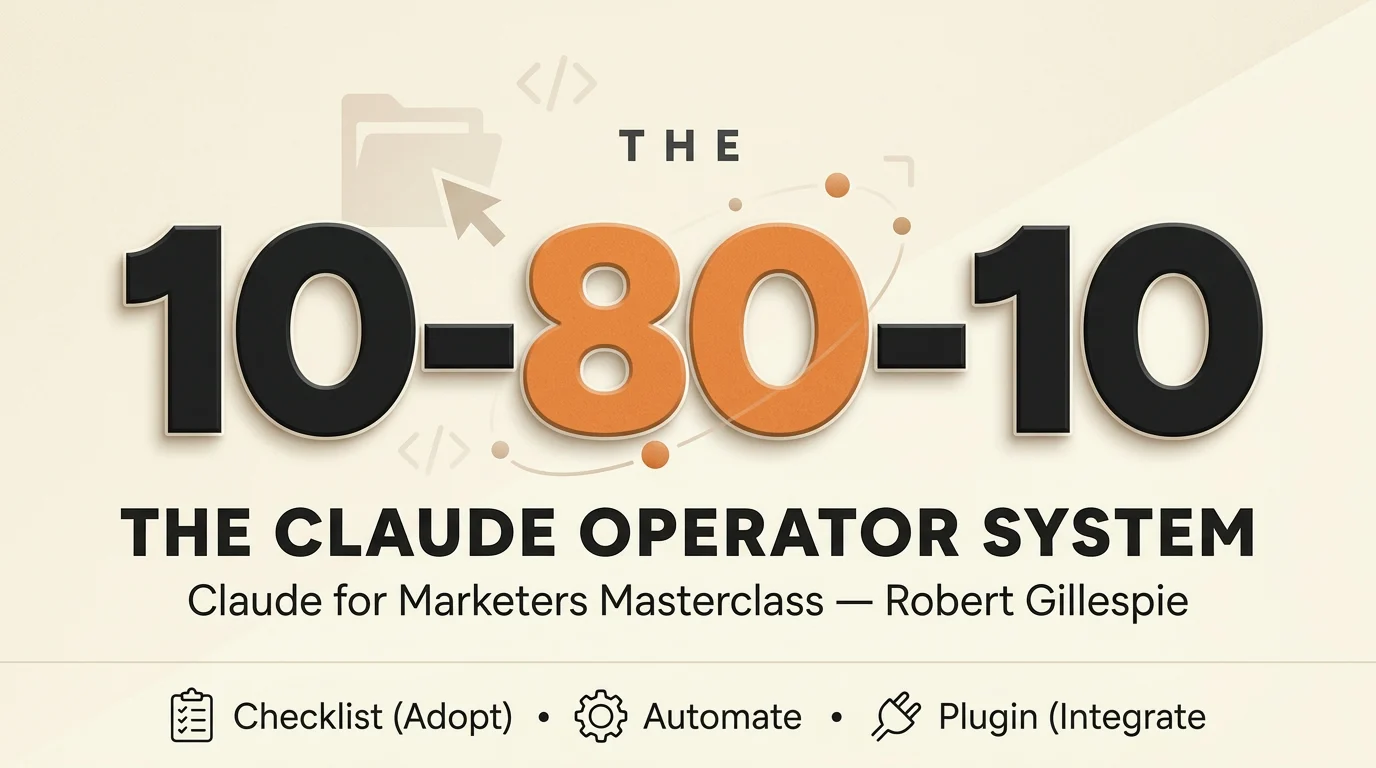
As a Claude for marketers curriculum, the program is structured as 10 to 12 or more hours across three phases. Adopt introduces the Hybrid Marketer identity, the 10-80-10 model and an end-to-end job by Module 2. Automate lists Cowork Projects, Skills, Connectors, Plugins and Scheduled Tasks, including competitor digests, weekly checks and daily ideas. Integrate moves to the Prospecting Engine, Content Engine, reporting workflow, Claude for Excel and PowerPoint, and Claude Design. The curriculum lists twelve modules, but Modules 11 and 12 were still marked as coming in separate months, with no year stated, when the material was produced. They should not be counted as delivered without current confirmation.
The content engine stops at sign-off
The strongest Claude for marketers example is Module 8’s Content Engine. According to the listing, it reads a brief and brand guidelines, researches the subject, drafts a long-form asset, adapts it into a LinkedIn post, an X thread and a newsletter email, then stages everything for approval. Nothing publishes before sign-off. That is a sound boundary, but it is a workflow description, not independent evidence of output quality or business results. The listing gives Robert Gillespie no biography beyond saying he runs the process inside companies, and it supplies no independently verified learner outcomes. Any creator income or student-count figure would remain the creator’s own claim, not verification; the supplied listing gives neither. Feature labels here describe the stated curriculum, not permanent facts about the software.
Governance is the missing companion discipline
Results require several weeks of using real briefs, cleaning source files, defining approval rules and comparing outputs with a human standard. Common failures are stale context, excessive permissions, silent source gaps, instructions that conflict and schedules that generate work nobody owns. Pair the lessons with an information-security policy, a content quality rubric and a simple change log. Choose dedicated marketing operations training instead if your bottleneck is ownership, intake and approval rather than assistant use. Compare a specialist CRM automation course when field mapping, lifecycle logic and data hygiene are the critical work. A structured prompt engineering program may fit better when you need stronger briefs and evaluation without cross-tool automation. Regulated, confidential or high-stakes publishing also needs domain supervision that a general marketing workflow cannot supply.
Your due diligence starts with the calendar and account
A Claude for marketers buyer should settle four product-specific questions. Which of Modules 11 and 12 are available now, given that both were marked as coming in different months without a year? Which software plan, account permissions and connected services are required for each demonstration? When is the included office-hours call scheduled, and how are questions submitted? How long will the lessons and bonus templates be maintained as interfaces and feature names change? The listing says call dates are confirmed within two weeks of purchase and that the call is recorded for anyone who cannot attend live, but it does not resolve the other version and support details. Clear answers separate current training from an attractive but aging map.