
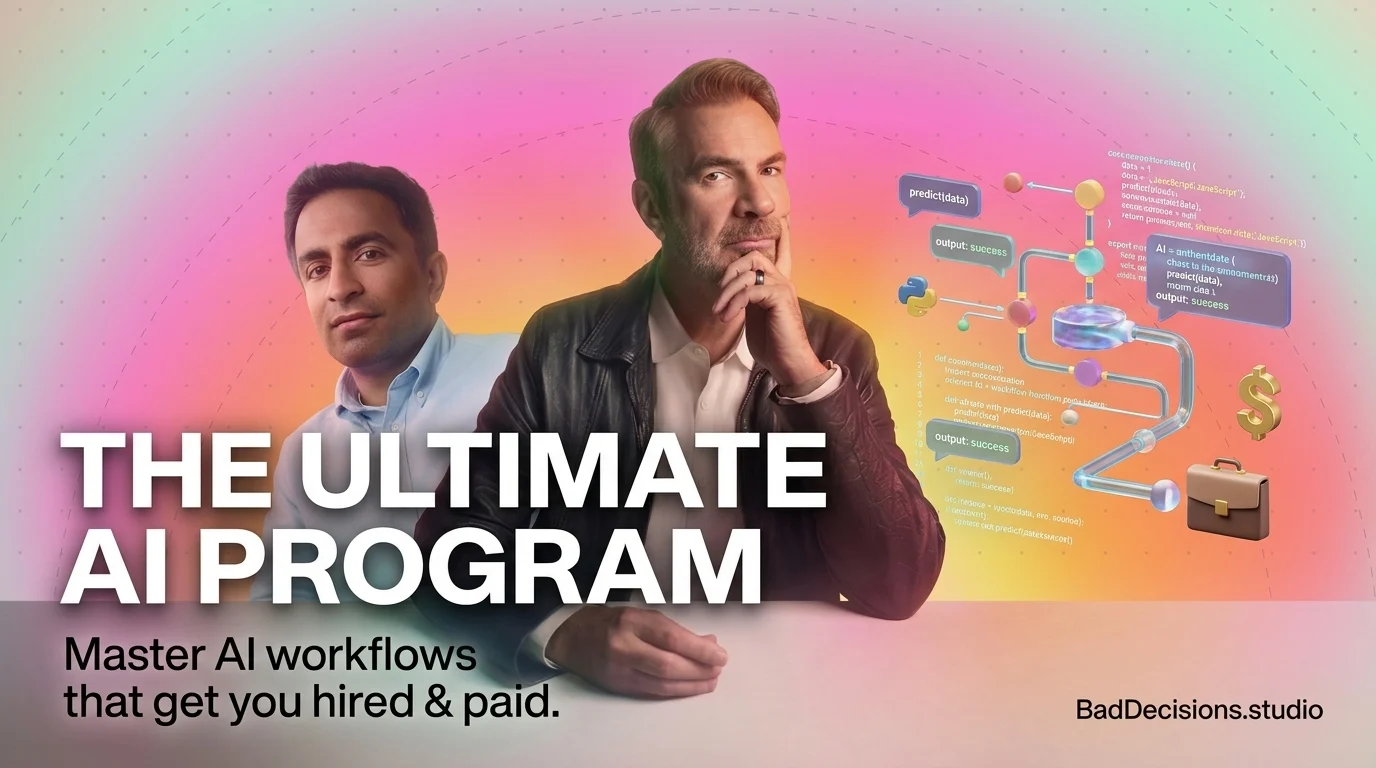
Ultimate AI Program is a multi-tool AI workflow course sold by Bad Decisions Studio, built around practical playbooks rather than isolated prompt tricks. It is aimed at freelancers, creators, marketers, designers, entrepreneurs and professionals who want to apply current AI systems to real deliverables. The important buying question is whether those workflows develop judgment as well as speed.
Fluent output is not the same as finished work
A demo usually rewards visible speed: produce a page, image, deck or prototype in minutes. Professional work is judged differently. The result must fit a brief, use trustworthy inputs, survive factual checking, respect constraints and remain editable when requirements change. A model will produce fluent output whether or not it is correct, so the durable skill is knowing what evidence should exist and how to inspect it.
The transferable workflow is to decide whether the task suits a model, split it into checkable stages, supply relevant context, define acceptance criteria and verify each result. Prompt syntax transfers only partly. Product menus, model selectors, automation buttons and interface-specific shortcuts can disappear within months. A workflow that increases output volume without increasing your ability to check it increases risk rather than productivity.
Five workflow patterns distribute judgment differently
Direct generation turns a bounded instruction into a draft. It is fast for reversible, low-risk work but weak when facts, calculations or missing context determine correctness.
Example-guided generation uses approved samples, rubrics or few-shot exemplars to establish the target. It improves consistency, although it can reproduce defects hidden in the examples.
Retrieval-grounded workflows make a model answer from selected documents or databases. They improve traceability, but retrieval quality and source freshness still need testing.
Human-in-the-loop production assigns drafting and transformation to the model while a competent person approves defined checkpoints. This remains the strongest general pattern for consequential professional work because responsibility stays visible.
Tool-using agent workflows let a model call software, search records or execute multi-step actions. They suit repeatable processes with observable states, but errors can compound when permissions, stopping rules and logs are poorly designed.
Lessons that never check their own output teach half the job
Before buying any AI workflow program, look for complete tasks rather than impressive outputs. A useful exercise should identify the input, constraints, model role, human decision, acceptance test and recovery path. Check whether students compare outputs against a known answer, primary source or expert rubric. Ask how examples are updated when tools change, whether projects expose failure cases, and whether the instruction distinguishes reproducible methods from interface tours.
The strongest programs also show where automation should stop. Their evaluation approach should resemble the risk-aware logic in the NIST AI Risk Management Framework: define context, measure performance, manage risk and keep monitoring rather than treating one successful output as permanent proof.
The claimed anchor is the studio’s own client work
The seller describes Ultimate AI Program as a centralised collection of hands-on workflows, curated tool selections, step-by-step playbooks and real-world projects developed over six months. The seller lists coverage including how large language models work, ChatGPT and Claude, image and video generation, and agentic workflows.
Named components make the positioning more concrete. The seller lists a Codex Masterclass for building AI agents and apps, and a Claude Design Masterclass for pitch decks and interactive websites. The wider tool coverage includes coding, design, voice, music, avatars and video systems. If the material is organised around real client playbooks as described, that is a better starting point than an undifferentiated prompt library, and multi-tool coverage discourages loyalty to a single platform.
Every interface lesson begins ageing immediately
Tool-specific training is the most perishable part of this category. A Codex lesson, a Claude design walkthrough or instructions for a current image generator may lose accuracy as controls, capabilities and pricing structures change, often within months. That is a structural property of fast-moving software, not a defect unique to one studio.
What does not date as quickly is deciding whether a task belongs with a model, decomposing it, providing sufficient context and checking the result against evidence. The value of this program therefore depends partly on whether its playbooks teach those decisions beneath the interface demonstrations and whether revised lessons accompany material product changes.
Studio visibility establishes identity, not learning outcomes
Bad Decisions Studio has a public creative technology site, publishes The Bad Decisions Podcast, offers a separate Unreal Engine course and states that it serves clients across several regions. That makes it a visible, client-facing operation rather than an anonymous handle. It does not prove that learners reproduce the studio’s results.
The six-month build period and use of real business workflows are the seller’s own descriptions. No individual instructor is named, so a buyer cannot assess one teacher’s instructional record, subject expertise or feedback style. The listing also supplies no independently measured completion, skill improvement or learner outcome evidence. Claims around Ultimate AI Program should therefore be judged through curriculum specificity, update practice and assessable student work.
Professional value still comes from practice outside the lesson
Expect to repeat workflows on your own briefs, preserve source material, record errors and develop a domain-specific checking routine. Common failure points include copying demonstrations without understanding dependencies, subscribing to more tools than the work requires, accepting plausible outputs and building a portfolio that shows polish without explaining decisions.
A beginner who lacks an underlying craft may be better served first by dedicated design fundamentals training. Someone seeking evidence of ability should compare a structured portfolio development program with assessed briefs and critique. A developer handling sensitive automations may need specialist AI governance training instead. For production engineering depth, choose a software testing and deployment course that treats generated code like any other code.
This course is more plausible as an integration layer for an existing skill than as a substitute for that skill. Its breadth demands selective practice, not completion for its own sake.
What the listing leaves unsaid about updates and access
Is the teaching recorded, cohort-based or mixed? The listing describes hands-on modules but does not specify the delivery rhythm, feedback mechanism or whether projects receive human evaluation.
Who teaches each specialist topic? The studio identity is clear, but no individual instructor is named for language models, creative generation, Codex or Claude.
How are changing interfaces handled? Ultimate AI Program spans numerous fast-moving products, yet the supplied description does not state an update schedule, revision log or policy for replaced tools.
What must a learner already possess? The audience ranges from beginners to working creatives and entrepreneurs, but the listing does not separate prerequisite design, coding, marketing or production skills. It also does not identify which exercises require separate third-party accounts. Those answers determine whether the advertised breadth becomes a usable workflow or an expensive tour of software.