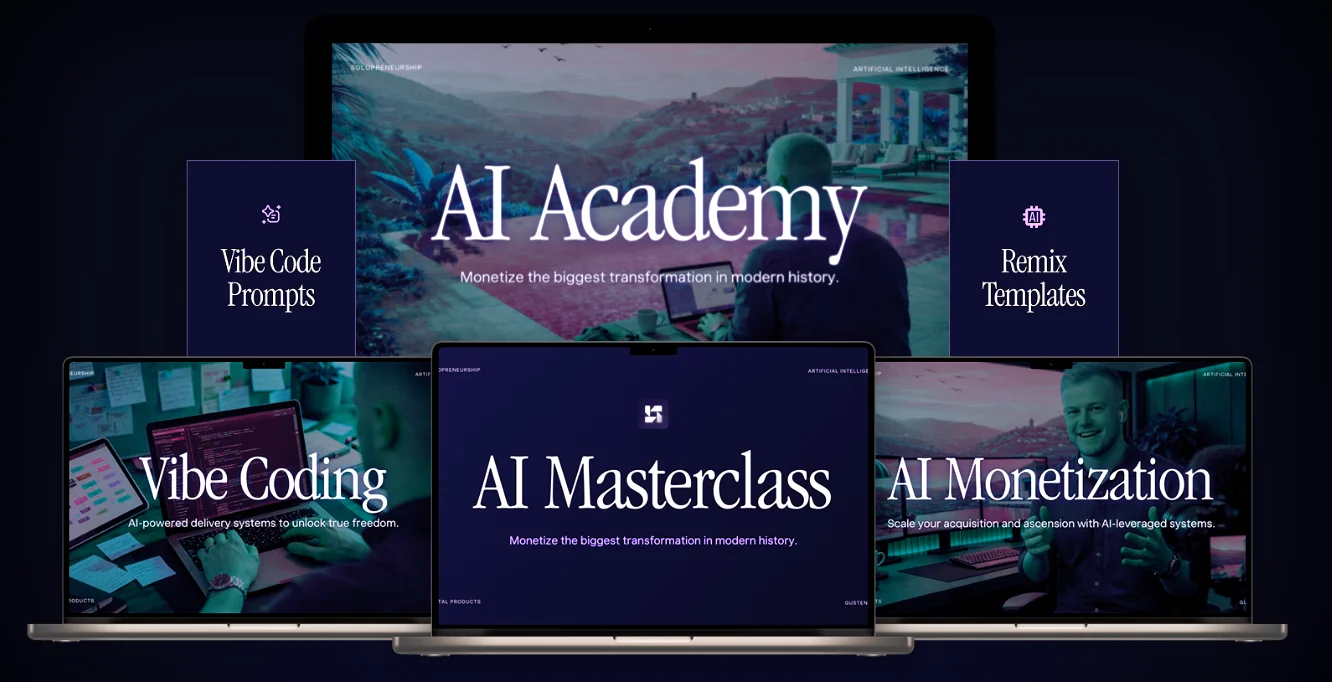
AI Academy by Gusten Sun is a membership-shaped training program for entrepreneurs and creators who want to use AI prompting, reusable app templates and guided builds to create digital products. Its mix of recorded lessons and ongoing support makes one decision especially important: are you learning to own the resulting software, or merely learning to generate it?
Any one-to-one access, weekly calls, community participation, feedback and monthly updates depend on active enrolment with the original provider and should not be assumed included elsewhere. What transfers independently is the recorded framework and template material, not future sessions, responses or updates.
Shipping AI-written software means owning code you did not write
Vibe coding works well when the problem is bounded and mistakes are cheap. A clear prompt can produce interface scaffolding, routine database operations, an internal utility or a quick integration experiment. The hard part starts after the demonstration works: requirements change, users enter unexpected data, dependencies update and failures must be diagnosed inside code you may not have written or understood.
Prompt quality helps, but it does not replace architecture, version control, automated tests, logging, access control or backups. Sensitive data needs explicit handling rules. A generated app still has to pass the OWASP Top 10 security checklist, including risks involving access control, injection and insecure design. Reusable templates accelerate setup; they do not supply demand. Without customer research, positioning, distribution and support, a cloned template remains software inventory rather than a business.
Specification loops, copilots and templates fail in different places
Specification-first prompting turns a request into acceptance criteria, data rules and edge cases before generation. It reduces ambiguity but demands enough domain knowledge to notice missing requirements.
Interactive copilot development keeps a person in a tight write, inspect, run and revise loop. It suits small changes and learning, though weak inspection can let defects accumulate.
Agentic repository editing gives an AI broader responsibility across several files and tests. It can accelerate coordinated changes, but larger action ranges increase the cost of a mistaken assumption.
Low-code visual building emphasizes managed components and integrations. It lowers initial technical friction while creating platform limits, migration questions and recurring dependency risk.
Template cloning begins from a reusable product structure. It is efficient for repeated patterns, but inherited code, unclear licensing and superficial differentiation can become liabilities.
Test-driven AI assistance asks the system to work against executable checks. Established testing practice supports this feedback loop, although passing tests only proves the cases somebody thought to write. Comparative evidence for complete AI building workflows is still developing.
A serious AI app course exposes the maintenance handoff
Before buying any program, inspect one complete project from blank brief to deployed change. It should show requirement definition, prompt iteration, code inspection, testing, error diagnosis, version history, secrets management and recovery from a failed deployment. Ask whether you receive editable source code, what services the project depends on and who handles updates when an API changes.
Examine templates as operational assets. You need to know their platform, licence, external costs, data flows and upgrade path. Look for exercises that require you to explain generated code and repair a deliberately broken feature. Finally, separate learning evidence from sales evidence: lesson hours and demonstrations establish scope, while maintained repositories, documented limitations and observable student work say more about skill transfer.
AI Academy wraps a training library in ongoing membership
The listing describes more than fifty hours moving from basic prompting to AI-assisted SaaS building. Its named components include the Vibe Coding Blueprint, Prompt Flows, a current AI tool stack, funnel templates, two-day event recordings and weekly live building sessions. The Remix library names the Freedom Score App, AI Chat Coaching App, Echo AI, 2nd Brain OS and Solopreneur OS.
This gives AI Academy considerable breadth and several starting points for practice. It also creates a sequencing risk: prompts, funnels, infrastructure ideas and app templates can feel productive without proving that you can maintain one project. The listing does not identify the platform used by the app templates, explain prerequisite coding knowledge or specify how template updates are handled. Those omissions matter more than the number of included assets.
Course breadth is not evidence of a durable app
The strongest support for the offer is descriptive: named resources, recorded instruction, live demonstrations and recurring group activity. Those facts establish format, not outcomes. Research found no independent page or profile that substantiates Gusten Sun’s background or the academy’s results, so the creator’s business and student claims should be treated as self-reported rather than verified. No income, speed or commercial outcome should be inferred from a demonstration or template.
A live build can reveal workflow and troubleshooting, but it cannot show long-term security, retention, maintenance cost or product demand. The useful evidence would be a versioned project followed through defects, user feedback and later changes.
Files you keep versus sessions that end with the membership
Do I need programming experience? The listing starts with basic prompting, but it does not state a coding prerequisite. If you cannot read code or use version control, expect to add foundational study.
Which platform runs the Remix templates? The listing names several apps but does not identify their platform. Confirm compatibility, required accounts and editing rights before treating them as usable assets.
Are the weekly calls and monthly updates part of every version? They belong to the original ongoing membership. A detached recording package cannot reproduce future calls, community responses or updates.
Are tool subscriptions included? A current tool stack is listed as instruction, but ownership of subscriptions and continuing service costs are not specified.
Durable products need distribution and an owner
Results require choosing one narrow problem, interviewing likely users, building a small version and maintaining it after feedback arrives. Common failure points are accepting generated code without inspection, combining too many services, storing data carelessly and switching templates before one project reaches real users.
If code comprehension is the constraint, you may be better served by foundational web development training. If the product handles accounts or sensitive records, compare a secure software development program. If nobody has demonstrated demand, choose product discovery and customer interview training before another builder course. Teams expecting paying users may also need SaaS operations training covering monitoring, incidents and support.
Gusten Sun’s program is most plausible for a self-directed builder who values a broad library, the Vibe Coding Blueprint and live membership context. Choose something narrower if you need accredited instruction, deep engineering supervision or a platform-specific implementation path.