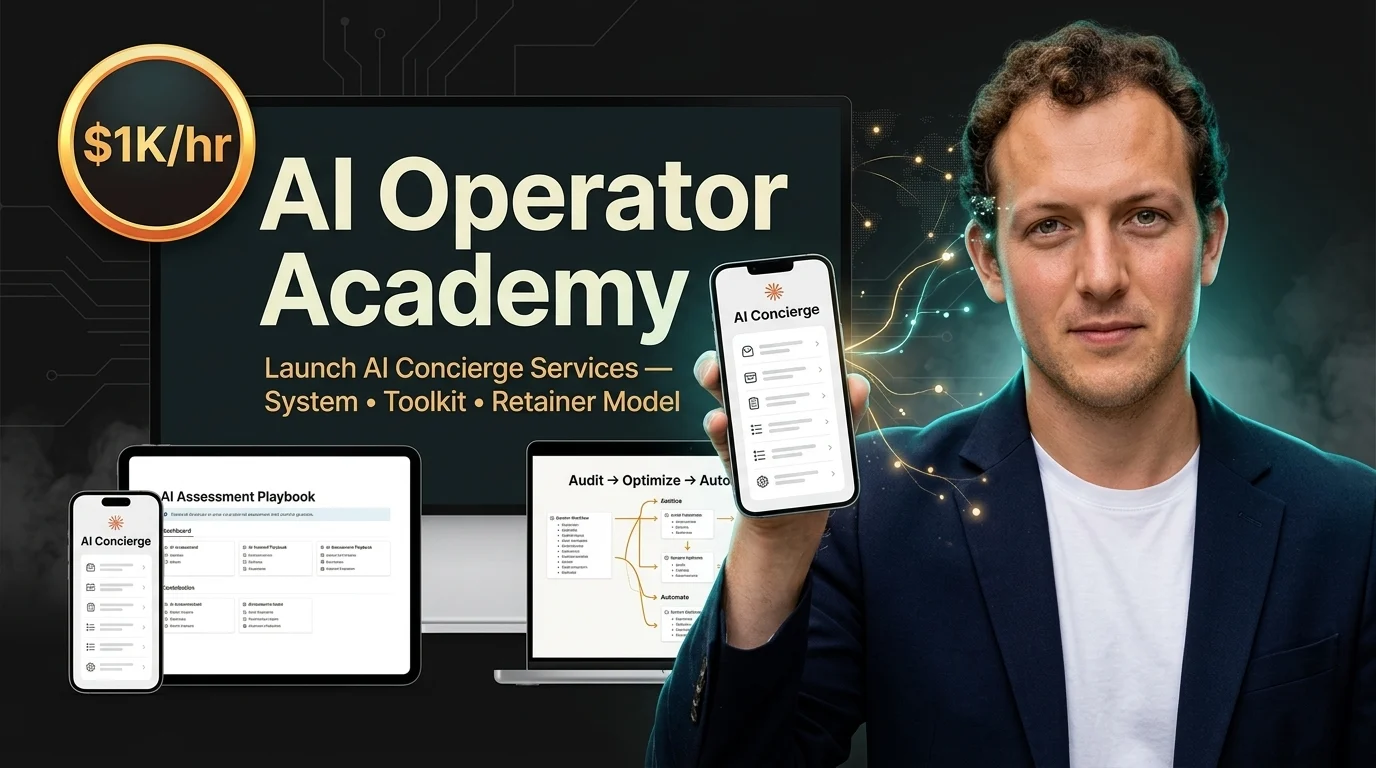
AI Operator Academy is Corey Ganim’s training offer for service providers who want to sell AI work through business relationships they already have. It is aimed at operators with an existing book of business who need a sequence for paid diagnosis, improvement, automation and recurring advisory support. The real decision is whether that sequence produces work a client can understand, measure and safely adopt.
The advertised live layer consists of two office hours and one workshop each month. One-to-one access, weekly calls, a community are not listed and should not be assumed; their availability, along with session-archive access, depends on active enrollment with the original provider. What transfers outside that setting is the training and the resources the listing names, not an assumed coaching relationship.
Automation starts after the workflow has earned a baseline
A paid assessment is a diagnosis, not a proposal wearing a consulting label. It should map one bounded workflow, identify its owner and users, record baseline time, errors and volume, and deliver prioritized findings, dependencies, risks and a next-step decision. Audit comes before optimization because automating waste only makes waste faster. Optimization removes duplicate approvals, clarifies inputs and standardizes common exceptions. Automation belongs on stable, repeated steps whose failures can be detected and reversed.
A retainer then needs explicit boundaries: meeting cadence, included systems, response expectations, change control and success measures. If an intake agent communicates with people, disclosure and human escalation should be designed from the start.
Assessment, optimization, implementation and advisory carry separate risks
Paid diagnostic consulting is useful when the client cannot yet define the problem; process mapping and baseline measurement support it, but a vague report creates no implementable decision.
Process optimization consulting improves an existing workflow before software enters it. It has strong roots in operational analysis, although it can stall when nobody owns the redesigned process.
Workflow automation implementation connects stable steps through software. Controlled pilots and acceptance tests provide better evidence than demonstrations, while brittle inputs and unhandled exceptions remain its weakness.
Fractional AI operations retainers provide recurring prioritization and oversight. They suit businesses with continuing demand, but become poor value when the scope is merely unlimited troubleshooting.
Conversational intake agents can standardize questions and capture structured answers. They require disclosure, consent-aware data handling, escalation paths and testing against misunderstood speech.
Paid AI assessments must end in a decision-ready document
Before buying instruction, ask to see an anonymized assessment output and trace every recommendation back to evidence. Check whether the method teaches baselines, workflow ownership, exclusions, risk ranking, acceptance criteria and a quantified business case without pretending estimates are facts. A credible program should separate diagnosis from implementation, show how retainers are scoped, and explain what happens when automation fails. For voice intake, inspect disclosure language, data retention, human handoff and correction procedures. Finally, determine whether practice receives expert feedback or only model answers.
Corey Ganim moves from a known business to recurring advisory
Inside AI Operator Academy, the AOA Method training presents an Audit → Optimize → Automate sequence for packaging AI services. The AI Assessment Playbook addresses landing and delivering a paid assessment with a business you already know, then opening a retainer conversation. Client discovery questions and an ROI Anchor support that diagnostic stage.
The AI Concierge retainer model is described as two 45-minute calls each month plus a simple messaging channel, installed into an existing book of business. A Resources Vault accompanies the training. The Voice Agent build is presented as a done-for-you skill that builds an assessment agent and runs the assessment interview, but the listing does not identify its platform or technical mechanics.
The curriculum is concrete; the outcome evidence is thin
AI Operator Academy presents a recognizable service architecture, and its order is operationally plausible. The listing does not provide an independent evaluation, a sample completed audit, measured client outcomes or evidence comparing the voice-led interview with a human one. Corey Ganim is the named teacher, but the description offers little information for judging implementation depth. Any revenue, sales or student figures associated with the offer remain the creator’s own claims, not verified expectations. Curriculum specificity establishes what is taught. It does not establish what a buyer will achieve.
Sales judgment and implementation depth carry the outcome
This approach requires trusted business relationships, disciplined discovery and the ability to turn findings into a bounded project. Common failures include recommending automation before measuring the workflow, leaving assessment conclusions too vague, under-scoping the retainer and deploying an agent without an accountable human handoff.
If you have no warm commercial relationships, you may be better served by dedicated cold-outreach training.
If process diagnosis is the weak point, compare a business-process mapping course.
If you need deeper tool execution, choose platform-specific workflow automation training.
If client conversations remain difficult, structured consultative-selling practice is the more direct intervention. Pair any implementation work involving sensitive records with data-protection and information-security training.
Machine-led intake needs a visible identity
The listing says the agent runs the assessment interview but does not say who is interviewed, what information is stored or where it is processed. If the agent speaks with people, they should be told they are interacting with a machine. The European Commission’s AI Act overview describes EU transparency duties for chatbots; operators elsewhere should check their current local rules. Buyers should also ask about consent, retention, corrections and escalation before using the material as operating guidance.
Enrollment decides whether the live layer exists
Does this replace lead-generation training? No. The offer is expressly built around a business you already know and a book of business you already run.
Which support remains available after enrollment closes? The description names monthly office hours, a workshop and a session archive, but does not specify future availability outside active original enrollment.
Is the material fully recorded or cohort-led? It combines named training, resources and an archive with recurring live sessions. Lesson length, release cadence and the form of review behind its promise of live eyes on your work is not specified.
Can the voice agent be evaluated before adopting it? The listing names its function but not the platform, integrations, operating costs, data controls or human-handoff behavior. Those answers materially affect whether AI Operator Academy suits your client environment.