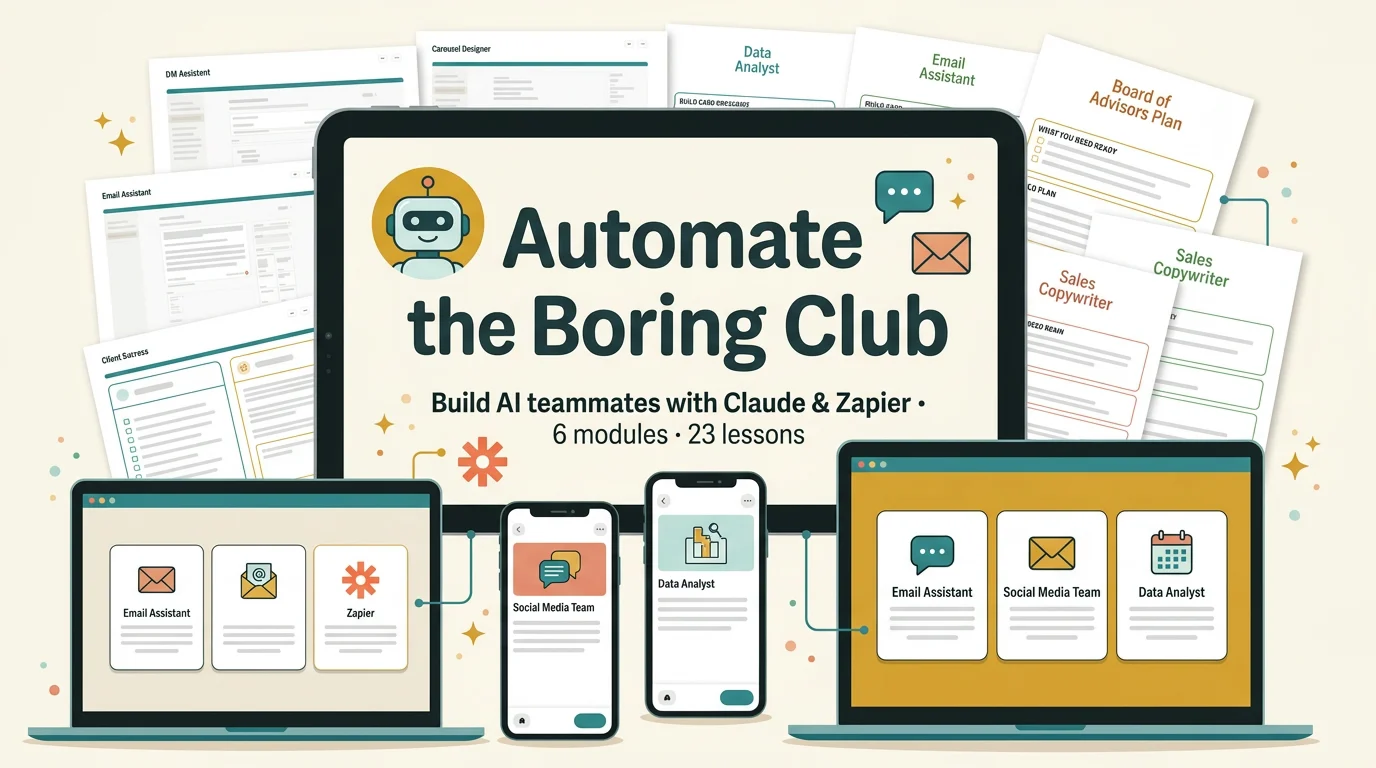
Automate the Boring Club is Ginny & Laura’s six-module course and club package for small online-business owners who want task-specific Claude setups for recurring social media, inbox, reporting and sales-page work. Its format combines recorded build-alongs and downloadable setup files with support elements tied to the original enrolment.
The three months of support, six bi-weekly calls with Laura, online community, monthly Expert Masterclasses and previews of future builds belong to that original enrolment. They should not be assumed included elsewhere, and neither should one-to-one access. The recorded frameworks and templates are the transferable part.
One bounded task beats a vague digital helper
A dependable assistant starts with one repeatable job, a known input and an observable output. An inbox triage setup might receive a message and return a proposed category plus a draft response. It should not silently send, promise terms or change a customer record. Define completion, exceptions and the person responsible for approval before writing the prompt. Final sign-off, client relationships and decisions carrying legal or financial consequences stay with a human.
Write the job down as a short specification before you build anything. Name the trigger that starts the task, the information the assistant receives, the format of the result and the point where a person reviews it. Then collect five or six real examples, including one messy case, and check each draft against them. If you cannot say what a good answer looks like, the assistant cannot either. Start narrow, keep a log of corrections and widen the task only when the same mistakes stop recurring.
Claude Projects preserve the operating context
A Project can hold shared knowledge and project instructions so they remain available across conversations. An instruction file records the role, source material, constraints, output format and escalation rules instead of making you repeat them in every chat. The Claude Projects help article explains this shared workspace model. It does not mean every conversation automatically remembers every other transcript, so important operating rules belong in maintained project material.
Triggers, actions and judgment belong to different systems
Prompt-only assistants are quick to test and useful for drafting, but they depend on someone supplying context each time.
Project-based assistants suit recurring work that needs stable instructions, examples and reference material, although outdated files can quietly degrade results.
Zapier workflows connect tools through a trigger and one or more actions: a new form submission can trigger creation of a database record. This rule-based automation is strongest when fields and conditions are predictable.
Agentic workflows allow a model to choose steps or tools, but their extra flexibility creates more failure paths and demands stronger monitoring.
Human-in-the-loop systems pause before consequential actions. This is the safer pattern when language is ambiguous, permissions are broad or mistakes reach customers.
A useful lesson should survive an unfamiliar example
Before buying any program in this category, trace one realistic input through its entire workflow. Look for explicit inputs, output schemas, permission boundaries, exception handling, test cases and an approval step. Check whether demonstrations include flawed data rather than only polished examples. Confirm which accounts you must supply, whether templates are editable, how tool changes are handled and which benefits depend on active enrolment. A strong curriculum teaches diagnosis, not merely template installation.
Four departments organize the recorded build-alongs
Automate the Boring Club places 23 lessons across Set-up, Social Media, CEO, Data Analysis, Sales and Protect the Human. Set-up covers Claude, tool connections, Zapier and department building. The named Claude setups then include an Instagram Account Auditor, Brand Copywriter, DM Assistant, Email Assistant, Morning Briefing, Data Analyst, Business Dashboard, News and Trend Tracker, Sales Copywriter and Sales Page Auditor. Each build is presented through prompts, project setup and an instruction file. Buyers need their own Claude and Zapier accounts.
Fourteen named setups leave the fifteenth unclear
The listing markets 15 AI assistants, yet the four operating departments name 14. That mismatch matters because the employee metaphor can make a Claude setup sound more autonomous than it is. The strongest evidence for Automate the Boring Club establishes scope: six modules, 23 lessons, downloadable Employee Files and recorded calls. It does not establish accuracy, business outcomes or continued support. Independent research found no separate creator or club evidence, and Ginny’s role is unspecified. Any creator income or student-count figures would remain self-reported; the listing supplies neither.
The Employee Files raise specific access questions
Are the “employees” actual staff or autonomous agents? No. They are Claude setups made from prompts, Projects and instruction files, sometimes connected to other tools.
Does the purchase include Claude and Zapier? The listing says buyers need their own accounts, without specifying required plans or ongoing tool costs.
Who delivers the live calls? The listing attributes the six bi-weekly calls to Laura. It does not explain Ginny’s role.
Are the community and masterclasses still active? They belonged to the original three-month Club enrolment. Only recordings may remain, and continued access is not specified.
The human owner still carries the operating risk
Results require clean source material, limited permissions, repeated testing and regular inspection after tools or business rules change. Common failures include oversized prompts, stale instructions, missing exception paths and automations that act before approval.
If your processes are still informal, begin with business process mapping training before adding AI assistants.
If customer or regulated data is central, choose AI governance and privacy training with deeper permission and retention coverage.
If weak persuasion is the real constraint, compare dedicated sales-copywriting training rather than expecting automation to repair the message.
This course best fits an owner who already has repeatable tasks and will supervise the builds. It is the wrong purchase for anyone seeking independent staff, fully managed implementation or consequential decisions without human sign-off.