
Lead The Launch is Dani Paige’s eight-module training program for mid-level copywriters who want to take responsibility for digital product launch strategy without abandoning copy. The intended buyer already understands client copy work and wants to manage the campaign around it. The real decision is whether you are ready to own assumptions, handoffs, measurement, and consequences rather than simply add more deliverables.
Cart close is only one phase of launch leadership
Treat a digital product launch as five connected windows. Pre-launch tests the offer, gathers audience language, prepares assets, and assigns owners. A conversion event, such as a webinar or demonstration, turns attention into a measurable decision. Open cart exposes objections and technical friction. Close requires deadline integrity and support coverage. The post-launch debrief compares assumptions with results and records what should change.
The basic arithmetic follows the purchase funnel: audience reached multiplied by click rate produces visits; visits multiplied by opt-in rate produces leads; qualified leads or checkout visitors multiplied by conversion rate produces sales. Denominators matter. A weak sales count can come from limited reach, poor lead quality, low attendance, checkout friction, or the offer itself.
Scope makes that responsibility manageable. Write down assets, versions, research inputs, owners, approval dates, revision limits, exclusions, and the process for changed work. A messaging brief should capture the audience, problem, desired outcome, offer mechanism, proof, objections, voice, claims, and call to action. During launch week, track agreed metrics and decisions daily; afterward, separate observations from explanations before recommending the next test.
Copy, operations and optimization create different kinds of leverage
Conversion copywriting training improves research, argument, offer presentation, and asset execution. Its weakness is that strong copy cannot repair poor traffic, weak positioning, or broken delivery.
Launch project management systems coordinate dependencies, deadlines, approvals, and contingency plans. Established project-management practices support clearer execution, but they do not establish that a campaign will convert.
Conversion-rate optimization and analytics training uses instrumentation, controlled tests, and segmented funnel data. Experimentation offers the clearest route to causal evidence, although small launches often lack enough observations for confident conclusions.
Fractional marketing strategy and value-based packaging broaden the role into diagnosis, prioritization, and commercial scoping. They can improve decision clarity, but packaging language alone is not evidence of campaign performance.
Inspect the seams between lesson, template and client decision
Before buying any launch-strategy program, ask to see the kind of work it expects you to produce. A useful curriculum should connect an offer diagnosis to a funnel map, a messaging brief to specific assets, and a timeline to named owners and approval gates. Check whether its metric examples preserve denominators, distinguish correlation from cause, and explain small-sample uncertainty. Confirm how scope changes, client delays, failed conversion events, technical incidents, and post-launch decisions are handled. Finally, establish the lesson format, update policy, feedback mechanism, required software, and whether templates remain usable without proprietary tools.
Dani Paige builds the transition in two distinct parts
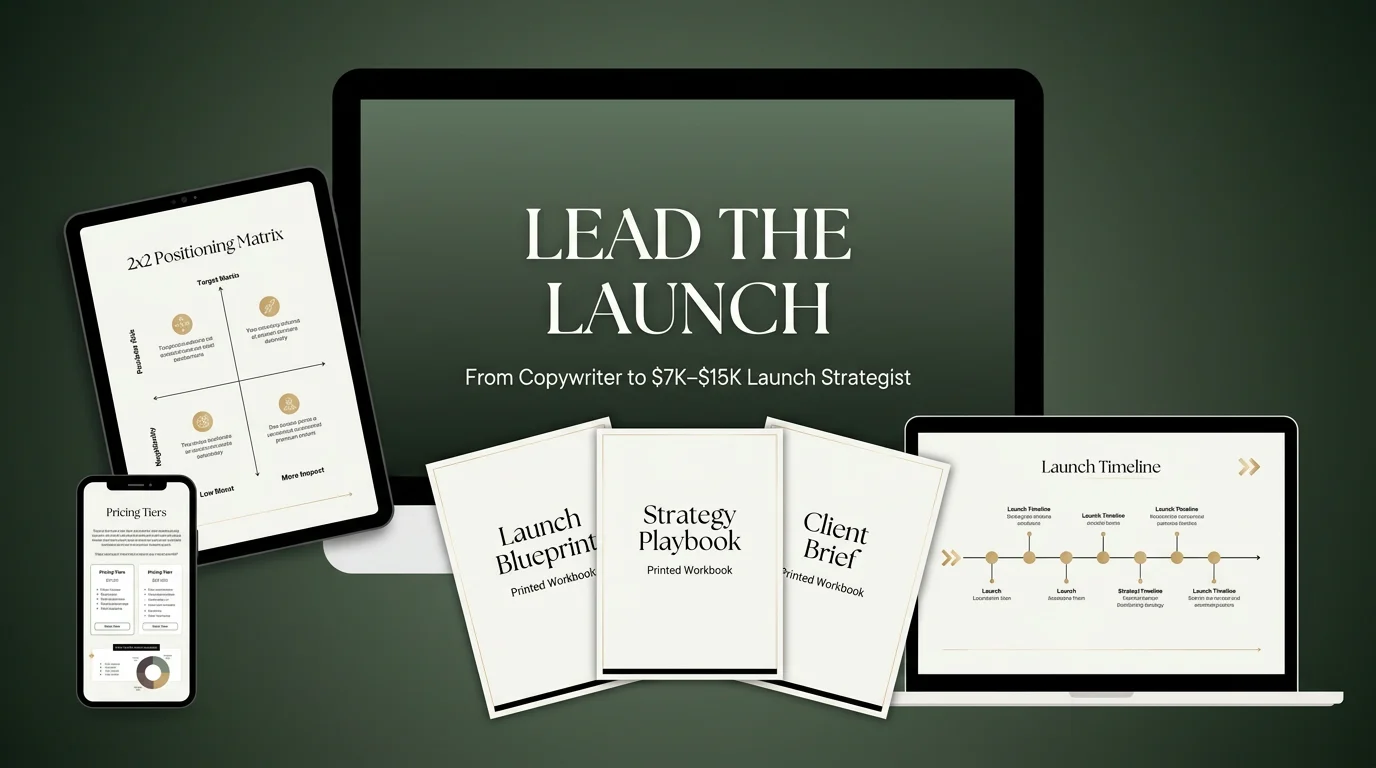
Lead The Launch divides the journey into foundations and a complete launch project. Part I contains Strategist Identity, Launch Baselines, and Mastering Launch Strategy. It introduces role boundaries, funnel terminology, launch mathematics, campaign phases, and strategic diagnosis. Part II moves through Prospecting, Pricing, Packages and Proposals, Creating Your Launch Roadmap, Project Implementation, and Managing the Launch Process.
The listing’s Soft Strategy Approach offers four involvement levels, from Curious Clara to Launch Leader Lucy. That staged model is sensible for a copywriter who wants to expand responsibility gradually. The later modules add onboarding, a kickoff call, timelines, messaging briefs, sales pages, launch emails, daily support, contingency planning, metric analysis, and a debrief. Breadth is the defining feature; specialist depth is less clear.
Launch Baselines and the Launch Matrix anchor the toolset
In Lead The Launch, the named working materials include the Launch Baselines Doc, Launch Strategy Guidebook, Strategic Pricing Suite, Ultimate Launch Matrix, and Launch Performance Tracker. Several custom GPTs support positioning, pitches, proposals, timelines, and a Messaging Doc. Those GPTs run inside the buyer’s own ChatGPT account, so suitable account access is required. The listing does not state whether the GPT configurations will remain available or be maintained. Their output should be treated as a draft requiring source checks and client judgment.
Curriculum detail is the strongest evidence on offer
The description supplies module names, intended outputs, and named tools, but no independent comparison, completion data, or verified student outcomes. It therefore supports claims about scope, not effectiveness. Any creator income or student-count figures associated with the offer would remain self-reported claims rather than proof of what a buyer will achieve. Dani Paige is described in third-party podcast material as a launch copywriter, strategist, and founder of a copywriter training program, but that background does not validate the course’s commercial promises.
Delivery unknowns change what the eight modules are worth
Does Lead The Launch include live coaching or community feedback? The listing describes neither live calls nor a community. Do not assume personal feedback, active enrollment support, or direct access to the instructor.
Is the program mainly about writing launch copy? No. Sales pages and launch emails appear in Project Implementation, but the larger arc covers scoping, packaging, timelines, launch management, measurement, and debriefing.
What delivery details remain unclear? The listing does not specify whether lessons are video, text, or mixed media, and it gives no lesson duration, assessment process, update schedule, or support terms.
Can a new copywriter use it? The stated audience is mid-level copywriters. A beginner without client research, copy execution, and discovery-call experience may struggle to apply the strategic tools credibly.
Sometimes the better purchase sits beside launch strategy
Results require more than completing modules. You need a real or realistic campaign on which to calculate baselines, negotiate scope, build the messaging brief, manage approvals, inspect daily data, and conduct a candid debrief. Common failures include treating templates as answers, accepting unverified GPT output, confusing weak volume with weak conversion, and taking responsibility without authority over traffic, technology, or the offer.
If asset quality is the immediate constraint, dedicated conversion copywriting training is the closer fit. If deadlines and stakeholder coordination keep collapsing, compare structured project management training. If measurement is the weakness, conversion-rate optimization and analytics training offers deeper experimental practice. Copywriters who cannot yet find or qualify suitable clients may be better served by consultative sales and prospecting training before expanding into launch leadership.