
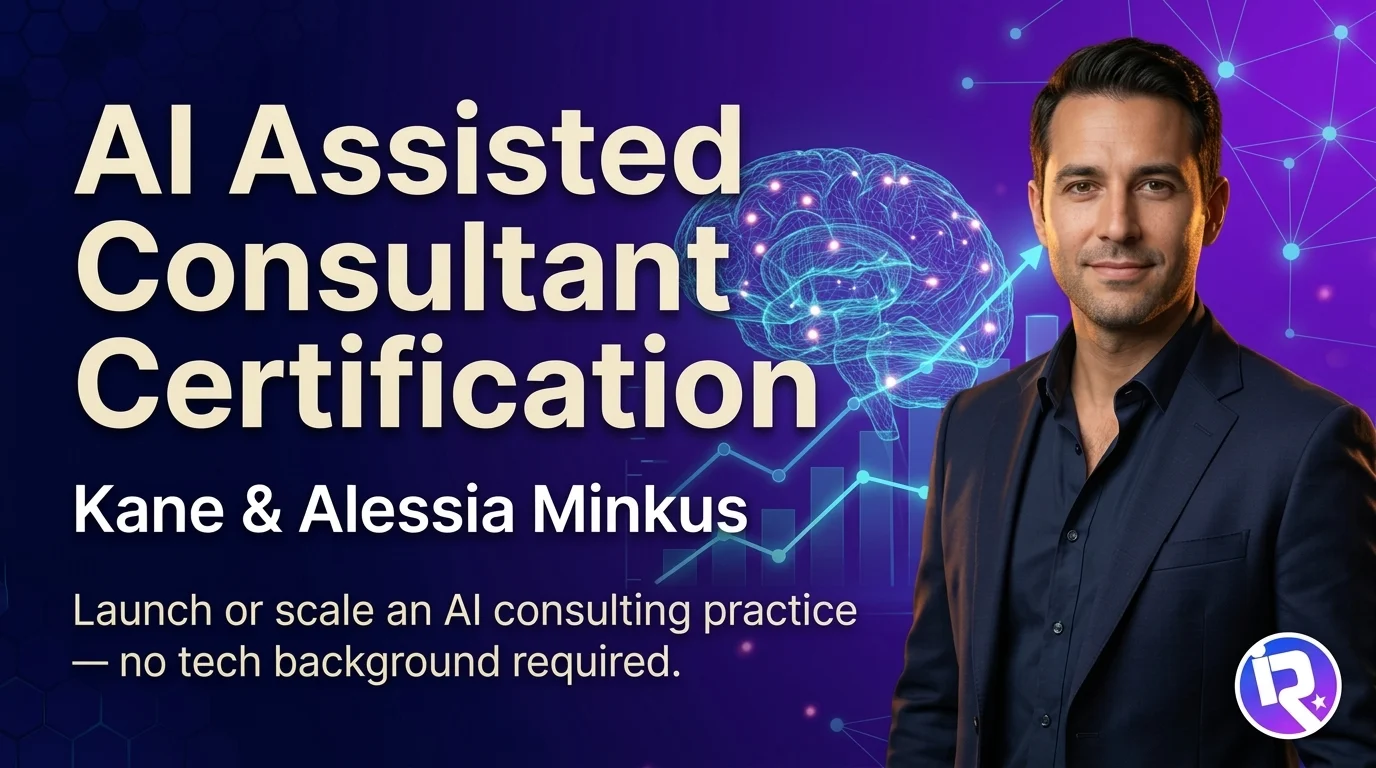
AI Consulting Certification is Kane and Alessia Minkus’s training program for professionals, consultants, strategists and aspiring advisers who want to assess organizations, package AI services and guide implementation. It says participants can build those capabilities without a technical background or coding knowledge. The useful question is whether its broad curriculum connects diagnosis to safe, testable delivery.
Any one-to-one access, weekly calls, community participation or feedback would depend on active enrollment with the original provider and should not be assumed included. The listing presents coaching expertise as a participant takeaway, not a promised delivery component. Only the frameworks, workflows and templates expressly supplied can safely be treated as transferable materials.
A useful AI project starts with a reversible workflow
An AI consultant is paid to reduce uncertainty, not recommend the newest model. Assessment begins by mapping one workflow: its trigger, actors, decisions, systems, handoffs, failure cost and baseline performance. You interview the people doing the work, inspect representative cases and establish whether the necessary data is available, permitted and reliable. A narrow first use case should have a measurable outcome, an accountable owner and a fallback if the system fails.
Packaging should separate discovery, pilot, rollout and managed support because each carries different uncertainty. Pricing must reflect scope, risk and responsibility, with assumptions and change control written down. Delivery then requires data access, acceptance criteria, evaluation cases, human oversight, monitoring, staff training and handover. Governance is operational: decide who may use the system, which data may enter it, how outputs are checked and when it must be stopped.
Diagnostics, pilots and managed services carry different risks
Strategy diagnostics prioritize workflows and produce a roadmap; they are useful before tool selection but become shelfware without owners and budgets. Data-readiness engagements examine access, quality, permissions and retention; they prevent expensive builds but do not prove user adoption. Prototype-first consulting tests feasibility quickly, though a demonstration can hide integration and security work. Vendor implementation configures an existing platform efficiently but can bias the diagnosis toward that platform. Governance-first consulting suits sensitive operations, while enablement workshops build staff capability without delivering the system. Managed AI operations cover monitoring and maintenance but create an ongoing dependency. Measured pilots and established change-management practices have firmer support than generic prompt collections because outcomes depend on workflow design, evaluation and adoption.
Artifacts reveal whether training reaches implementation
Before buying any program, look for an end-to-end case that moves from stakeholder interviews to a deployed, monitored workflow. The instruction should produce an opportunity register, prioritization logic, data audit, risk register, scope of work, acceptance criteria, evaluation set, implementation plan and handover process. Check whether pricing lessons address uncertain discovery and scope changes rather than supplying a single formula. Technical demonstrations should explain data boundaries, failure modes and maintenance. Finally, determine who examines your work, what rubric they use and whether feedback reaches the decisions that matter. A certificate without assessed evidence says little about consulting competence.
The Minkus curriculum crosses strategy, data and deployment
Within AI Consulting Certification, the listing moves from evaluating company requirements and developing tailored strategies to AI-grade data, internal LLMs, chatbots, prompts and copilots. It also names lead generation, personalized marketing, sales conversion, product development, departmental applications, workshops, workflows and automations. The AI Assisted Consultant Certification further covers packaging services and progressing from solo consulting toward an agency. Kane and Alessia Minkus are named as the program’s designers.
This is unusually broad coverage. The listing’s claim that no technical background or coding knowledge is required sits in tension with building data foundations, internal LLMs and chatbots. It does not specify whether those topics mean strategic oversight, configuration or hands-on implementation, nor the technical prerequisites needed to perform them responsibly.
Coaching language does not establish live delivery
The product description does not specify a cohort schedule, lesson duration, learning platform, project sequence, recordings or feedback mechanism. It teaches how to conduct client workshops; it does not say the provider conducts workshops for participants. Likewise, the reference to coaching expertise cannot be read as personal coaching. Buyers can reasonably expect named workflows, templates and prompt packs from the listing, but not an active service layer that has not been described.
Certification proves only what its assessment proves
The AI Consulting Certification credential is the creators’ own private certificate, not an accredited qualification. The listing names no accrediting body, examination, external standard or renewal requirement, despite referring to certifications in AI consulting, AI implementation and data science. It therefore should not be treated as a professional license or independent validation of technical ability.
Evidence should come from assessed project work: a defensible diagnosis, tested system, documented risks and measured outcome. The NIST AI Risk Management Framework offers an authoritative reference for governing and measuring AI risk. The listing supplies no independent outcome study. Creator performance and participant-count figures presented elsewhere would remain creator claims, not verified evidence of a typical result.
Client readiness decides whether the framework survives contact
Results require access to real processes, usable data and decision-makers willing to change how work is done. Common failures include selling a broad transformation before defining one workflow, building a prototype without an owner, ignoring permissions and leaving model monitoring outside the scope. Templates accelerate documentation; they do not resolve those conditions.
If you need to build production data pipelines or customize models, you may be better served by dedicated data engineering training. If staff adoption is the obstacle, compare a structured change-management program. Work involving sensitive decisions may require specialist AI governance training. If the technical service already exists but conversations with buyers stall, dedicated consultative sales training is the more direct choice. This program is also a poor fit if you need an independently accredited qualification or clearly documented live supervision.
Format, examination and technical depth remain unanswered
Is the program live, self-paced or mixed? The listing does not say, so you should not infer scheduled sessions, recordings or a current cohort.
What must you complete to receive the certificate? No examination, capstone, grading rubric or external assessment is identified. Ask whether a real consulting engagement is evaluated.
How technical are the LLM, chatbot and data lessons? The description names these subjects while saying coding knowledge is unnecessary. Buyers need to know which systems they will actually configure and what remains conceptual.
Does AI Consulting Certification stay current as tools change? Trends, workflows and prompt packs date quickly, yet the listing gives no update cadence or version policy. That answer affects the value of such a tool-spanning curriculum.