
Full-Funnel B2B Marketing Academy is a program by Vladimir Blagojevic and Andrei Zinkevich for marketers and consultants serving B2B companies with high contract values and long sales cycles. It organizes strategy, demand generation, account-based marketing, and post-opportunity campaigns into courses and practical playbooks. The purchase question is whether that structure matches the constraint inside your revenue process.
The listing says Academy members can request feedback or advice from Andrei and Vlad. Founder feedback depends on active enrollment and should not be assumed available elsewhere. The listing does not establish 1:1 access, weekly calls, or a community. The portable value should therefore be judged by the stated frameworks and playbooks.
One account can contain several different buying problems
An ideal customer profile defines the organizations likely to have a valuable, solvable problem. A buying committee maps the people inside them who initiate research, evaluate risk, control resources, use the solution, and approve change. Those roles rarely move together. Demand creation helps buyers recognize a problem or category before they are shopping; demand capture converts existing intent when buyers actively seek an answer. Account-based marketing becomes worth its research, personalization, and coordination costs when a limited set of accounts can materially change the business. Reporting remains difficult because a long cycle contains private conversations, several stakeholders, offline influence, and delayed outcomes. Marketing can document contribution without pretending every touch caused revenue.
Demand creation, capture and named-account work obey different economics
Broad demand creation uses thought leadership, education, events, podcasts, and category content to build recognition, but its delayed effect is difficult to attribute. Demand capture uses search, comparison content, conversion paths, and retargeting to serve buyers already in market; it is measurable but cannot create unlimited intent. Account-based marketing concentrates research, advertising, content, and sales coordination on named accounts; it suits concentrated markets but becomes wasteful when selection is weak. Buyer enablement gives committees shared evidence, decision tools, and implementation clarity, while pipeline acceleration targets unresolved concerns after an opportunity exists. Lifecycle marketing focuses on adoption, renewal, and expansion rather than acquisition. Marketing-operations measurement connects CRM stages, campaign activity, and account engagement, although multi-touch attribution remains descriptive rather than causal. For wider perspectives on B2B decision-making, LinkedIn’s B2B Institute is a useful public source.
Curriculum quality shows up in the handoffs
Before buying any program, trace one account from selection to renewal. Look for explicit ICP exclusions, stakeholder roles, stage definitions, channel choices, sales handoffs, and a measurement model that admits uncertainty. Check whether examples explain why an account qualified, not merely what campaign ran. A sound program should distinguish account engagement from individual leads and demand creation from demand capture. Inspect whether ABM instruction includes research effort, data quality, campaign costs, and stop conditions. Finally, ask what you must produce: an approved ICP, buying-committee map, campaign calendar, account plan, pipeline intervention, and reporting specification are more revealing than lesson volume.
The Academy follows the buyer past opportunity creation
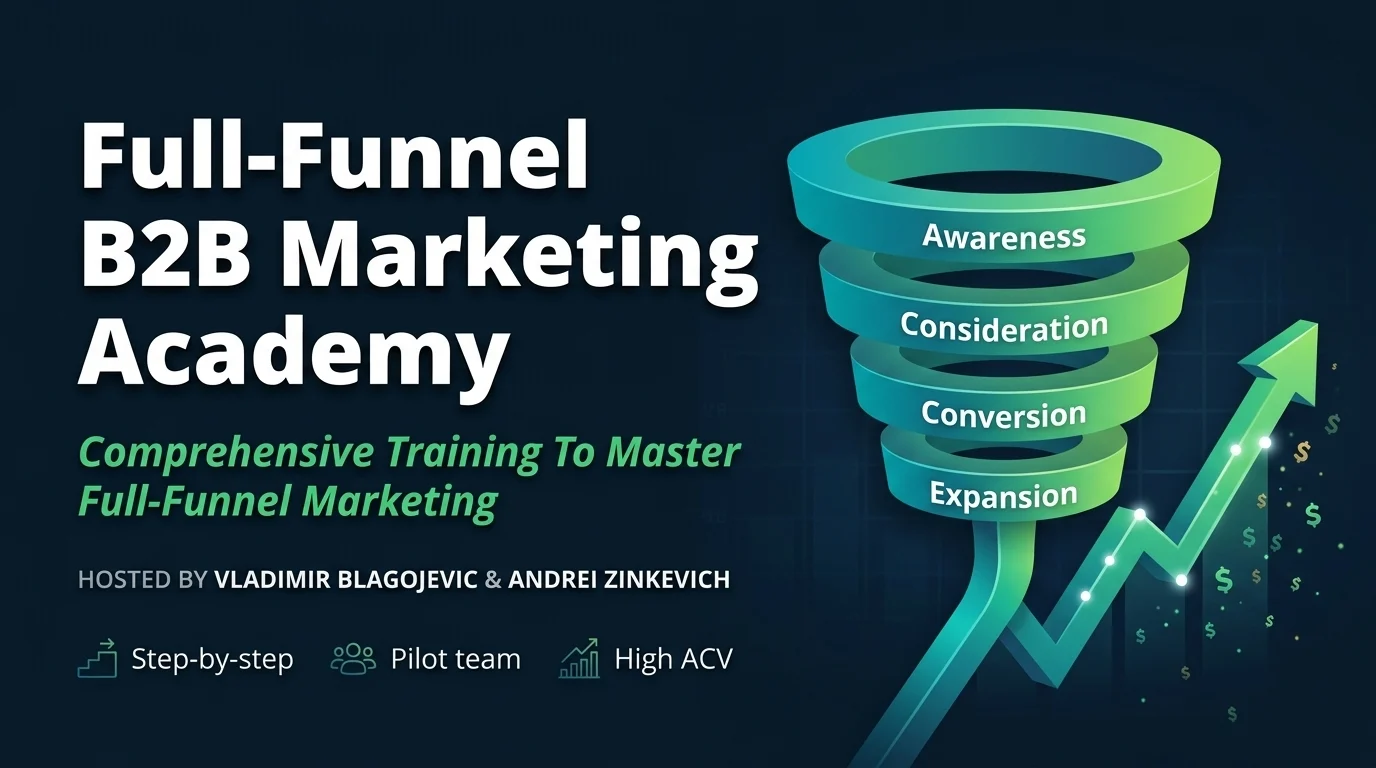
Full-Funnel B2B Marketing begins with management buy-in, ICP development, buying journeys, positioning, sales alignment, and unified reporting. Its awareness and demand-generation component describes more than ten playbooks covering journey-based content, thought leadership, co-creation, podcasts, newsletters, webinars, events, distribution, and campaign planning. The account-based component adds nine playbooks for intent data, committee warm-up, account research, personalized campaigns, multichannel follow-up, and an ABM dashboard. A fourth component addresses buyer enablement, pipeline acceleration, expansion, and renewal. The creators present this as an answer to their view that marketers often withdraw after an opportunity is created. ABM on LinkedIn appears as a bonus course covering content, conversations, relationships, profiles, and audience development.
Playbooks are specified more clearly than delivery
FullFunnel Academy is unusually specific about the operating areas it covers, but the listing does not state the teaching medium, lesson duration, enrollment schedule, update policy, assessment process, or expected completion time. It also refers generally to further courses and playbooks without defining which are included in a particular enrollment. Full-Funnel B2B Marketing is therefore easiest to assess as a broad implementation library with a membership-dependent feedback layer, not as a clearly documented cohort experience.
Attribution claims need baselines and time windows
The description presents the methods as grounded in the creators’ client work, but it supplies no controlled comparison, completion data, or distribution of participant outcomes. Playbook counts establish scope, not effectiveness. Revenue reporting across a long cycle also cannot prove that one marketing touch caused the outcome. Any creator income or student-count figures presented elsewhere would remain creator claims rather than independently verified facts, and no financial result should be inferred. Evidence worth requesting would include anonymized before-and-after operating artifacts, account-selection logic, campaign costs, measurement windows, and examples that include unsuccessful tests.
Sales, data and leadership attention decide execution
Results require clean account data, CRM discipline, management agreement, sales participation, content production, and enough time for committee-level behavior to become visible. Common failures include choosing accounts from enthusiasm rather than evidence, personalizing before validating relevance, counting engagement as pipeline, and launching more channels than a small team can maintain. If customer evidence and positioning remain weak, specialist positioning and customer-research training is a better first purchase. If account strategy is sound but prospecting execution is the constraint, dedicated cold-outreach training may fit better. If acquisition works while retention does not, compare a customer-success and expansion program. Teams with unreliable CRM stages may first need dedicated marketing-operations training.
Membership status changes the final decision
Is enrollment active, and exactly which requests receive founder feedback? The answer determines whether you are buying supported implementation or only the stated course and playbook material. How are courses delivered, and is there a required sequence? The listing names five major components but leaves the learning experience undefined. Are all referenced playbooks included, including the Full-Funnel B2B Marketing material for pipeline and existing accounts? General references to additional resources are not an inclusion list. What reporting tools, data sources, and team access does implementation assume? That answer reveals whether the program fits your current operation or requires a separate systems project first.