TL;DR: The AI GameDev Lab Claude Code course is a founder-led, 6-module video curriculum by Gökhan Kınay covering Unity MCP, Godot, Pygame, and a 6-step ship pipeline from idea to monetization. Requires an Anthropic Claude subscription (Pro from $20/month, Max $100 to $200/month) or API credits, sold separately. UDCourse delivers the recorded curriculum only.
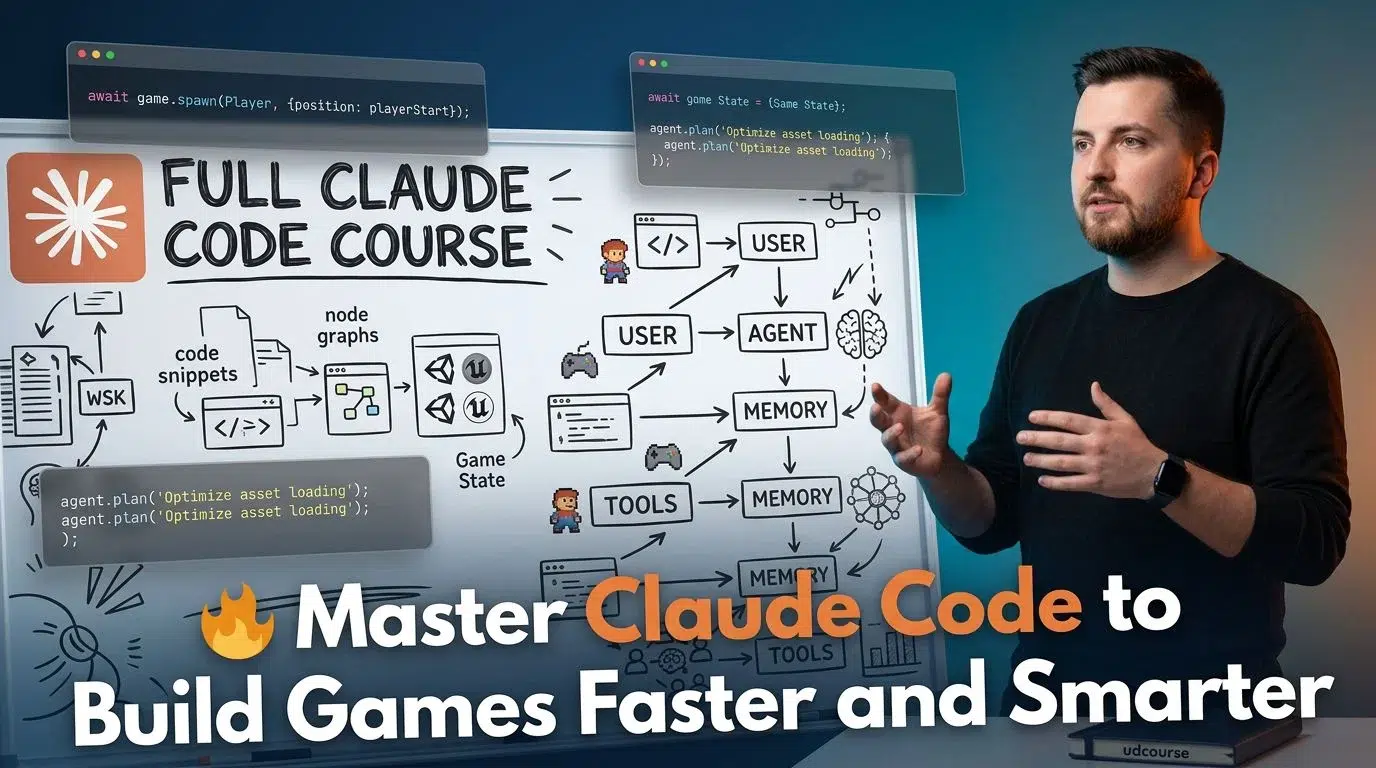
Inside AI GameDev Lab: Gökhan Kınay’s Curriculum for Indie Devs
Start with the creator. According to the instructor, Gökhan Kınay runs Istanbul-based Trifles Games (active since 2013) and built the AI GameDev Lab Claude Code course for solo and small-team game makers. The AI GameDev Lab team states his studio has partnered with Rollic and Homa Games, and Forbes featured him in 2023 at age 27. UDCourse has not independently verified those credentials. The curriculum reads the way a shipping founder would teach: ruthless about the build-publish loop, light on theory. One note before you buy. You need an active Anthropic Claude subscription (Pro from $20/month, Max $100 to $200/month) or pay-as-you-go API credits, on top of this course.
The Claude Code Way: Skills, Subagents, and MCP for Game Systems
Modules 1 and 2 of the AI GameDev Lab Claude Code course cover fundamentals (install, CLAUDE.md project memory, slash commands, custom skills, subagents) and assemble those primitives into what Gökhan calls “the Claude Code Way”: small agent teams that scaffold game systems through MCP servers. He frames it as a way to reduce manual coding time, not to remove the developer. For a deeper, engine-agnostic look at the same primitives applied to backend systems, Matt Pocock’s Claude Code for Real Engineers covers production-grade patterns that map cleanly onto game tooling. Treat any “10x faster” framing as the instructor’s aspiration rather than a tested benchmark. Your prompts and your review still set the ceiling.
The 6-Step Ship Pipeline From Idea to Monetization
The spine of the curriculum is a 6-step ship pipeline: (1) idea selection, (2) AI-friendly design doc, (3) AI-assisted build, (4) test and optimize, (5) publish, (6) monetize. The publishing module walks through Steam, App Store, Google Play, CrazyGames, Poki, Yandex, and Armor Games. If the idea-to-income arc is the part you care about most, Pat Walls’ AI App Bootcamp teaches a similar validate-build-monetize loop for AI apps outside gaming. Outcomes are not assured. Each platform has its own review queues and quality bars.
Engines Covered: Unity MCP Bridge, Godot, Pygame, and Web
The primary engine track is Unity, taught through the Claude Code plus MCP bridge so the agent can manage assets, edit scripts, and toggle Play mode from natural language. Godot, Pygame, and browser engines are covered for code-direct iteration. There is no Unreal Engine deep-dive. The course also walks through OpenClaw, the open-source AI-agent harness for headless Claude Code pipelines. Transparency note: OpenClaw was previously called Clawdbot, then Moltbot, before its early-2026 rename. Older lessons may still use the earlier names, but concepts carry over.
How AI GameDev Lab Compares to Other Claude Code Training
The closest reference points are all generalist. Anthropic Academy is the first-party Claude Code track and a solid baseline, but it covers software engineering broadly with no engine bridges or publishing layer. Vanderbilt’s Claude Code course on Coursera gives academic rigor on Claude Code, again with no indie-shipping focus. Master Claude Code by Ray Amjad is polished, paid, and engine-agnostic. Free GitHub stacks (Claude Code Game Studios, Godogen, Unity MCP) give you tooling without curriculum. The AI GameDev Lab Claude Code course wedge is the combination: Claude Code depth plus the Unity MCP bridge plus a 6-step ship pipeline in one paid program.
What’s Inside the Download and What’s Not
What you get: the recorded video curriculum, workflow recipes (prompts, CLAUDE.md templates, slash-command and skill blueprints), Unity plus MCP setup walkthrough, OpenClaw setup walkthrough, self-publishing playbook references, and supporting templates. Not included with this AI GameDev Lab Claude Code course download: live Skool community access, weekly Q&A or office-hours calls, 1:1 mentorship, the $300 first-publish bonus tied to the live community, and any OpenClaw cloud deployment. If you need those perks, buy from the AI GameDev Lab community directly. The MIT Game Lab keeps a useful primer on indie design fundamentals at gamelab.mit.edu.
AI GameDev Lab Claude Code Course: Common Questions Answered
Is the AI GameDev Lab Claude Code course worth it?
If you want a founder-led path that pairs Claude Code with engines and a publishing layer, it fills a gap generalist Claude Code courses do not. Factor in the Claude subscription on top.
Is AI GameDev Lab legit?
Yes. Gökhan Kınay, Trifles Games, and the Skool community exist publicly. We attribute Forbes 2023 and Rollic/Homa claims to him rather than as verified. The curriculum and tooling are real.
Do I need a paid Claude subscription?
Yes, in practice. Anthropic Claude Pro starts at $20/month, Max tiers run $100 to $200/month, and pay-as-you-go API is also an option. None of that is included.
Which game engines are covered?
Unity is the primary track via the Claude Code plus MCP bridge. Godot, Pygame, and web-based engines are also covered. No Unreal Engine deep-dive.
Will Claude just write my whole game?
No. Expect an AI-augmented workflow where you set goals, review Claude’s output, and integrate it. Output quality depends on your prompts and review.
Is the content kept up to date?
The Claude Code, MCP, and OpenClaw landscape moves fast. Some lessons may reference earlier tool names (Clawdbot, Moltbot) before the early-2026 OpenClaw rename. Concepts remain applicable.