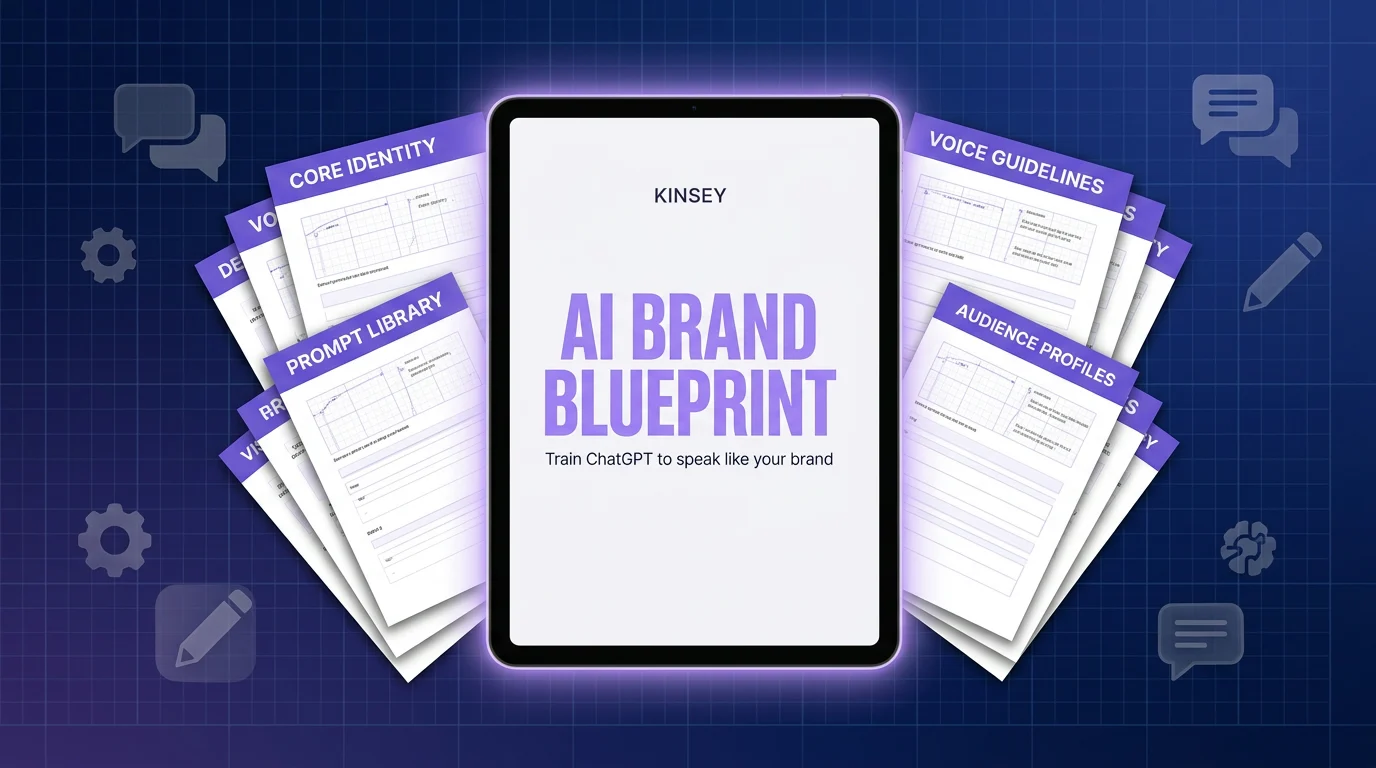
If ChatGPT keeps returning polished copy that could belong to any company, the AI brand blueprint listing is aimed at you: brand owners, marketers and client-facing teams trying to make generated work sound recognisably theirs. It presents a seven-module video course attributed to Kinsey, supported by document templates, prompts and a lesson on building a Custom GPT. The useful question is whether those materials help you make the decisions a model needs, rather than merely giving it more adjectives.
The listing describes training videos, templates and prompts, not a live cohort. One-to-one access, weekly calls, community participation and personalised feedback depend on active enrolment with the original provider and should not be assumed included with a third-party copy. What can be evaluated here is the recorded instruction, frameworks and templates.
A model cannot infer the brand decisions you have not made
Generic output is often treated as a tone problem, but tone sits downstream of strategy. A useful reference document tells the model who the audience is, what problem each offer addresses, which proof supports its claims and what action the reader should take. It also defines the vocabulary the brand uses, sentence rhythm, level of formality, preferred examples and phrases the brand does not say. Negative boundaries matter. “Warm and confident” is vague; prohibiting hype, invented urgency and unsupported superlatives gives the instruction operational meaning.
The document should distinguish durable facts from changeable details and include approved examples beside explanations. Storing that reference beats reconstructing it in every prompt because the team works from one version, omissions become visible and changes can be governed. It does not remove judgment. An oversized or contradictory document can dilute the important instructions, while an outdated one makes inconsistency repeatable.
Prompt recipes, examples and retrieval carry different kinds of context
Ad hoc prompt recipes are quick and useful for isolated tasks, but consistency depends on remembering the same constraints each time. Structured brand briefs centralise audience, positioning, offers and voice, making them strong for repeated work, although someone must maintain them. Example-led prompting, often called few-shot prompting, shows the desired pattern directly and captures rhythm better than adjectives, but weak examples reproduce weak habits. Retrieval-augmented knowledge bases select relevant material from a larger library, which suits changing catalogues and extensive documentation, at the cost of more setup and more ways to retrieve the wrong passage. Custom assistant configurations make recurring instructions convenient, but they can conceal stale context and create platform dependence.
The strongest directly applicable support is model-provider guidance: OpenAI’s prompt engineering guidance recommends clear instructions, relevant context and reference text. That supports the underlying practice, not the effectiveness of a particular commercial program.
A sample output should expose the document’s weak spots
Before buying any program, ask to see the kind of context document it produces and whether its fields force real choices rather than collecting flattering adjectives. Check whether it covers audience, offer differences, message hierarchy, approved claims, vocabulary, prohibited language and representative examples. A credible process should also explain how to resolve conflicting instructions, date revisions and test the same difficult task before and after context is supplied.
Inspect the operating details too. You should know whether templates are editable, whether the method travels between tools, how sensitive client information is handled and whether platform-specific lessons are kept current. Look for an evaluation method based on factual accuracy, voice fit and editing required, not merely whether the first output sounds impressive.
Kinsey’s curriculum is document-led, while the bot remains unfinished
On the listing’s own terms, the AI Brand Blueprint course contains seven modules and more than twenty training videos. Its sequence starts by outlining five core brand strategies with ChatGPT, including identity, ideal customers, voice, offers and messaging. It then moves into assembling a training document, using that document as future context, creating a Custom GPT through a bonus lesson and sharing the resulting context with a team.
The named supporting resources are multiple Google Doc template versions, the Brand Strategy Prompt Playbook, prompting best practices for ChatGPT and more than seventy-five prompts for brainstorming, outlining, writing and repurposing stories. The separate Brand Blueprint Bot is marked “Coming Soon,” so it should not be counted as an included component.
Who built this, and what happens after launch, stays unstated
The phrase Kinsey AI Brand Blueprint identifies a seller-attributed offer, but the listing names the creator only as Kinsey. It supplies no surname, agency, client roster or professional credentials. For the AI brand blueprint, there is also no independent outcome evidence, sample completed blueprint, update policy or detailed support arrangement in the supplied description. Any creator income or student-count figures associated with an offer are the creator’s own claims, not independently verified facts. Generated output still requires human checking for accuracy, permissions and brand fit.
The blueprint becomes useful only when someone owns its maintenance
Expect work beyond watching the videos. Someone must reconcile conflicting stakeholder opinions, select approved examples, remove obsolete claims and test the document against real briefs. Common failures include describing an aspirational voice instead of the voice customers recognise, mixing several audiences into one profile and treating a plausible AI answer as an approved fact. Pair the document with a fixed test set and an editorial approval process.
If audience and positioning remain unresolved, compare a facilitated brand strategy workshop instead. If factual product information changes frequently across many documents, retrieval-augmented knowledge-base training may be a better fit. If several writers need approval gates and claims control, look for editorial governance and style-guide training. A recorded framework is the wrong purchase when your main need is live mediation between stakeholders or hands-on correction of current campaigns.
The missing answers concern access, upkeep and workspace requirements
Is the course entirely self-paced, and how long does enrolment remain active? The listing does not say. Does the Custom GPT lesson require a particular ChatGPT plan or workspace configuration? That is not specified either. Are the Google Doc templates independently editable, and are completed blueprints portable to other AI tools without losing important behaviour? The method is described as usable with similar tools, but compatibility details are absent. Finally, who updates the platform-specific lessons and answers implementation questions when ChatGPT changes?
Choose the AI brand blueprint when you want a document-first framework and are prepared to maintain, test and govern it yourself. If you need active strategic facilitation or verified performance evidence, the supplied listing does not establish that fit.