
Production-Ready App is a practical training program by Dan Shipper for developers, technical entrepreneurs, startup founders, indie hackers, creators, and AI coding experimenters who want to turn a working prototype into usable software. It focuses on the engineering and product judgment required after a successful demo, when real users replace controlled conditions. Picture the first support request arriving while you are asleep: the code ran on your machine, but a stranger supplied an input you never tested. That is the boundary this course addresses.
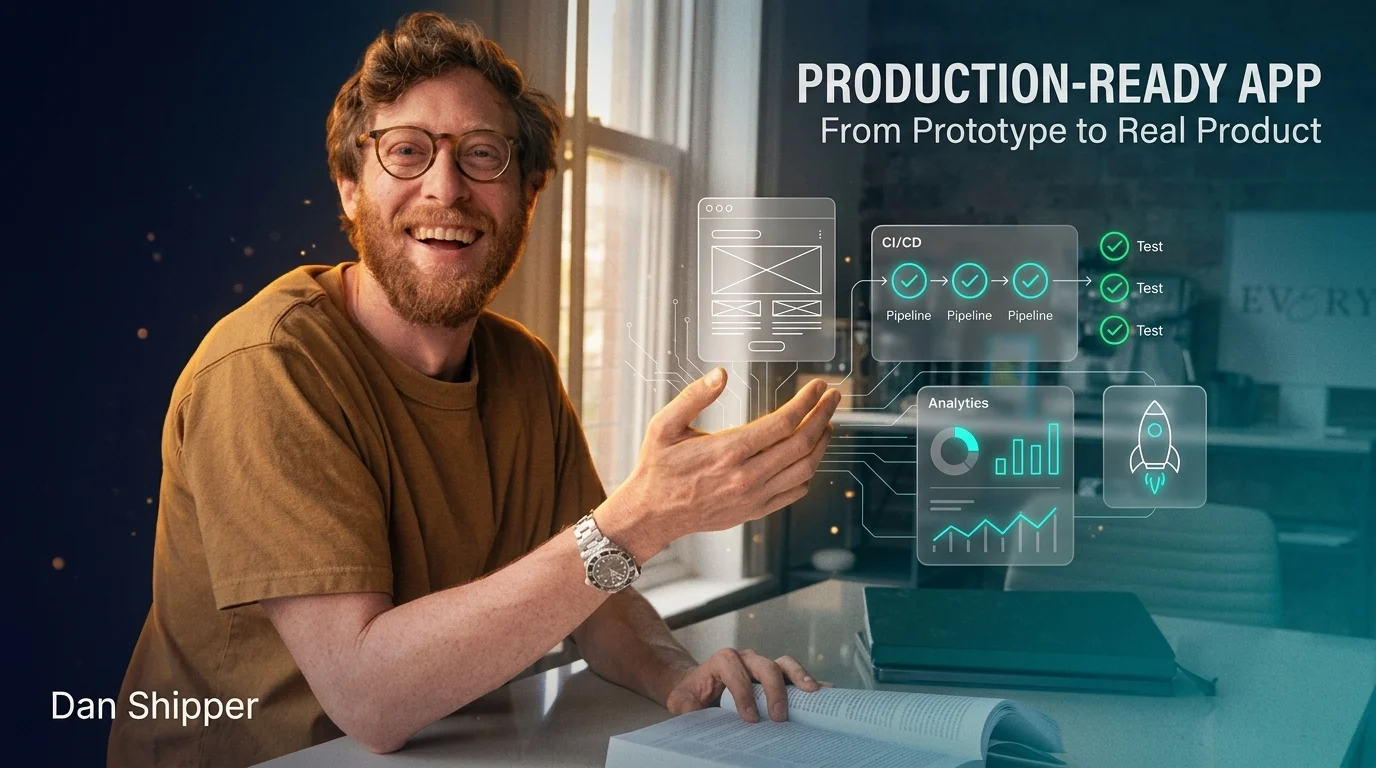
A prototype succeeds in a room that production cannot control
A prototype has to work once, for its builder, on a controlled machine, with chosen inputs. Production software must work repeatedly for strangers whose devices, timing, permissions, data, and behaviour were not part of the demonstration. The standard changes from “can this idea work?” to “can this system fail safely, recover predictably, and reveal what happened?” Usability, architecture, reliability, security, deployment, and maintenance all follow from that change.
Generated code is thinnest where nobody asked it to look
Generated code is usually thinnest on the unhappy path. An upstream service becomes unavailable, a malformed field crosses an assumed boundary, or two people update the same record simultaneously. Credentials may sit in source code instead of configuration. Input validation may be missing, read and write permissions may be indistinguishable, schema changes may lack a migration path, and failures may leave no useful trace. A model optimises for code that satisfies the request. If the request describes only success, the unseen failure cases receive little attention.
Web security is documented knowledge, not folklore
Web security is not folklore. The OWASP Top 10 is the reference standard for critical web application risks and represents a broad consensus. Security work examines trust boundaries, identity, authorisation, inputs, credentials, dependencies, data exposure, logging, and response. Fluent generated code can be harder to inspect than visibly rough code because its polished surface gives no clue where assumptions are hiding. Launch is also the beginning of the cost curve: dependencies change, third-party interfaces move, data grows, users need support, and hurried decisions accumulate interest.
Reliability comes from overlapping engineering disciplines
Risk-based planning and threat modelling identify assets, failure consequences, and trust boundaries before implementation. They are strongest where a defect would be expensive, but they depend on honest assumptions.
Test-driven development, property-based testing, and fuzz testing turn expected behaviour and unusual inputs into repeatable checks. They catch regressions well, though tests cannot cover requirements nobody recognised.
Peer code inspection, static analysis, and dependency scanning search for defects through complementary human and automated lenses. Their value depends on review quality and whether findings are actually resolved.
Staged delivery, feature flags, rollback plans, and observability limit the blast radius of change and expose failures after release. They add operational complexity, but provide stronger evidence than a clean demonstration.
Site reliability engineering and incident practice treat availability, recovery, and learning from failure as ongoing work. This suits operating systems with real users, not merely completing the first build.
User research, accessibility testing, and usability testing reveal whether people can understand and safely use the product. Technical correctness alone cannot answer that question.
Evidence lives in artifacts, not confident demonstrations
Before buying any program in this category, ask what you will produce besides code. A useful curriculum should lead to written failure scenarios, boundary tests, an access-control model, safe credential handling, data migrations, deployment and rollback procedures, and logs that connect a user-visible fault to its cause. It should show how those artifacts change decisions, not merely name them.
Then examine the teaching proof. Does an example survive malformed data, concurrent actions, dependency failure, and a schema change after records exist? Can you see tests fail before a correction, a release rolled back, and an incident diagnosed from evidence? Finally, check whether the material separates durable engineering principles from fast-changing tool instructions and assigns responsibility for updates after launch.
Production-Ready App concentrates on the work after generation
Production-Ready App sits on the principles and workflow side of the landscape. Its stated coverage moves from ideas, product and feature planning, and application architecture into debugging, testing, quality control, reliability, user experience, deployment, and iteration from real-world feedback. AI-assisted development workflows provide the context, but the listing does not present code generation as the finish line.
The description deserves credit for its candour. It explicitly says that quickly generating an application does not make it customer-ready, that AI-generated code requires careful review, that production work still needs hands-on practice, and that development tools change rapidly. It also recognises that technical execution alone does not produce a successful application.
The evidence remains limited to that description. Dan Shipper is named, but no biography, affiliation, track record, learner result, or independent outcome evidence is supplied. The topic outline supports a production-mindset course. It does not establish how deeply each discipline is demonstrated or whether a learner can apply it afterward.
The course needs a real application beside it
Production-Ready App benefits from a working project, regular practice, and willingness to investigate failures nobody has written a lesson about. Common breakdowns include copying a pattern without understanding its boundary, adding tests after architecture has hardened, treating deployment as completion, and collecting feedback without converting it into prioritised changes.
If you want a specific toolchain and a worked build, compare the hands-on, tool-specific build course Turn Prototypes Into Live Products With AI alongside this one; the two address different halves of the same problem.
Anyone without a grounding in how an application fits together may prefer SaaS application architecture training, which covers application architecture and the client and server split.
A team handling sensitive information should pair this material with secure software development lifecycle training, and a builder already facing outages needs site reliability and observability practice that a course outline alone will not supply.
If deployment, containers and monitoring are the unfamiliar part rather than the code, dedicated DevOps training covers that ground directly.
The best fit is someone who already understands basic development concepts and has an application on which to practise planning, debugging, testing, deployment, and iteration. Conceptual familiarity without a running system leaves the hardest lessons untouched.
Your next deployment exposes the unanswered details
Is the instruction live, recorded, written, or mixed? The listing does not state the delivery format, so you cannot yet judge whether questions, demonstrations, or feedback are available.
How much teaching sits behind the topic outline? No lesson titles, module count, or duration are supplied. Ask for enough structure to distinguish detailed demonstrations from a high-level framework.
Does one example travel through failure, deployment, and maintenance? The named subjects form a sensible lifecycle, but the description does not confirm an end-to-end case showing how the decisions connect.
What outcome has been demonstrated? There is no quantified result, case study, or testimonial in the supplied listing. Decide using curriculum depth, delivery, practice requirements, and relevance to your own application rather than assuming a result.