TL;DR: Stacey Boehman built 2k for 2k around the two skills most new coaches skip, booking consultations and converting them. The program stacks a five-step process delivered on demand with weekly live coaching, a private podcast, six workbooks, and more than ten bonus courses. It is aimed at coaches who have not yet signed a paying client.
What Stacey Boehman Actually Teaches In 2k for 2k
Most coaching programs open with brand, positioning, and a content calendar. Boehman opens somewhere much narrower. She trains life, business, and health coaches on two things only: getting a consultation booked, and running that conversation so it ends with a client. Every module feeds one of those two moments. The name 2k for 2k points at the program’s own earnings target, which is branding and a marketing hook rather than a forecast for anyone who buys it. She reports having built a very large coaching business on the same approach, and we report that as her account rather than as an audited fact.
Inside The 2k for 2k Program
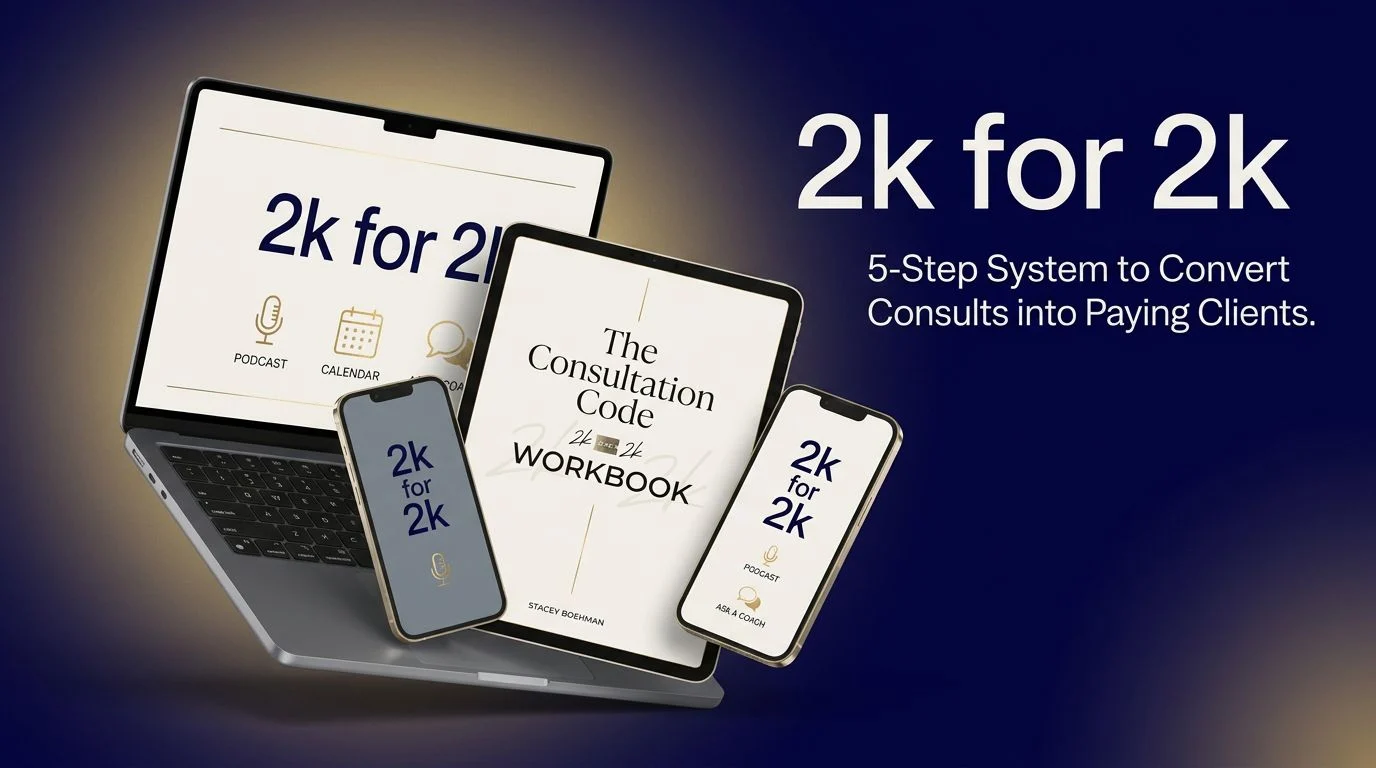
The spine is a five-step process delivered on demand. Around it, the program stacks an online community of coaches, weekly live coaching, and unlimited written coaching through an ask-a-coach channel. There is a private podcast, six workbooks including a consultation framework filled in line by line, and over ten bonus courses covering consults, offer design, applying the coaching model to money, and client renewals. The organic marketing modules handle finding clients on and offline, selling a free consultation, what to share publicly when you have no results yet, audience building, and selling something intangible.
Why Stacey Boehman Narrows It To Consults And Offers
The offer modules carry the other half of the curriculum: structuring free and paid offers, calling an audience to act, and making a small audience comfortable enough to reply and buy. That last piece is the part we judge most useful in 2026, because new coaches rarely have a traffic problem. They have a conversion problem with the handful of people who already know them. General business advice, including the SBA’s small business guidance on marketing and sales, covers the same ground at a high level. The contribution here is script-level detail written for coaching conversations specifically.
Who 2k for 2k Is Not For
This is built squarely for brand-new coaches. Anyone already running a full practice on referrals will find most of it basic. It also assumes willingness to do direct outreach and hold real sales conversations, which is precisely what most new coaches avoid, and no workbook fixes that reluctance for you. The community and the live coaching are worth something only if you participate. Coaching income depends entirely on the individual, the niche, and the selling. Most new coaches take far longer to earn than any program suggests, and nothing here is promised.
2k for 2k: Common Questions Answered
Is 2k for 2k legit?
Yes. It is a real coach-training program with a defined five-step curriculum, workbooks, live coaching sessions, and a documented set of bonus courses on consults, offers, money, and renewals.
Who is Stacey Boehman?
She is a coach-business trainer who teaches life, business, and health coaches how to sign their first paying clients. She reports having built a very large coaching business of her own.
Does it work without a big following?
The offer modules are written for small audiences. Whether it works still depends on you actually starting conversations, which the material teaches but cannot do on your behalf.
What does Stacey Boehman mean by a five-step process?
It is the sequence that moves a stranger to a booked free consultation and then to a paid engagement, with each workbook mapping to one part of that sequence.
Is it useful for health and life coaches, not just business coaches?
Yes. The selling-an-intangible-service module is aimed exactly at coaches whose result is hard to show in a screenshot.
Is 2k for 2k Worth It?
If you are a new coach with no clients, the narrow focus is the strongest argument for it. Consults and offers are the two gates, and Stacey Boehman spends the whole curriculum there instead of on brand aesthetics. The weakest case against it is the same narrowness: experienced coaches will recognise most of it, and the live-coaching component rewards only the people who show up and ask.