
Part Time Hypnotist 4.0 is Dan Candell’s coaching-led program for hypnotists who want to reach a first or next paying client and package their work across four sessions. It is aimed at practitioners building a part-time practice with live feedback, business messaging, scripts, community support and temporary planning software. The buying decision depends on whether those resources fit your present competence and local professional duties.
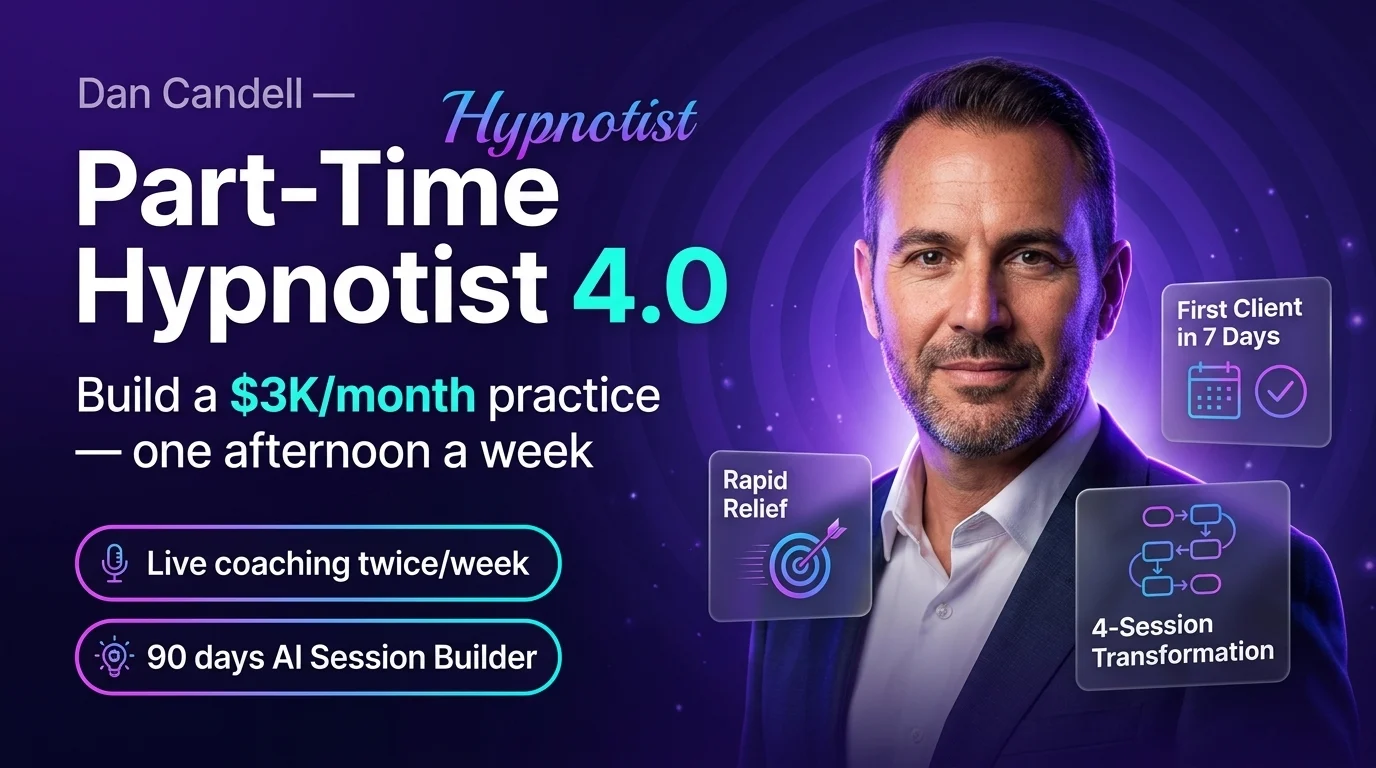
The live layer depends on active enrollment with the original provider. The twice-weekly coaching sessions, community, feedback and any one-to-one contact should not be assumed to accompany a separate copy. Dan AI and the AI Session Builder are provider software available for 90 days and do not come with a copy; the durable elements are the stated frameworks, playbooks and scripts.
A paid hypnosis session begins with boundaries
Before charging a client, define the service, its limits and the circumstances requiring referral. Intake should establish the client’s goal, informed consent, relevant history, privacy expectations and permission for record keeping. The agreement should explain fees, cancellation, confidentiality limits and how either party can stop. Training material is education, not therapy or clinical treatment. Client work also requires suitable insurance and a referral path to qualified health professionals when a request falls outside your competence.
Four appointments need four decision points
A package is not simply one session multiplied. Each appointment needs a purpose, an observable checkpoint and a decision to continue, adapt, refer or close. State what the package includes without promising a clinical result. Document consent again when the plan changes, record what occurred, and finish with a clear handoff or follow-up boundary. Packaging can improve continuity, but it must never trap a client in unnecessary sessions.
Scripts, supervision and business coaching solve separate gaps
Business-launch coaching develops positioning, an offer and client conversations, but cannot establish practitioner competence. Structured referral coaching builds relationships with appropriate professionals, though it depends on trust and local networks. Supervised skills practice provides observed repetition and corrective feedback, which passive study cannot replace. Case-formulation and intake training improves planning and referral decisions. Script-library training supplies prompts and consistency but can encourage mechanical delivery. Practice-management and legal-ethics education addresses consent, records, privacy and insurance. For training design, deliberate practice and qualified supervision have a stronger basis than earnings stories or script volume.
The sample case should expose the operating system
Before buying any program, ask to see how one fictional case moves from enquiry through intake, consent, planning, documentation and closure. Check whether feedback involves observing your work or merely answering business questions. Examine instructor credentials, supervision arrangements, software privacy terms, access periods and the treatment of client data. A worthwhile syllabus should distinguish marketing instruction from clinical preparation, identify referral thresholds and tell you which legal or insurance questions require local professional advice.
Dan Candell joins client acquisition to a four-session offer
Part Time Hypnotist connects the First Client Process, covering message, offer and conversation path, with the 4-Session Transformation Framework. The Complete Rapid Relief Method and Rapid Relief script library supply the practice-facing structure, while nine client-acquisition playbooks and support-programme scripts extend the business side. Delivery includes twice-weekly sessions with Dan for three months, three months in the PTH Family Skool community, practice sessions with Coach Jonathan and a Client Clearing Group call. The listing does not specify how the core training itself is delivered, and its bonus descriptions repeat several core components.
Issue-labelled scripts do not establish clinical efficacy
The library is organised around anxiety, confidence, weight, smoking, stress and other issues, but those labels establish organisation, not efficacy. No outcome for any presenting issue should be inferred. The Rapid Relief framework is Dan Candell’s own model, not settled clinical consensus, and no short course qualifies someone to treat anxiety, depression, trauma, addiction, smoking or weight concerns. Anyone dealing with depression, anxiety, trauma or a diagnosed condition should speak to a qualified professional first. For context on established talking-therapy categories, consult the NHS overview of talking therapies and counselling. Any creator income or student-count statement remains a seller claim, not verified evidence.
Competence has to outlast the coaching window
Part Time Hypnotist still requires repeated practice, case discussion, documentation and independent supervision. Common failures include selling packages before defining scope, relying on scripts when a client needs referral, and uploading sensitive intake information without understanding software privacy. If foundational practitioner education is missing, choose an accredited clinical hypnosis training route instead. If client flow is the bottleneck but competence is established, compare a structured referral coaching program. If consent forms, privacy or insurance remain uncertain, start with dedicated small-practice legal and ethics training. A supervised skills-practice cohort may also suit practitioners who need observed feedback more than marketing material.
Enrollment turns on access, delivery and duplicated bonuses
Ask four product-specific questions. Is the core instruction live, written or delivered in another format? Are the twice-weekly sessions with Dan the same access described again in the ninth bonus, or is anything additional included? What privacy, retention and deletion rules govern intake forms uploaded to Dan AI or the AI Session Builder? Which materials remain usable after the three-month coaching, community and software periods? Local rules matter too: the UK does not statutorily regulate hypnotherapy as one profession and uses voluntary registers, while US requirements vary by state, including registration or practice restrictions in some places. A course certificate is not a licence. Scope, consent, records, insurance and referral duties must be checked where you practise, with independent professional and insurance advice before taking clients.