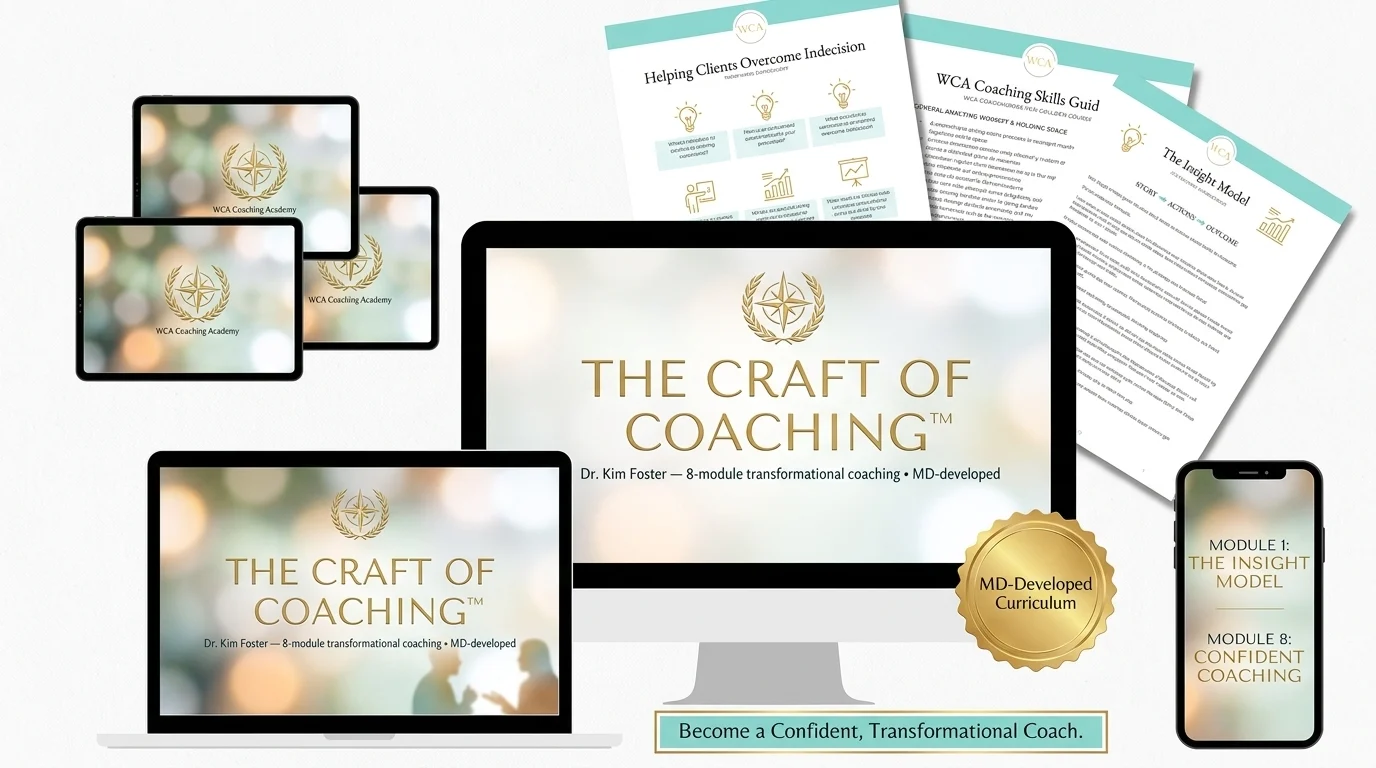
The Craft of Coaching is a self-paced online course for people learning to lead coaching sessions and build client programmes. Dr. Kim Foster appears in the product name, while the listing separately says an experienced medical doctor and wellness coach designed the curriculum without identifying that person. The central buying question is whether online instruction alone provides enough practice for responsible client work.
A coaching session turns conversation into a working decision
A useful session begins with a clear contract: what the client wants from the conversation, what coaching can address and how the available time will be used. The coach listens for patterns, tests assumptions with open questions, reflects important language and periodically summarises. Insight matters only when it changes the client’s available choices. Before closing, coach and client convert one choice into an observable action, identify likely obstacles and agree how progress will be checked. Coaching is not therapy, medical care or clinical treatment, and it is not a substitute for professional care. When a concern involves diagnosis, trauma processing, risk or clinical symptoms, the coach refers the client to a qualified professional. The NIMH explanation of psychotherapy clarifies the different purpose of professional mental health treatment.
Programmes need a change hypothesis, not a calendar
A coaching programme should connect a stated outcome to a plausible sequence of conversations and experiments. Start by defining the client’s desired change, present situation, constraints and evidence of progress. Each session can then revisit the contract, examine experience, select an action and capture learning for the next meeting. A good programme also contains review points and an ending, rather than creating dependence through indefinite sessions. Insight without action becomes interesting conversation; action without reflection becomes random activity. The bridge is a small commitment that the client owns, can perform in context and can evaluate afterward. Programme design remains provisional because goals, capacity and circumstances can change.
Different coaching methods solve different moments
Goal-focused coaching uses defined outcomes, options and accountability well, but can rush past ambiguity or conflicting values. Solution-focused coaching looks for exceptions, existing resources and a preferred future; it is efficient, although poorly handled questions may oversimplify complex barriers. Cognitive-behavioural coaching examines links among interpretations, emotions and behaviour, with useful conceptual support, but it must not drift into treating a clinical condition. Motivational interviewing-informed coaching explores ambivalence through reflective listening and change talk; motivational interviewing has an established evidence base in health behaviour contexts, though brief exposure is not the same as practitioner competence. Developmental coaching examines identity, perspective and role transitions, which suits longer change but can produce abstraction without experiments. Somatic awareness and mindfulness-based coaching bring attention to bodily cues and present experience, yet claims should stay modest and non-clinical. Integrative coaching combines methods, demanding more judgement rather than less.
Practice, observation and referral rules reveal training quality
Before buying any coaching programme, inspect how it turns concepts into behaviour. Look for complete session demonstrations, repeated practice, feedback from a competent observer and assessment against stated criteria. Check whether programme design includes contracting, progress measures, reassessment and planned endings. Ethics teaching should define confidentiality, conflicts, record handling, informed consent, referral and emergencies. Instructor experience is relevant, but it cannot replace evidence that learners practise. Ask whether a credential is accredited, independently recognised or merely issued by the provider. Finally, verify the delivery format, feedback entitlement, access period, update policy and workload. A long syllabus can still leave the hardest skill, responding well in real time, untested.
Eight modules move from foundations to difficult moments
The Craft of Coaching follows an eight-module sequence: Foundations; Core Coaching Skills & Opening A Session; The Insight Model; The Transformational Process; Taking Action; How To Structure A Coaching Session; How To Structure A Coaching Program; and Challenging Situations & Protecting Your Energy. That progression moves from philosophy and ethics through insight, action and increasingly larger structures. The Insight Model is presented as the creator’s proprietary framing. Delivery is online and self-paced, but the listing does not specify lesson media, demonstrations, exercises, assessments, feedback or total study time. It also presents an upgrade path into the full Wellness Coach Academy certification programme leading to the Certified Wellness Coach credential.
Medical authorship does not establish coaching outcomes
The listing’s statement that a medical doctor and wellness coach designed the curriculum describes the author’s background; it does not establish clinical outcomes for a learner’s clients. It supplies no independent studies, assessment results or supervised-practice evidence for the Craft of Coaching. The proprietary Insight Model is the creator’s framing, not settled clinical consensus, and no efficacy claim for any presenting issue follows from the syllabus. Anyone dealing with depression, anxiety, trauma or a diagnosed condition should speak with an appropriate professional first. A course does not qualify someone to treat anxiety, depression, trauma, addiction, smoking cessation or weight concerns. The CWC offered through the upgrade pathway comes from an upgrade pathway, and the listing names no accrediting body for it, and the listing names no accrediting body. A course certificate is not a professional licence; requirements depend on where you practise and must be checked locally. Client work also creates scope-of-practice, consent, record-keeping, insurance and referral duties that the listing does not cover, so obtain independent professional and insurance advice before accepting clients.
Coaching skill grows through observed work
Expect progress to require practice sessions, recordings or observation, candid feedback, case reflection and revision of your questions. Common failures include over-talking, chasing insight without an action, prescribing solutions and continuing beyond competence. Pair the course material with peer coaching triads or qualified supervision so that someone can examine what happens under pressure. If you need assessed performance and live correction, compare a supervised coach-skills practicum. If recognised standing matters, investigate an accredited coach-training pathway and verify its acceptance in your jurisdiction. If ambivalence is the central client problem, dedicated motivational interviewing skills training may offer narrower, deeper practice. People expecting preparation for mental health treatment are better served by regulated clinical training, not a coaching course.
Self-paced study leaves the learning mechanics unresolved
What form do the online materials take: video lessons, written lessons, workbooks, session demonstrations or some combination? Does enrolment include feedback on an actual coaching conversation, or is every exercise completed alone? What completion requirements make someone eligible to upgrade into the Wellness Coach Academy pathway, and what additional training does the CWC route require? How long can materials be used, and are future updates included? The listing does not answer these purchase-critical questions. Before choosing the Craft of Coaching, obtain the current answers directly and decide whether the delivery model supplies enough observed practice for your intended level of client responsibility.