
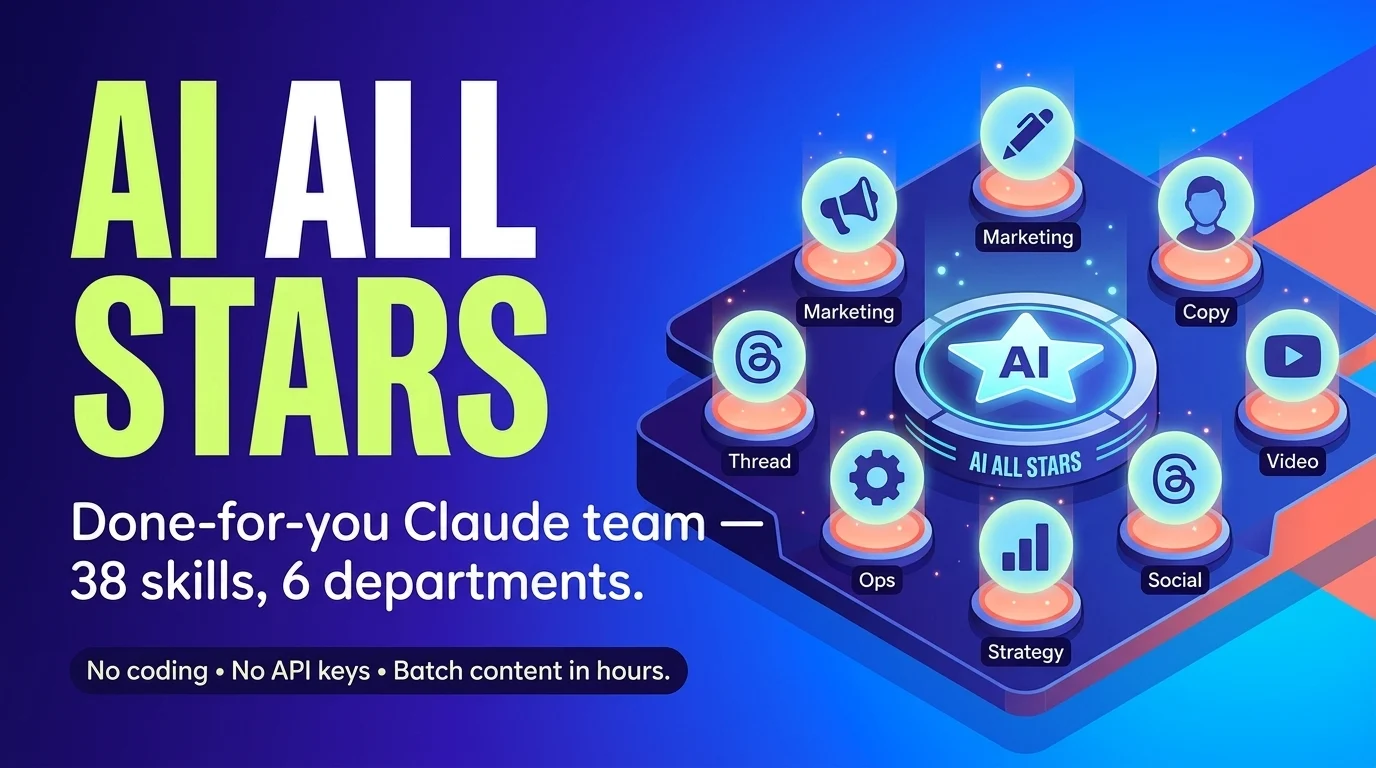
If you are deciding whether 38 named AI roles can replace a folder of repeated prompts, AI All Stars is Gemma Bonham-Carter’s packaged library of Claude Skills, training and supporting playbooks. It is aimed at online business owners and course creators who want repeatable help across marketing, sales, delivery, operations and customer work. The useful question is not whether an assistant can produce a draft. It is whether the surrounding instructions make that draft dependable enough to reuse.
The listing does not promise one-to-one access, weekly calls, a community or personal feedback. Any such support, ongoing updates or interactive help depends on active enrolment with the original provider and should not be assumed included elsewhere. What transfers is the recorded training, frameworks, playbooks and named skill packages.
From one-off request to maintained operating procedure
A one-off prompt can carry a task, an example and a tone request. Repeating it scatters business logic across chats, so an improvement made today may be absent tomorrow. A reusable skill centralizes that logic. A good playbook holds required inputs, decision rules, sequence, examples, output format, brand constraints and escalation conditions; the short prompt then supplies the current assignment and facts.
Anthropic’s Agent Skills documentation describes a skill as a folder containing instructions, scripts and resources that Claude can load when relevant. That creates one place to correct a procedure and reuse it for a bounded role. It does not create judgment. A library inherits its authors’ assumptions, while stale sources, weak inputs and ambiguous cases still produce weak work. Accuracy and brand fit require human checking.
Context can live in prompts, playbooks, retrieval or automation
Saved prompt templates are quick and transparent, but users must remember which context to add and which version is current. Structured skill packages join instructions, examples and resources around a repeatable task; they improve consistency but can preserve a flawed process just as consistently. Retrieval-augmented assistants draw from an approved knowledge base, which suits changing policies and product facts, although retrieval quality and source freshness become new failure points. Workflow automation links triggers, tools and outputs, making it useful for routine handoffs but brittle when exceptions require interpretation. Fine-tuned models can shape recurring behavior at scale, yet they demand suitable training data, evaluation and maintenance. Human-in-the-loop operating procedures keep approval with a responsible person and remain the strongest choice for consequential work. Evidence should come from representative task evaluations, not the architecture’s name.
Versioning, test cases and ownership decide reusability
Before buying any role-specific library, ask to see one complete example from input to checked output. Run the same realistic task against your current method, then compare factual errors, missing context, editing time and adherence to brand rules. Inspect whether the playbook defines required inputs, forbidden assumptions, source boundaries and escalation points. Establish who maintains it when tools, policies or offers change. Check data permissions, connected services and workspace requirements before uploading customer material. Finally, confirm that you can revise the procedure and keep a version history. A sealed package may save prompting today while creating maintenance debt tomorrow.
Thirty-eight named packages cover six business departments
AI All Stars arranges its 38 packages across marketing, sales and conversion, partnerships and PR, product and delivery, operations strategy, and customer experience. Their human first names are labels, not people or hired staff. Sloane drafts social captions, Lennon works on landing-page copy, Ivy prepares podcast interviews, Clementine outlines curricula, Sienna converts an interview into an SOP, and Cora analyzes customer feedback. That sample shows the library’s real shape: narrowly described production roles spread across a broad business.
The listing says each package is built on a 50-plus-page playbook and attributes the underlying training to 15 years of online-business experience using an unnamed collective “we.” It does not establish that history as Gemma Bonham-Carter’s individual record. Four bonuses add a Claude crash course with short lessons, a business playbook and Cowork automations; a brand-book process; training for a student-support assistant; and guidance for building an additional role.
Breadth is visible, while outcome evidence is absent
The detailed role descriptions establish what the seller intends the packages to do. They do not establish output accuracy, conversion improvement, search visibility or saved labor under a buyer’s conditions. AI All Stars provides no independent benchmark, controlled comparison or disclosed success rate in the supplied listing. Long playbooks and numerous roles are implementation details, not proof of results. Any creator income or student-count figures remain seller claims rather than verified outcomes and should not drive the decision. Quarterly curriculum refreshes are also provider commitments whose availability depends on continued delivery through the original source.
Human sign-off begins where the playbook ends
Useful results require your current offers, audience language, brand guidance, source material and examples of acceptable work. Assign an owner to each role, create a small evaluation set and record recurring corrections. Sales claims, customer messages, analytics interpretations, prospect research and public-relations drafts deserve especially careful checking. A named package cannot accept accountability for an invented fact or a poor business decision.
If changing internal knowledge is the bottleneck, compare a retrieval-augmented knowledge-base course instead. If you need cross-tool triggers, permissions and approvals, dedicated workflow automation training is the closer fit. If persuasive copy is commercially critical, specialist conversion-copywriting coaching with critique may be more valuable. Organizations handling regulated or sensitive data should also pair any library with AI governance and data-protection training. This bundle is the wrong purchase when you need validated source grounding, expert feedback or operational integrations more than first-draft assistance.
Claude setup and update terms remain purchase-critical
Which Claude plan and workspace support the supplied materials? The listing does not say. How are the skills installed, updated and transferred, and can a buyer edit the underlying playbooks? Do the 12 Cowork automations require particular connectors, accounts or permissions? Are quarterly curriculum updates restricted to active enrolment with the provider? Can you inspect a complete playbook, a realistic output and its correction history before committing? Those answers determine whether AI All Stars is a maintainable operating library or simply an extensive starting point.