
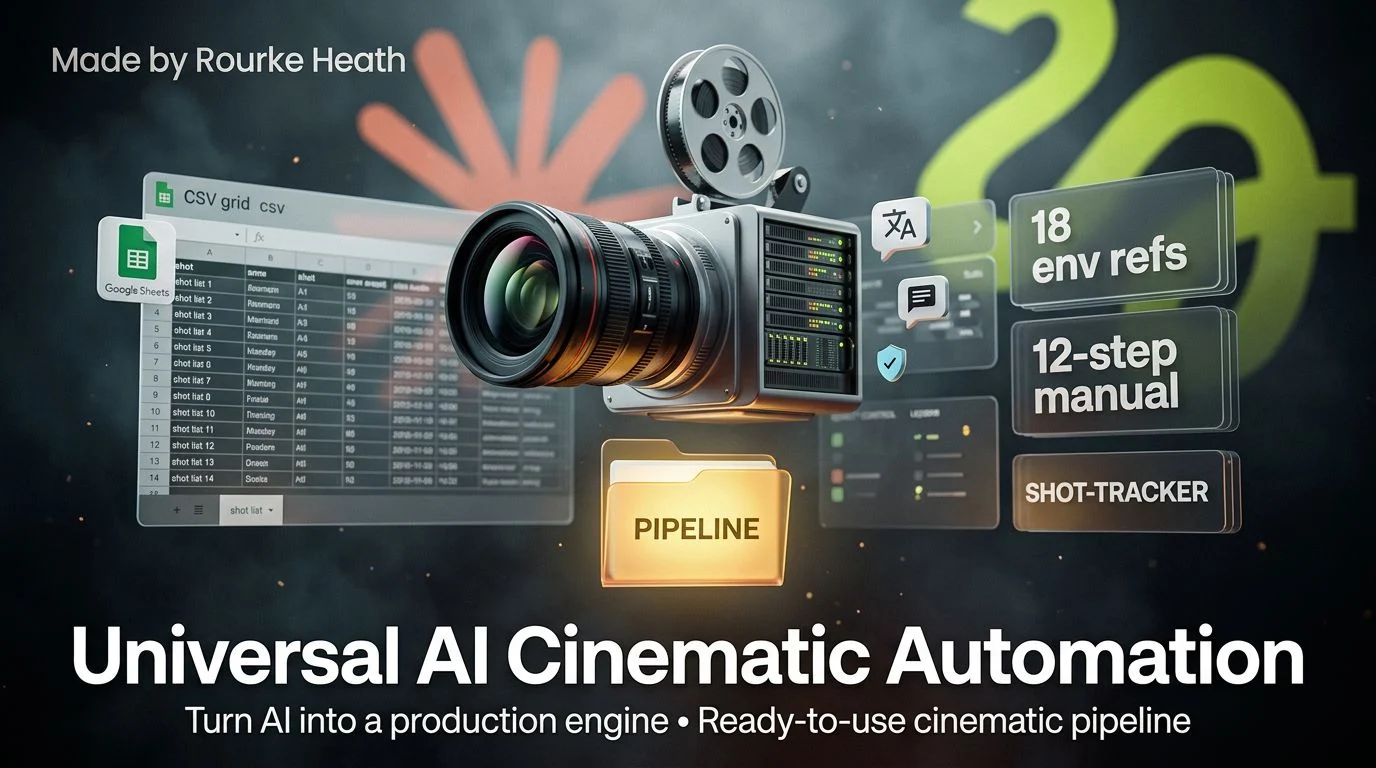
TL;DR: Rourke Heath’s Universal AI Cinematic Automation is a downloadable production pipeline kit, not a video course. You get 18 environment reference images, a 12 step markdown manual, prompt frameworks for image and video, logging and failure map templates, plus a CSV shot tracker built to run multi shot AI video through an AI coding agent.
What Universal AI Cinematic Automation Actually Is
Buy this expecting lessons and you will be disappointed. Universal AI Cinematic Automation is a folder of files: reference images, prompt frameworks, templates, a manual and working subfolders. No video teaching layer, no module list. What you get is the scaffolding one person built to keep a multi shot AI film consistent between generations. Heath says the prompt work behind it accumulated over roughly two years, which is his claim rather than something we can verify. That distinction matters more than anything else on this page.
What Is Inside The Kit
The bundle leads with 18 environment reference images, the visual anchors you reuse so a sequence does not drift. Around them sit prompt frameworks for still image and video generation, and a 12 step instruction manual written as a markdown file rather than a PDF, which tells you something about the intended reader. The templates are the quiet workhorses: a reference template, a logging template and a failure map for recording what broke and why. A Google Sheets CSV shot tracker handles the spreadsheet side.
Treating Shots As A Production Problem
The interesting idea here is structural. Most AI video material treats output quality as a prompting problem. This kit treats it as a production management problem instead. You configure an AI coding agent, Claude in the documented setup, to act as prompt engineer, production manager and quality checker at once, driving a generation CLI while tracking reference IDs and shot states in the logs. The framing is more mature than most, and the templates encode real workflow discipline: name your references, log your failures, know which shot sits at which stage. The official Claude Code documentation covers the agent setup this depends on.
Who This Is Not For
Four honest limits. It assumes you are already comfortable with an AI coding agent, a command line and markdown files, so beginners will stall early. It is coupled to specific tools and CLIs, and those change or disappear, so parts of the pipeline will need patching. There is no teaching layer, which means someone who cannot already generate a decent shot will not be rescued by better logistics; the kit organises output, it does not improve taste. And generating the shots runs on your own model access, which the kit does not cover.
Universal AI Cinematic Automation: Common Questions Answered
Is Universal AI Cinematic Automation a course?
No. It is a downloadable file bundle you run inside your own tooling. There are no lectures or walkthrough videos. The 12 step manual is the closest thing to instruction, and it assumes you already work this way.
Is Universal AI Cinematic Automation legit?
It is a real, self contained set of files matching the listing: reference images, prompt frameworks, templates, a tracker and a manual. It does not teach prompting from scratch, and public detail on Heath is thin, so judge it on the artefacts.
What skills do I need before using Universal AI Cinematic Automation?
An AI coding agent, a terminal, markdown editing, and the ability to get usable output from a video model already. Universal AI Cinematic Automation manages a pipeline. It does not supply the underlying skill.
Does it work with any generation tool?
It is built around a specific generation CLI and agent driven setup, so it is tool coupled by design. Porting it to another stack is engineering work, not configuration.
Who is Rourke Heath?
He is the creator of the kit and reports roughly two years of accumulated prompt work behind it. Verifiable public detail beyond that is thin.
Is Universal AI Cinematic Automation Worth It?
Worth it if you are already producing AI shots and losing track of which reference belongs to which scene. The shot tracker, the failure map and the reference discipline solve a genuine and unglamorous problem that most 2026 AI video material ignores. Not worth it if you want to be taught. This is a set of production rails for someone who can already drive, and it will feel empty to anyone hoping files will do the creative work.