
TL;DR: Miko AI Content System V3 is a large, documentation-led library that connects AI-assisted content production to product research and ecommerce testing. Its strongest feature is the sequence from reference analysis to finished creative; its main trade-off is a multi-platform workflow that buyers must keep current themselves.
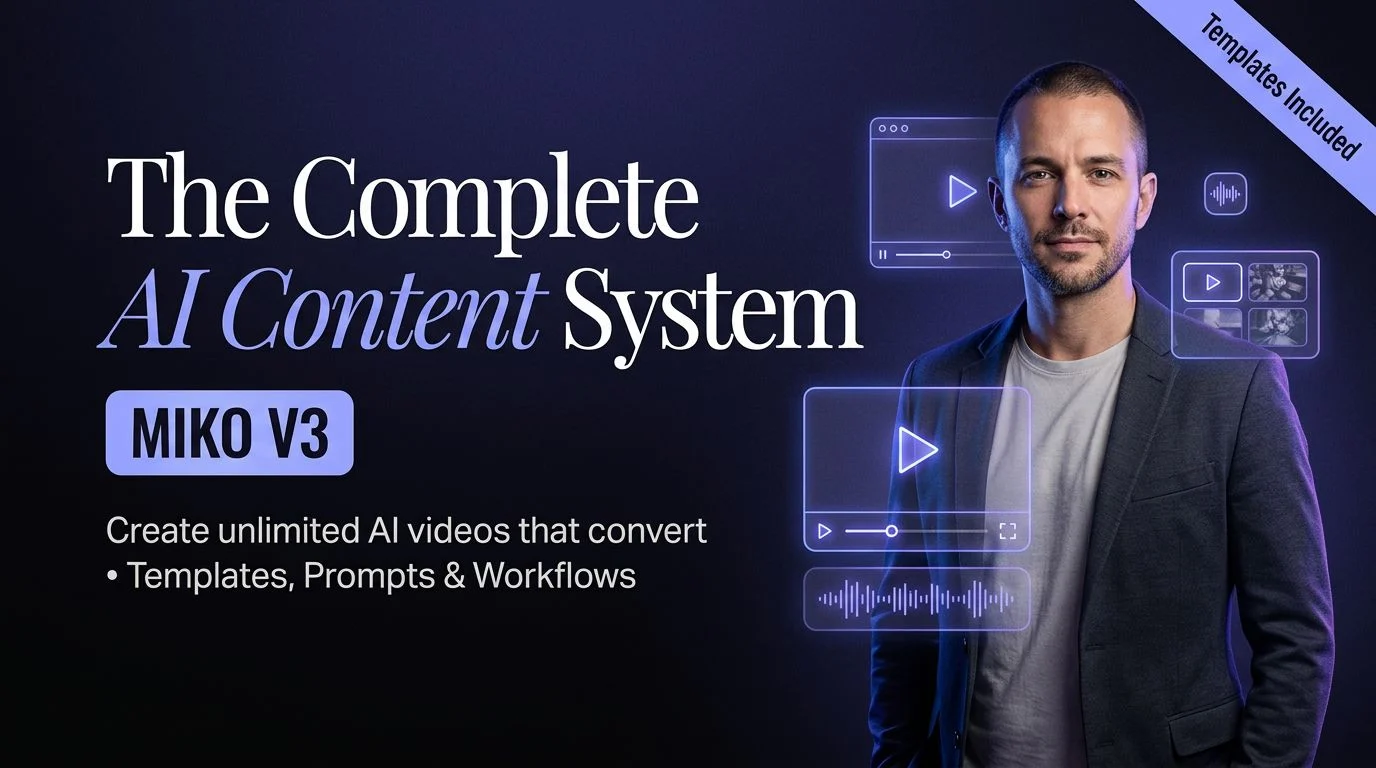
What Miko AI Content System V3 contains
The frozen inventory records 99 files in 31 folders, totaling 1.13 GB. Its 18 videos, 76 PDFs and five documents cover AI UGC reference analysis, image creation, voice generation, video workflows, upscaling, organic marketing, product research, testing, ecommerce operations and scaling topics. A V3 guide and a June 25, 2026 update pair are also present.
The balance matters: this is primarily a reference library, not a continuous video class. Selected demonstrations support the production steps, while the larger PDF collection is better suited to a learner who likes written procedures, checklists and material that can be revisited during implementation.
From reference analysis to a production chain
The practical distinction is the order. The curriculum starts with finding UGC worth examining and extracting its script before moving through images, voice, motion and upscaling. That makes each tool a stage in a production chain instead of presenting unrelated prompts with no clear role in the finished creative. A buyer focused only on AI UGC execution may prefer a narrower AI UGC execution course.
Named workflows include Nano Banana, ElevenLabs, Sora 2, Seedance 2, HeyGen and VEED Fabric. Their presence shows breadth, but it does not establish that every platform is mandatory, included or currently available on the same terms. Buyers should choose the path that matches their production bottleneck and verify accounts, credits and regional availability. A more focused AI content workflow can be a useful comparison when a buyer is deciding how much breadth the workflow needs.
Why the ecommerce material changes the scope
The library does not stop at asset generation. It also addresses organic marketing, product research, validation, testing cycles, conversion problems, store decisions and scaling systems. Editorially, this is useful because a creative workflow becomes more actionable when it ends with a testable commercial decision, rather than assuming that producing more content is the result. When the operational question shifts from producing assets to AI UGC performance testing, that is a logical next research step.
That breadth is not proof of performance. The inventory supports the topics taught, not a typical quality, conversion or income outcome. Operators still need to judge the offer, audience, creative and market response for themselves.
Tool dependencies and responsible publishing
Realistic synthetic content creates responsibilities beyond production technique. YouTube’s guidance on altered or synthetic content explains when creators must disclose meaningfully altered or generated realistic media. Buyers also remain responsible for consent, rights, truthful endorsements and the rules of every platform where the work appears.
This makes the changing tool stack a meaningful trade-off. Interfaces, restrictions and output options can move faster than a recorded workflow. A careful buyer should treat the course as a method to adapt, with a separate review step for current platform rules and publication risks.
Who should use it and who should skip it
It is a good fit for self-directed creators, performance marketers and ecommerce operators who already understand basic short-form content and want to connect research, production and testing. A small team could also use the sequence to make roles and handoffs more explicit.
It is a poor fit for someone wanting one all-in-one application, a beginner-only tour of every platform or done-for-you creative. Buyers seeking live support, hosted community access, proprietary tools or future updates should also skip unless those services are verified separately; the frozen package does not establish them.
Miko AI Content System V3 FAQs
What format does the supplied library use?
The inventory contains 18 videos, 76 PDFs and five documents across 99 files, so the material is documentation-led by file count.
Is this only an AI video course?
No. The documented scope combines image, voice, video and upscaling workflows with organic marketing, product research, testing and ecommerce operations.
What tools should buyers verify first?
Check the accounts, subscriptions, credits and regional availability for the platforms used in your chosen workflow; the inventory does not prove one fixed included stack.
Does the course prove AI UGC will convert?
No. The evidence verifies curriculum coverage, not a typical realism, conversion, income or return-on-investment result for a learner.
Editorial verdict
Miko AI Content System V3 is most useful as an operating sequence: study a reference, extract the structure, build the assets, assemble the creative and assess the commercial response. Its wide scope rewards experienced, self-directed implementers; buyers who need a fixed platform or guided video path will likely find the breadth and PDF-heavy format frustrating.