
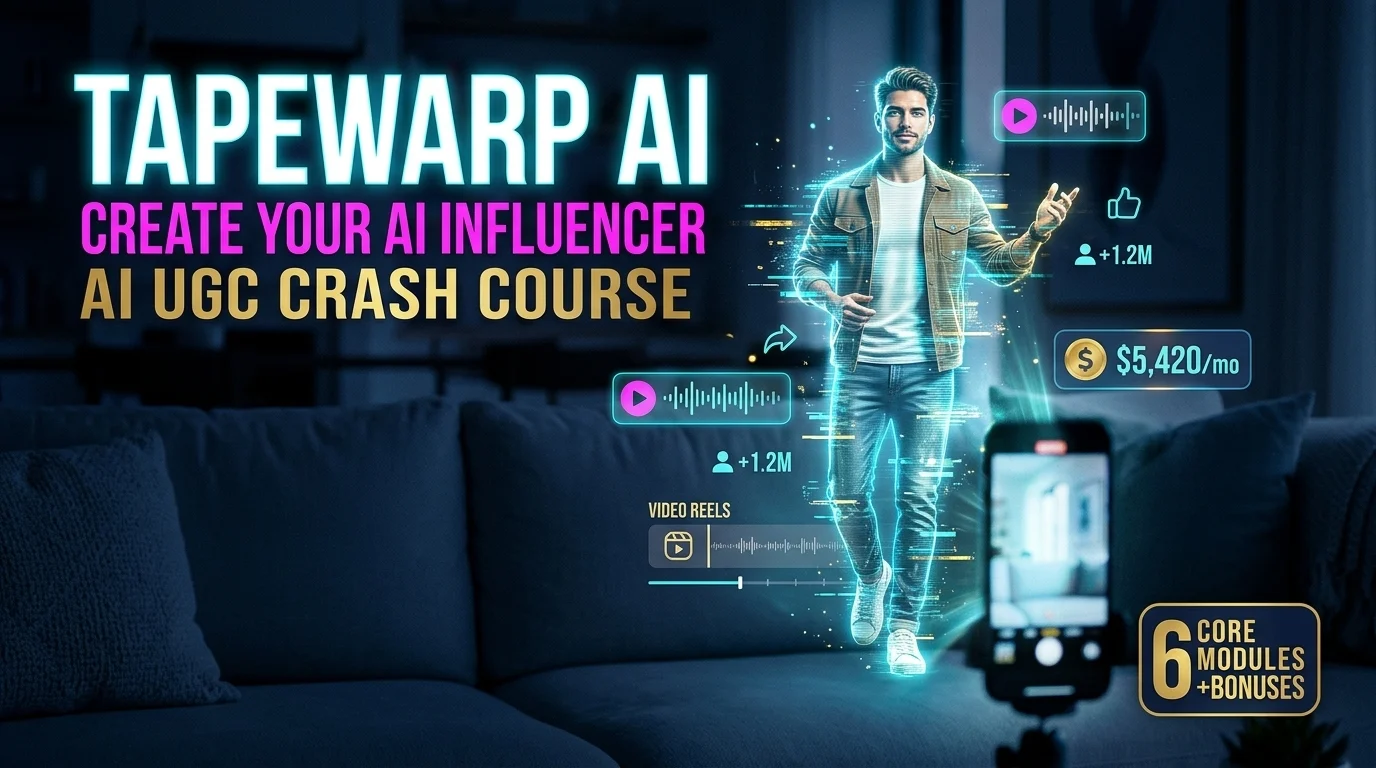
Tapewarp ai’s Create Your AI Influencer: AI UGC Crash Course is a course built around six core modules and bonuses for creators, marketers, founders and brands developing a synthetic presenter for product content. It targets readers who want a repeatable character they can use across ads, reels and feeds. The key choice is whether its compact outline supplies enough guidance for the character, production and disclosure problems involved.
A recognisable synthetic face depends on stable anchors
Character consistency is not a single prompt. It comes from controlling the features that viewers unconsciously use to recognise a person: face shape, hair, age cues, skin details, body proportions and voice. Fixed reference images provide the visual baseline. A small wardrobe, recurring setting, restrained lighting plan and defined camera range reduce variation that the generator might otherwise invent. Voice needs its own reference and pacing rules because a stable face paired with a changing accent or cadence still feels like another character. Keep approved outputs as references, record prompt and edit changes, and compare every new image or clip with the baseline rather than merely asking whether it looks attractive.
Real products draw a truth boundary around synthetic UGC
A product shot must preserve the real packaging, proportions, colour, controls and visible use. The safest workflow photographs or films the actual item, then composites the synthetic presenter around verified product footage. Fully generated handling needs stricter inspection: an invented button, altered label or impossible result can turn a polished clip into a false claim. The spoken script must stay within facts the brand can substantiate.
A synthetic presenter cannot honestly recount personal ownership, satisfaction or results. Portraying one as a delighted customer creates a misleading endorsement even when the product itself is real. AI-made posts and ads need a visible label wherever a platform or advertising rule requires one; Meta explains its own labelling approach for content on its services. An avatar based on a real person also requires that person’s informed permission for the likeness, voice, intended uses and duration. A borrowed face from social media is not a neutral reference asset.
Self-study, software guidance and expert critique carry distinct risks
Self-teaching offers maximum flexibility and demands the most experimentation. It suits someone able to build reference sets, diagnose generation drift and establish a disclosure process independently. A tool-led route is quicker when one application controls most of the workflow, but the skill may not transfer when the interface or model changes. Live coaching costs scheduled time yet gives direct correction on identity drift, compositing and motion. A narrow specialist course trades breadth for a defined production sequence, which is useful when you already know what output you need. Choose self-study when experimentation is affordable, software instruction when one stack is already selected, coaching when critique is the missing input, and specialist training when the project has a clear format but no dependable process.
Tapewarp ai compresses character, product and volume into one outline
The Tapewarp ai brand is the named creator identity; no individual instructor is presented. Its curriculum consists of six core modules plus bonus modules, described as moving from setup to monetization. Four advertised skills define the scope: building a hyper-realistic influencer, creating UGC-style material with real products and emotional expression, maintaining consistent visuals across ads, reels and feeds, and producing content in greater volume. The stated audience includes creators seeking a digital version of themselves as well as marketers, founders and brands building their own character. The humanlike framing needs a firm boundary: the goal must be a clearly disclosed synthetic presenter, not an imitation intended to pass as an unsuspected real customer.
Six core modules carry more breadth than the outline proves
The course description supplies module counts but no lesson titles. It names no software, generation model or platform, so a buyer cannot tell whether demonstrations match an existing workflow. Lesson duration, delivery format, exercises, feedback and support are also unstated, and no live component is mentioned. Monetization appears as an endpoint without any identified method. That makes the four skill bullets the reliable boundary of the offer. The real-product emphasis is relevant, but the outline does not say that it teaches product-claim verification, endorsement honesty, AI labelling, likeness permission or adaptation when a face drifts between images and motion. A face that holds in stills but shifts once it moves points toward training in consistent AI characters for video.
Specialist training can deepen the crash course boundaries
A creator needing tighter identity control across speaking clips can pair this broad outline with synthetic influencers and avatars training focused on continuity. A commerce team whose hardest problem is preserving packaging and believable hand interaction can pursue ai product placement instruction. A marketer who already has a stable character but needs stronger testing, hooks and iteration can move toward paid social creative training. Those are adjacent specialisms, not implied parts of this curriculum. Likewise, someone modelling the character on their own face may want AI video cloning instruction that pairs a video clone with a voice clone.
One disclosed character and one verified product make the cleanest fit
Choose Tapewarp ai when you want a compact starting structure, are comfortable selecting and operating the necessary software yourself, and can supply your own safeguards for consent, disclosure and product accuracy. Begin with one character, one wardrobe system and one real item; if that combination stays consistent across a still, a reel and an ad variation, the workflow has earned expansion. Take another route when you require named tool walkthroughs, personal critique, a detailed monetization model or guidance on advertising and likeness rules. A team that wants every production step written down for handoff can study a documented AI avatar video workflow instead. The AI UGC Crash Course outlines an ambitious production direction, but its sparse curriculum description leaves those needs unresolved.


