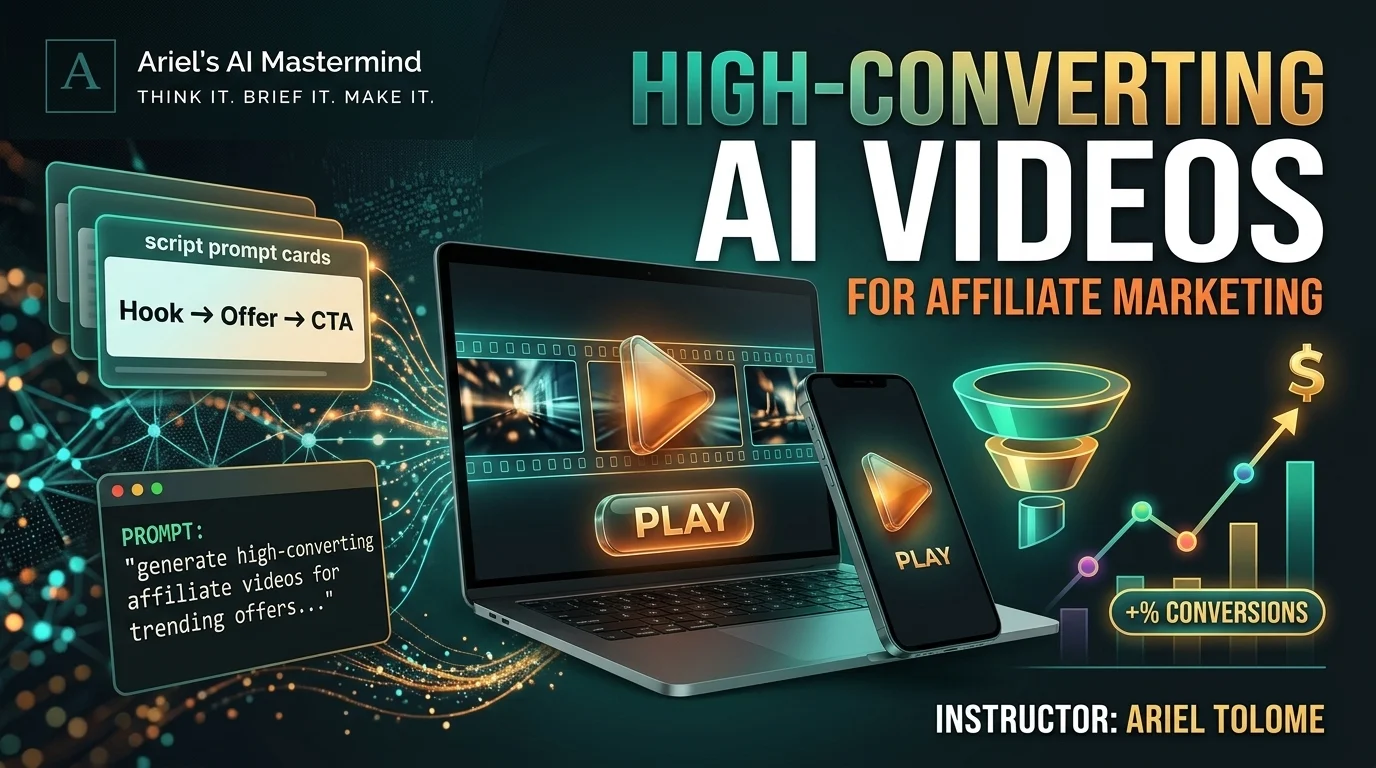
You have a product page, an AI video tool and no clear idea what the first three seconds should say. Ariel Tolome: AI Videos for Affiliate Marketing is a self-paced recorded course for creators and affiliate marketers who want to turn that starting point into a script, prompt and generated clip. Its value therefore depends less on access to a generator than on whether its process improves the choices made before and after generation.
Awareness stage rewrites the first three seconds
Start by naming what the viewer already knows. An unaware viewer feels a problem or desire without connecting it to a category. A problem-aware viewer recognises the friction but not the remedy. Someone who is solution-aware understands the available approaches, while a product-aware viewer knows specific offers. The most-aware viewer mainly needs a timely reason to act.
That stage changes what the video must say first. Showing a named product immediately can work for someone comparing options, yet confuse a person who has not identified the problem. Conversely, explaining the entire category to a product-aware viewer wastes scarce attention. Write one sentence describing the viewer’s current belief, then make the opening frame answer that belief rather than repeating a generic promise.
Reach and escape conditions turn features into stakes
People rarely want a feature in isolation. They want to reach a condition such as finishing creative work faster, presenting an idea clearly or feeling confident enough to publish. They may instead want to escape repetitive editing, unclear messaging or clips that look polished but say nothing. The useful condition is observable and close enough to the product to be credible.
Next, connect that condition to a mechanism. A mechanism explains why the proposed solution could move the viewer from the present state toward the desired one. It is not a slogan. If a tool converts a structured scene description into video, show how the description governs subject, setting, action and camera behaviour. This gives the body of the promotion something concrete to demonstrate.
An AI clip needs a brief it can fail
A short promotional video still needs a hook, body and call to action. The hook earns the next moment by presenting a relevant tension, result or demonstration. The body proves or explains the mechanism without introducing three new arguments. The call to action names one appropriate next step. Turn those choices into a prompt by specifying the audience context, message, scene, visible action, pacing, spoken or on-screen words and intended ending.
Generation is a draft, not completion. Compare the clip with the brief: does the opening match the viewer’s awareness, does the visual demonstrate the mechanism, and does the ending make the next step clear? Inspect continuity, legibility, unsupported claims, awkward motion and whether the product remains recognisable. Revise the failed instruction or creative choice instead of regenerating blindly. AI-made promotion should also be labelled wherever the platform requires it. Obtain consent for anyone’s likeness, and never make a synthetic presenter appear to be a real endorser.
Eight strategy lessons carry the idea into a prompt
Ariel Tolome devotes eight lessons to the part many tool tutorials skip. The sequence covers creative-strategist thinking, five awareness stages, reach-or-escape conditions, personas, hooks, body copy, calls to action, mechanisms, prompt assembly and presentation formats. This is the course’s deepest match with the workflow above. The workbook is meant to preserve those choices as an idea moves between stages rather than leaving them scattered across prompts.
The six generation-and-review lessons then demonstrate three starting inputs: an original idea, a product page and a reference video. They include installing the Copyfirst and Omni Flash skill packages, generating a clip, comparing it with the brief and revising it. No campaign results, comparative tests or learner outcomes are supplied, so the syllabus supports a claim about process coverage, not performance. Creators whose chief difficulty is believable delivery on camera need on-camera confidence training rather than another prompting sequence.
Higgsfield, Kie.ai and Gemini widen the workflow and the gaps
Ariel Tolome demonstrates Wispr Flow, Gemini Omni Flash, desktop projects and plugins, computer-use setup, a Gemini API key for video analysis, and a choice between Higgsfield or Kie.ai. These are third-party services used through the learner’s own accounts. Requirements and pricing can change, and the course listing explicitly tells buyers to check them before selecting a provider.
The scheduled-production lesson is lighter. It describes research, analysis, creation and delivery as a repeatable routine, but its demonstration still has unresolved permissions. Treat it as workflow planning, not a completed autonomous system. The welcome lesson is called Ariel’s AI Mastermind, although the described product contains edited self-paced lessons and no live group element.
Affiliates who can already produce clips but cannot connect viewer activity to useful measurements need affiliate attribution training. Anyone creating a recurring digital spokesperson needs synthetic-character continuity training that deals more deeply with likeness permission, identity consistency and deception risk. The underlying business model is affiliate marketing, so the relationship between promoter and product should be disclosed clearly to viewers.
Your first week ends with one revised promotional clip
Begin with one product and one audience state. During the first two days, write the viewer’s awareness stage, desired or unwanted condition, mechanism, hook, body and call to action. Convert that brief into one prompt on day three. Generate on day four, then compare the output with the original brief and record every mismatch. Spend the remaining days revising the weakest creative instruction, checking disclosures and permissions, and publishing only after a final claim check.
You can follow that routine with or without the course. Ariel Tolome adds value if you want recorded setup walkthroughs, provider examples, worksheets and reusable skill packages arranged around the same path. It is a poor match if you want live feedback, a proven automated production system, platform-specific campaign analytics or training centred on appearing naturally on camera.