
AI Content Engine is Nick Ponte’s workflow training package for creators and marketing teams that want to turn AI-avatar videos into a documented production process. It suits buyers who plan to use their own production tools and need a handoff-ready system, not merely a lesson in generating a talking avatar.
A repeatable avatar channel begins before the avatar renders
The first decision is not which avatar to use. It is whether a topic reflects durable audience demand or merely today’s news cycle. Start with recurring questions, costly problems and search behavior, then use news as a timely angle. Chasing every announcement produces speed without a coherent audience.
A retention script makes one clear promise, earns attention quickly and delays selected information through honest open loops. Each beat should advance that promise. A single call to action gives the viewer one next step; several competing requests weaken both the ending and the measurement.
Realism comes from aligned inputs: natural source footage, clean voice training, believable pauses, correct pronunciation and restrained gestures. Editing should remove dead air, vary shot scale, introduce relevant B-roll and use screen recordings when showing a process. An operating procedure must document inputs, naming, approvals, disclosure, export standards and quality checks so another person can reproduce the work.
Evergreen libraries and trend desks run on different clocks
An evergreen demand library organizes videos around recurring audience problems. It compounds into a useful catalog, but it can respond slowly when the market changes.
A trend-responsive newsroom watches current developments and publishes quickly. It can capture timely interest, but weak verification and rushed scripts make it prone to shallow or inaccurate work.
Template-led batch production standardizes hooks, scenes, graphics and calls to action. It improves throughput, although visible repetition can make every video feel interchangeable.
A human-in-the-loop studio uses automation for drafting and assembly while people retain editorial, factual and visual approval. This usually gives better control than unattended generation, but it requires clear review ownership.
An outsourced production line separates research, scripting, avatar generation and editing across specialists. Its evidence is operational: consistent outputs, fewer corrections and stable turnaround. More generally, audience research, controlled testing and measured watch behavior provide stronger evidence than claims about automation alone.
Test the workflow on one complete video
Before buying training, ask to see the artifact chain behind one finished video: research brief, approved script, consent record, voice and avatar inputs, edit notes, disclosure decision, export checklist and performance review. A course should explain who owns each decision and what causes work to be rejected.
Then examine whether its templates specify standards or merely provide prompts. A useful pilot is a small run made by someone other than the process designer. Track revision rounds, factual errors, pronunciation failures, pacing problems and completion time. Also check tool dependencies, delivery format, update policy, feedback arrangements and whether outsourcing instruction includes quality control after hiring.
Nick Ponte connects prompts, production and delegation
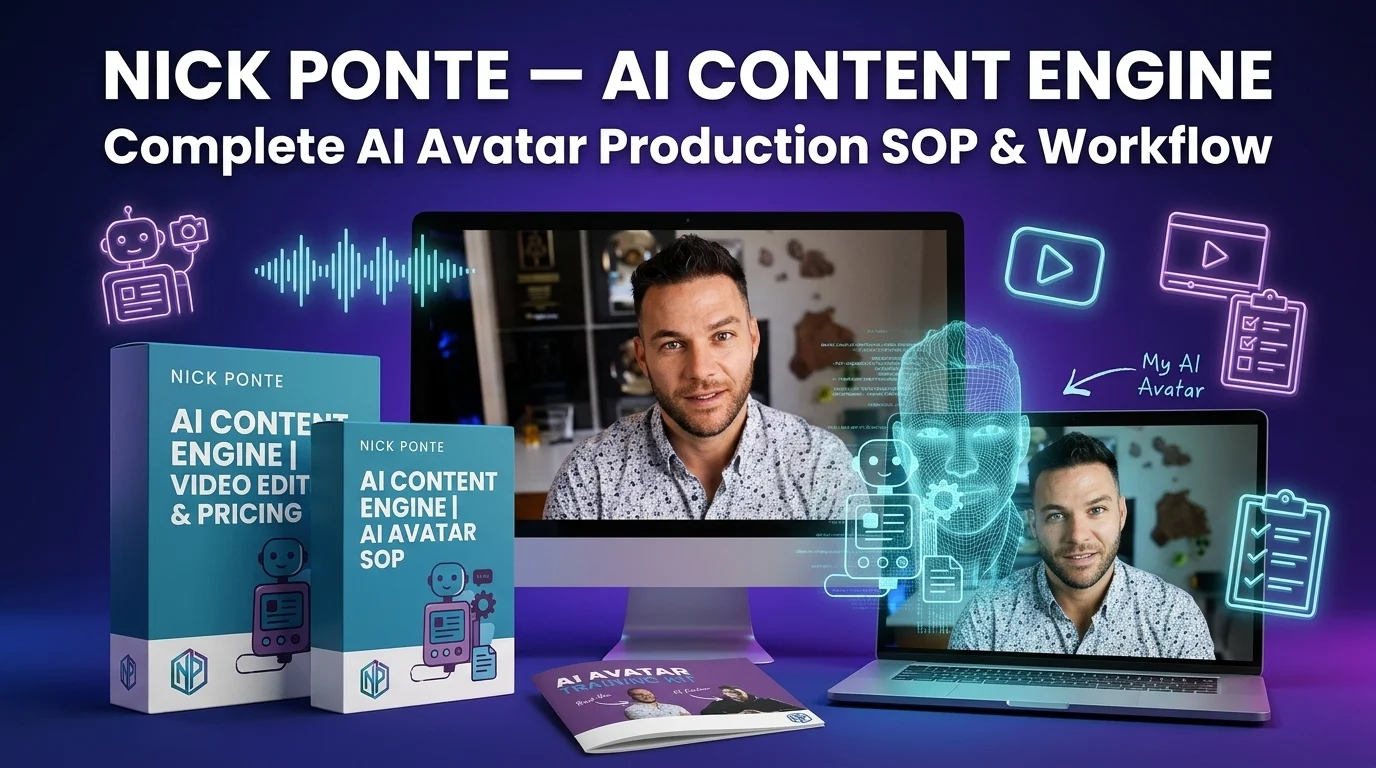
Nick Ponte AI Content Engine places six practical layers in one pipeline: the production SOP, HeyGen avatar setup, a trending-topic engine, a script framework using Claude prompts, editing and retention systems, and the ‘Systemize Everything’ delegation blueprint. The wider workflow also names packaging, publishing checklists and performance tracking. Editing instruction covers pattern interrupts, visual pacing, B-roll and screencasts, while the outsourcing material includes Upwork hiring posts and editor instructions.
Press profiles describe Ponte as the founder of Nick Ponte Marketing, a Maui agency offering SEO, PPC and web design, and of Offline Sharks, a marketing education community. Those profiles establish professional context, not the effectiveness of this particular training.
The listing shows scope, not channel results
The listing is specific about covered processes, yet it provides no controlled comparison, representative student outcomes or independently audited performance data. Topic prompts, retention structures and an internal workflow can be inspected as methods. They do not establish audience growth or commercial results.
The supplied material includes no independently verified creator-income or student-count evidence. Any figures encountered elsewhere should be treated as the creator’s own claims, not confirmed outcomes. Results also depend on topic demand, source accuracy, creative judgment, distribution and the buyer’s existing audience.
Synthetic media adds obligations that a production checklist must not hide. Only clone your own face and voice, or those of someone who gave informed consent. Platforms such as YouTube ask creators to disclose realistic altered or synthetic content, as YouTube’s altered-content guidance explains. Undisclosed likeness use creates deception, consent and reputational risks.
HeyGen and Claude remain outside the package
HeyGen and Claude are separate paid tools requiring the buyer’s own accounts; neither is included. The listing discusses HeyGen setup, avatar optimization, audio and export settings, plus Claude systems for scripts and packaging, but it does not state how tool changes will be reflected in the material.
The Upwork posts are examples, not a hiring service. References to Ponte’s team describe his operation and do not transfer team access, production help or continuing updates. The listing also leaves lesson length, precise delivery format, feedback, community access and the availability of future revisions unspecified.
Questions to settle about delivery before buying
Is the AI Content Engine course live or self-paced? The listing presents training, prompts, an SOP and blueprints, but does not identify a cohort schedule or confirm a self-paced format. Ask the seller to define delivery before purchasing.
Does it include the required software? No. You need your own HeyGen and Claude accounts, and the listing does not describe any bundled tool entitlement.
Will Ponte’s team produce or hire for the buyer? The description teaches delegation and provides hiring-post examples, but it does not offer Ponte’s team, editor recruitment or managed production.
Does the listing show how quality is approved after handoff? It names production standards, editor instructions and performance tracking, but does not expose a sample approval rubric or completed handoff for inspection.
Human judgment is still part of the system
Using AI Content Engine realistically means maintaining an editorial calendar, consent records, pronunciation references, source checks, brand rules and a recurring analytics review. Common failures include selecting topics for novelty alone, accepting the first script, training a weak voice sample, filling every pause with irrelevant footage and delegating before the quality standard is written.
If the real gap is understanding what an audience values, dedicated audience-research training is a better first purchase. If personal presence is central to trust, compare human-presenter video coaching. If watch time collapses after filming, structured short-form editing training addresses the narrower constraint. Teams whose work repeatedly stalls at approvals may benefit more from SOP design and production-management training. Pair any avatar workflow with factual review, platform-policy monitoring and a documented escalation path for uncertain content.