
The Threads Code is a Kira Goldberg course hosted inside Skool for creators who want a repeatable Threads publishing workflow connected to an existing or planned offer. The listing pairs the main training with more than 500 done-for-you viral threads, so the immediate decision is whether the instruction, community participation and reusable copy are clearly included in the version being sold.
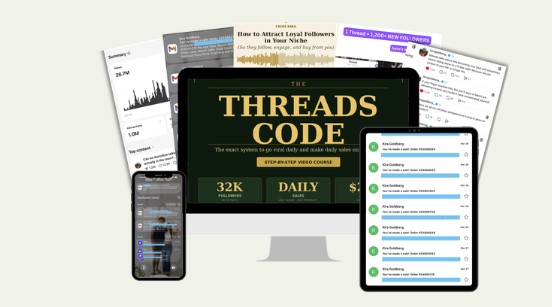
The Threads Code is a community product, not simply a standalone recording. Any one-to-one access, weekly calls, group discussions, feedback or other live element depends on active enrolment with Goldberg and should not be assumed to travel with recorded material. Only recorded frameworks and templates actually supplied can transfer, yet this listing exposes no inspectable content inventory.
Replies are the first distribution test
Follower count is not a distribution entitlement on Threads. Replies give a post more conversation surfaces, while strong early response signals that the post may deserve wider testing beyond the author’s current audience. That makes the opening idea and the first wave of interaction important, but it also makes reach volatile.
Revenue begins after reach. A creator still needs a relevant offer, a credible bridge from post to profile, a next step and a way to follow up with interested people. Daily posting also has a cost: idea research, drafting, replying, moderation, measurement and the opportunity cost of doing this instead of serving customers. The sustainable target is not maximum volume. It is a cadence that preserves useful ideas and enough response time to turn attention into trust.
Expertise, conversations and paid reach solve different gaps
Expertise-led publishing turns specific observations, examples and opinions into original posts; it builds a recognizable voice but demands a continuing supply of real insight. Conversation-led networking uses thoughtful replies and follow-up exchanges; it can earn relevant visibility but is labor intensive and easy to reduce to empty engagement.
Repeatable content frameworks give hooks and post structures a consistent rhythm; they reduce drafting friction but become formulaic without fresh substance. Done-for-you content libraries accelerate output, but originality and audience fit weaken when many buyers receive the same language.
Collaboration and structured referral loops borrow trust from peers; they work best when audiences overlap and the relationship is genuine. Paid social distribution buys controlled exposure, yet it does not prove that organic content or an offer works. Owned-audience capture moves interested readers to email or another permission-based channel; it adds setup but provides stronger control and measurable follow-up.
A daily publishing system needs four kinds of proof
Ask for a dated curriculum, a sample lesson and a clear statement of what is recorded, editable, live and updated. Check whether the teaching covers profile positioning, idea generation, post construction, reply practice, analytics and the handoff from attention to an offer. A useful program should explain why examples worked, not merely display high-performing screenshots.
Then calculate the weekly workload, including replies. Confirm who teaches, what support is active, how template reuse is handled, and whether claimed outcomes are typical, exceptional or promotional. Finally, define your own test: one audience, one offer, a publishing window, leading measures such as qualified profile visits, and a conversion measure you control. If the method cannot be evaluated without headline metrics, the purchase is hard to judge.
The Threads Code bundle has two unresolved inventories
Goldberg says the official Threads Code course has seven modules covering method and mindset, profile setup, an AI content engine, post construction, a daily game plan, audience loyalty and monetization. That sequence treats posting as an operating system around an offer rather than a caption bank. It suits a hands-on creator more than someone expecting automated output.
The official offer is also described as including a prompt resource, written monetization playbook, Instagram growth walkthrough, automation walkthrough and weekly update videos. None is confirmed in this UDCourse package. Its title instead names a main product and a large done-for-you add-on, while the current official page reportedly uses a different prompt-resource count. With no visible course-content surface, buyers cannot tell whether these are different editions, separate assets or the same resource described differently. The listing also omits file format, lesson duration, update date and which participation benefits attach.
One creator’s reach figures do not become buyer forecasts
Goldberg states that she reached 8.8 million views and more than 44,800 followers. Those are her own results, not independently verified evidence or a forecast for another creator, and the platform can reward early movers disproportionately. Her statement that most days produce a viral thread is likewise an individual marketing claim.
Any creator income or student-count figures should be treated as creator-supplied claims, not buyer outcomes. The FTC’s advertising guidance says objective advertising claims need support. Useful proof here would include dated cohort distributions, definitions of active students, tracked conversion events and examples showing unsuccessful as well as successful tests. None appears in the supplied listing.
Borrowed posts cannot replace owned demand
A pack sold to many buyers creates a structural collision: multiple accounts can publish near-identical text on the same platform. Platforms rank for originality and can demote repetition, buyers compete for the same distribution, and an audience gathered through borrowed phrasing may not trust the seller’s real voice. Treat every supplied post as research material to rewrite, not finished publishing.
Threads is owned by Meta. Reach, ranking and monetization terms can change unilaterally without notice; the audience is rented, and tactics tuned to current behavior date as the system changes. A follower count is not revenue. Conversion has separate failure points in positioning, offer fit, calls to action, checkout and follow-up.
If you do not yet know what you sell, structured offer-positioning training is the better starting point. If your ideas lack customer language, compare dedicated audience-research training. If platform dependence is the concern, prioritize owned-email-list building. If you attract attention but cannot move people toward a decision, conversion-copywriting training is more relevant. Daily execution still requires original thinking, reply time, testing and restraint.
Four details to settle with Kira Goldberg
- Is the large post add-on included? Request its exact format, edition and inclusion terms.
- Are all seven stated modules present? The official sequence is creator-provided, not an inspected inventory of this package.
- Does enrolment include the current Skool group? Confirm discussions, feedback, update videos and any live participation directly.
- Can you rewrite rather than copy the supplied posts? Without a defined audience, offer and personal voice, the add-on solves speed while leaving relevance unresolved.