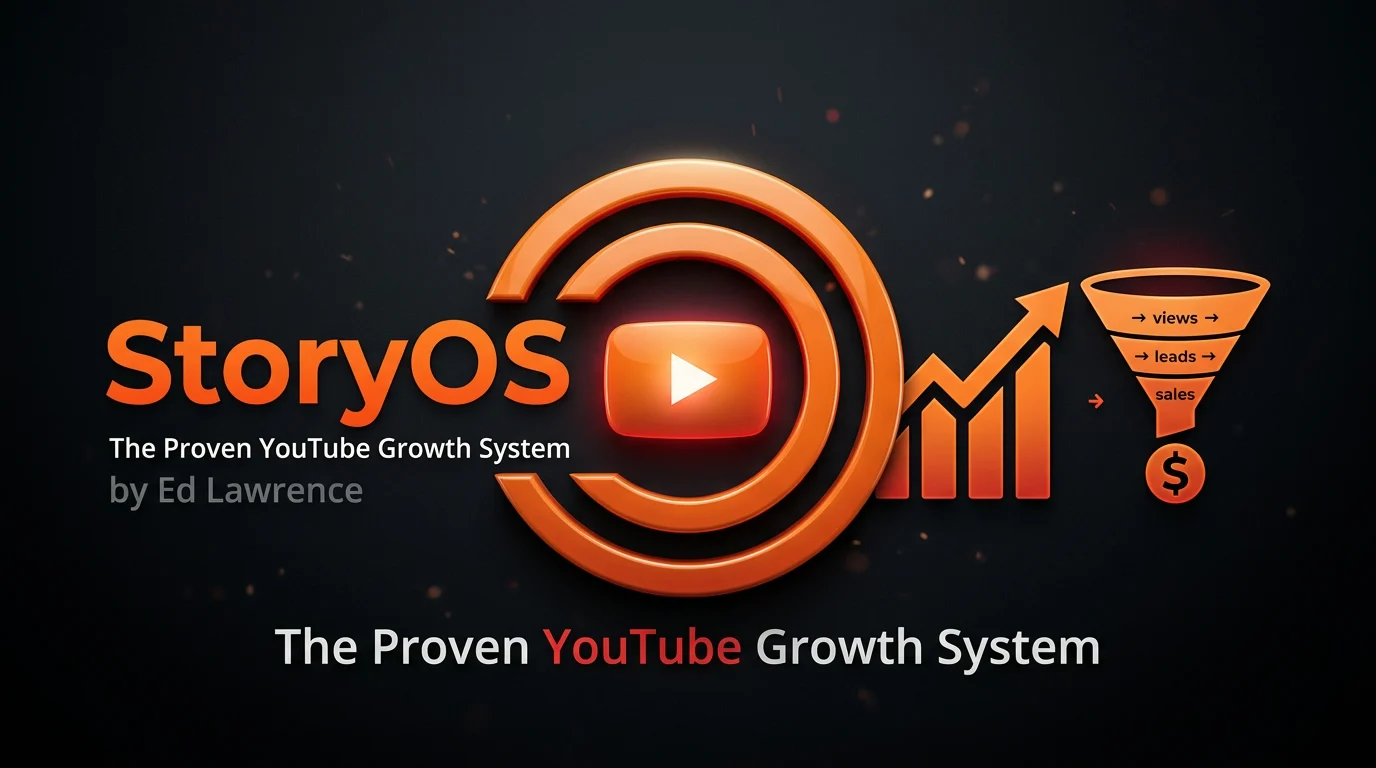
The StoryOS YouTube system is Ed Lawrence’s Academy curriculum for experts who want YouTube videos to attract potential buyers, not merely collect broad views. It teaches a buyer-led path from channel diagnosis and audience research to packaging, video structure and post-publication measurement.
Academy access ends before the operating layer
The scope footnote changes this purchase. Ed Lawrence StoryOS Academy access covers the current Academy curriculum and updates to that existing curriculum, but expressly excludes the purpose-built software, membership benefits, live events, recording libraries, separately released products, advanced programs and new tiers. What the footnote places inside Academy access is that curriculum and its updates, including its frameworks and any templates contained there, not the custom AI Coach or continuing live diagnosis.
Do not assume 1:1 access, weekly calls, community participation or feedback. They are not specified as Academy inclusions. The twice-monthly StoryOS live reviews, where active members may submit channels and funnels for possible selection, depend on an active enrolment with the original provider and should not be treated as part of the StoryOS YouTube system described by the Academy entitlement.
A qualified view begins with a buying problem
A reach-led channel asks what the largest plausible audience might click. A buyer-led channel starts with a narrower question: which viewer has a problem connected to your expertise, and what must that person understand before considering an offer? Research therefore goes beyond collecting popular topics. Examine the videos those viewers choose, the language used in comments and searches, the alternatives they compare, and the beliefs that delay action. YouTube’s explanation of search and discovery confirms that recommendations respond to each viewer’s behavior, so relevance to the intended viewer matters more than imitation of an entertainment hit.
The thumbnail and the opening make different promises
Click-through rate measures whether an impression becomes a view, while retention shows whether the video keeps earning attention. They can pull against each other. An exaggerated title may win clicks but lose viewers when the opening cannot fulfil its promise; a precise title may attract fewer people but produce stronger watch behavior and better commercial fit. Structure should close that gap: establish the promised problem quickly, create a logical sequence, demonstrate rather than announce expertise, and place any next step after sufficient value. Performance must be read by traffic source, audience and video purpose, not from one channel-wide average.
Buyer research has several valid homes
Search-demand research finds explicit questions and is useful for discoverable tutorials, but it misses problems buyers describe differently or never search for. Audience-observation research studies viewing choices, comments and adjacent channels; it supplies behavioral evidence, although copying visible winners can erase your offer’s distinction. Customer-interview research captures decision language and objections, but small samples can overrepresent vocal customers. Competitive packaging analysis compares topics, titles and thumbnails; it reveals conventions, not the hidden causes of performance. Hypothesis-led publishing tests one audience, promise or structural change at a time and produces the strongest channel-specific evidence, but it requires enough impressions and patience. Performance-led iteration uses click, retention and conversion signals together; it is powerful only when tracking definitions remain consistent.
The audit worksheet must produce falsifiable decisions
Before buying any program in this category, ask to see the decision process rather than a collection of successful examples. A useful method should define the intended viewer, business objective and traffic source before diagnosing a video. It should separate packaging failure from opening failure, weak topic demand, poor audience fit and a broken post-view path. Look for sample audit artifacts, explicit hypotheses, measurable success criteria and guidance for low-data channels. Check whether conversion tracking is taught, whether examples include disappointing results and whether feedback is part of the purchased format. An audit can identify plausible constraints. It cannot prove why a video behaved as it did or predict the next upload.
StoryOS joins four stages under an uneven entitlement
The StoryOS YouTube system organizes the work into an audit of the channel and funnel, buyer-focused viewing research, development of ideas and drafts, and analysis after publication. The listed Academy curriculum says it covers attracting potential buyers, researching what they want to watch, creating ideas, titles and thumbnails, structuring trust-building videos, and measuring improvement. That is a coherent loop. However, several described workflows rely on excluded components: the custom AI Coach is presented as turning a brain dump into a plan and first draft, while the software is presented as housing research, a vision board, scripts, analysis and repurposing.
The listing also says Lawrence developed the method across more than one billion views and more than one thousand clients. Those are the creator’s own claims, not independently demonstrated outcomes. No comparative study, complete client denominator or controlled performance record is supplied. The stated analysis of past videos may highlight recurring patterns; it does not establish prediction or prevention of future mistakes.
Publishing exposes the gaps no framework can close
Results require a specific offer, regular production, enough impressions to interpret patterns and tracking from video to the next meaningful action. Common failures include researching a broad audience, changing several variables simultaneously, treating a retention dip as a single-cause diagnosis and judging buyer quality from views alone. You must also confirm which exercises remain usable without the excluded software.
If the offer and buyer are still unclear, start with structured customer-interview research instead. A channel dependent on discoverable tutorials may be better served by YouTube search optimization training. Creators whose ideas are sound but delivery loses attention should compare dedicated presentation coaching. If viewers watch but do not become leads or customers, choose funnel analytics training before another scripting system. The right alternative follows the constraint, not the size of the curriculum.
Access terms decide whether the Academy is enough
Does the StoryOS YouTube system include the AI Coach and software? The listing’s scope footnote says Academy access does not include software or membership benefits, so obtain written confirmation of any separate entitlement.
Can every buyer submit a channel for diagnosis? The twice-monthly sessions concern active members, every active member may submit, and Lawrence selects which channels to examine; submission is not individual analysis.
What happens to Academy access if membership lapses? The listing does not say. Its footnote defines what Academy access covers, not how long it lasts, so treat continued access as unconfirmed rather than assumed.
Will the method work for a new or low-traffic channel? The listing does not specify minimum data requirements, sample sizes or a separate diagnostic path for sparse analytics. These answers determine whether the Academy alone matches the way you intend to work.