You may be deciding whether five business courses under one acronym form a usable sequence or merely bundle familiar topics. SMART System by Nesha Woolery is an online business program for beginners and solo service providers who want to build around one digital product using niche messaging, Instagram, email, a launch, and shorter-week routines. The decision becomes clearer once you separate the business model from the sales story.
Personal replies in lesson discussion areas are enrollment-dependent. The listing does not promise one-to-one sessions, weekly calls, or a separate community, so none should be assumed included. Any feedback depends on active enrollment with the original provider; the portable value is the lesson frameworks and templates.
A one-product business breaks at the handoffs
Choosing one digital product simplifies production, but it concentrates risk. The niche must describe a recognizable buyer and problem, the message must give that buyer a reason to care, and the offer must turn the message into a specific change. If any handoff is weak, more posts or automation only send more people toward an unclear proposition.
Instagram can create attention and rapid feedback, but its reach is rented and variable. A permission-based email list gives you a more direct, exportable relationship, while a launch creates a deadline for testing whether attention becomes demand. None of this escapes arithmetic: a small relevant audience caps sales, however polished the funnel is. A sustainable week therefore comes from limiting offers, documenting recurring work, and maintaining the system, not from eliminating work.
Search, social, referrals and email create different demand
Customer-discovery interviews and positioning research expose the language, alternatives, and constraints buyers actually use, although stated interest is weaker evidence than a purchase. Organic social content marketing is useful for fast message testing and conversation, but reach is platform-dependent and attribution is often messy. Search-led content marketing captures existing intent and can compound over time, though it develops slowly and favors problems people already search for.
Partnership and referral marketing borrow trust from existing relationships, but growth depends on partner fit and a repeatable introduction process. Permission-based email lifecycle marketing supports education, launches, and follow-up with measurable delivery and response data; weak list quality still limits it. Pre-selling and beta launches test demand before extensive production, while evergreen funnel automation is better applied after the offer has earned evidence. Paid acquisition can accelerate a working system, but it makes poor economics fail faster.
Inspect the offer, funnel and workload as one system
A worthwhile program should connect its niche method to a real offer, its traffic method to list growth, and its email teaching to a launch or continuing sales process. Look for concrete outputs such as an audience statement, offer page, opt-in asset, email sequence, launch calendar, and weekly operating routine. Check whether examples show decisions and revisions rather than finished pages alone.
Then inspect the learning conditions. Are platform demonstrations current? Can you see how feedback works, who supplies it, and when it ends? Does the program distinguish validation from automation, identify required software, and state the continuing workload? A curriculum that promises simplicity but cannot show the maintenance burden is hiding the most important cost.
Five lettered courses carry the business from niche to routine
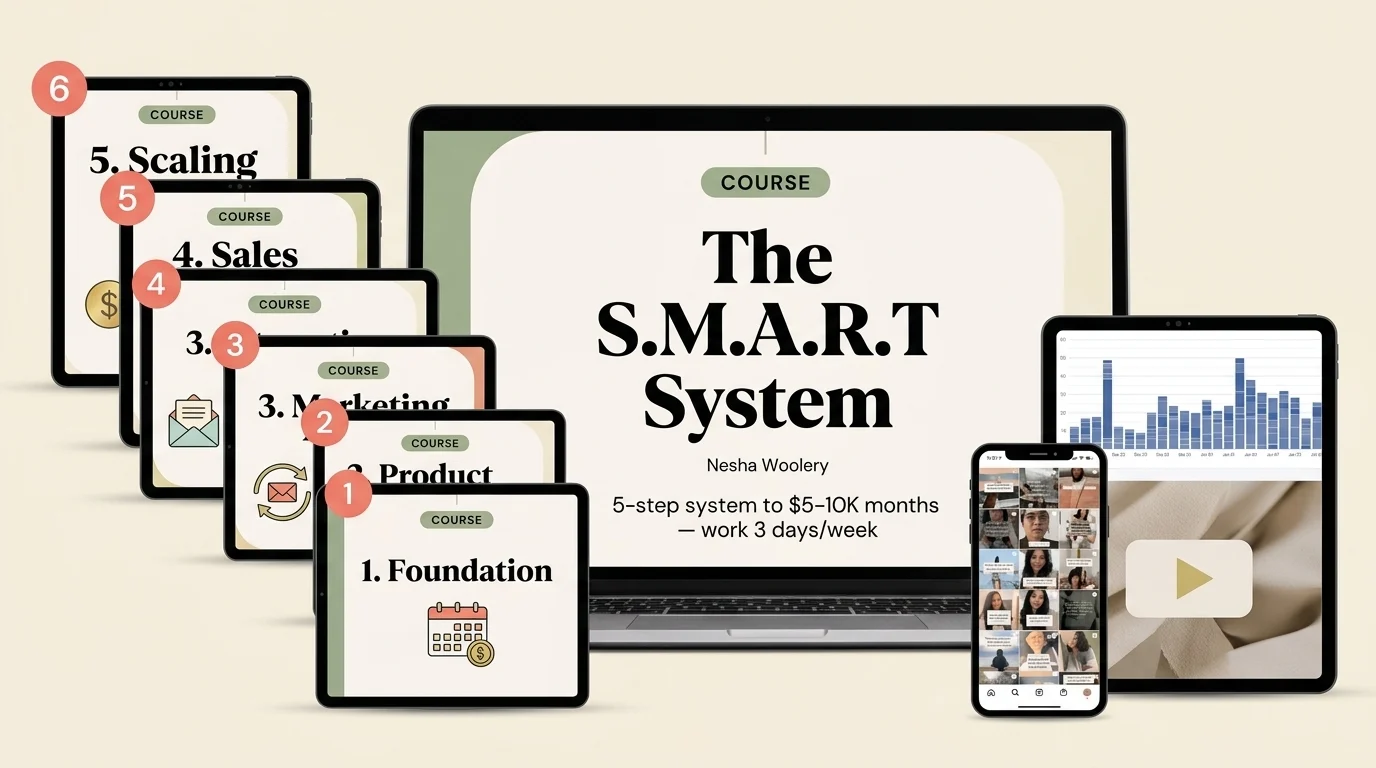
The SMART System turns its acronym into five courses. Super Niche covers positioning and messaging through the owner’s perspective or style. Magnetic Instagram Strategy addresses content and includes ManyChat automations. Automated Email Marketing covers a freebie and a six-month funnel. The digital-products course covers creation, naming, pricing, a sales page, technical setup, and a 30-day launch plan. Thrive In Three addresses systems, mindset, and routines for a shorter working week.
The listing also names implementation templates, a Start Your Business From Scratch primer, and Successfully Sell Services, which is taught by Nesha Woolery and other business experts. Lesson-level discussion areas and personal replies distinguish the offer from a bare content library, but their present availability must be confirmed.
Seller examples are not a forecast
The supplied listing uses Nesha’s own business examples to support its sales case, but it provides no independent learner-outcome study, comparison group, or complete account of unsuccessful implementations. Those examples establish possibility, not probability. Any creator results or student-count figures should be treated as self-reported unless independently documented. SMART System is better judged by the specificity of its workflow and artifacts than by promotional outcome language.
An automated email funnel still carries legal duties
Automation does not remove the sender’s obligations. In the United States, CAN-SPAM requires commercial email to identify the sender, use honest subject lines, include a working opt-out mechanism, and provide a valid postal address, as explained in the FTC’s CAN-SPAM compliance guide. Other countries apply their own consent and electronic-marketing rules. Course material is not legal advice, so obtain qualified guidance for your location and business model.
Templates cannot choose the market for you
Implementation still requires audience conversations, regular content, email writing, technical setup, launch execution, and measurement. Common failures include automating an untested message, building before checking demand, treating followers as subscribers, and abandoning the system when the first launch produces ambiguous evidence. Woolery explicitly acknowledges that launching and starting out can require full-time work during some seasons.
If the offer remains vague, compare a customer-discovery interview program instead. If Instagram is a poor match for buyer behavior, dedicated search-led content training may be more useful. A relationship-driven service business may benefit more from structured referral coaching. A company that needs direct prospecting should consider dedicated cold-outreach training with appropriate compliance guidance. Pair any broad business program with platform-specific technical instruction when the setup itself is the bottleneck.
Discussion threads matter only while somebody is answering
Is SMART System available entirely on demand, released on a schedule, or tied to defined enrollment periods? How long do the lesson discussion areas remain open, and is Nesha currently providing the stated personal replies? Are the ManyChat automations and templates updated when platforms change? What software, recurring tools, accessibility features, lesson lengths, access terms, and update policies apply? The listing does not answer those format questions, and they determine whether you are buying a maintained learning environment or principally a curriculum and template collection.


