
Private Practice Academy is Kelly McKenna’s business-course bundle for already-licensed therapists who want help organizing a private-pay practice, marketing it on Instagram and developing work beyond individual sessions. It is business education, not training in how to practise therapy.
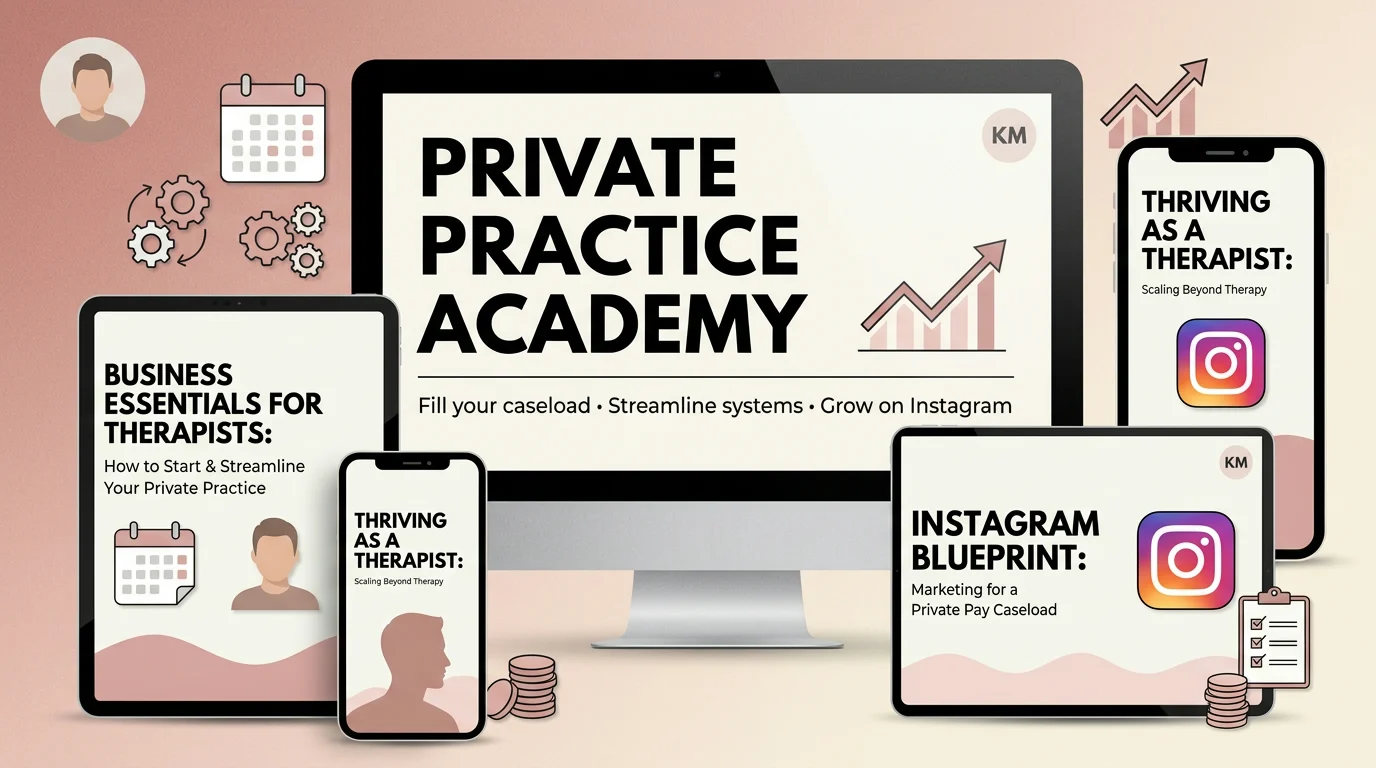
McKenna’s bundle spans setup, Instagram and diversification
The Private Practice Academy combines Business Essentials for Therapists, Instagram Blueprint and Thriving as a Therapist. The first addresses fees, out-of-network benefits, introductory calls and administrative systems. The second covers niches, bios, Reels, graphics, captions, stories, collaborations and community-building. The third introduces brand partnerships, hiring an associate therapist, therapy groups and email marketing. The listing also names bonuses concerning Psychology Today, referral networks, a content calendar, a website, pricing, Instagram advertising and answer engine optimization, although its two curriculum summaries organize those bonuses differently.
This business bundle offers no clinical or outcome evidence
Kelly McKenna is described in podcast directories as an LCSW, MBA, therapist, business coach and host of the Business of Therapy podcast. Her own earnings language is a creator claim, not verified evidence that buyers will reproduce her results. The listing supplies curriculum breadth but no comparative outcomes, completion data or independently measured business results.
This is education, not therapy or clinical treatment, and it is not a substitute for professional care. Anyone personally dealing with depression, anxiety, trauma or a diagnosed condition should speak with an appropriate professional. The material makes no clinical efficacy claim, presents no clinical method and does not qualify anyone to practise therapy. Licensure depends on the relevant state or national licensing authority.
A private-pay practice is built in the calendar and ledger
Setting up a practice means defining the service, jurisdiction, client population and capacity before choosing marketing channels. The operating layer includes registration, banking, accounting, privacy and record systems, informed-consent documents, scheduling, payment collection, cancellation terms, emergency procedures and referral routes. Requirements differ, so local legal, licensing, insurance and tax advice matters.
A sustainable fee starts with capacity and costs, not aspiration alone. Account for clinical hours, administration, leave, supervision, software, insurance, taxes and unpaid gaps. An introductory call should establish scope, fit, availability, fees and practical next steps without becoming a compressed therapy session or a pressure script.
A useful niche joins competence, genuine demand and a population you can describe accurately. Referral development then becomes repeatable relationship work with clinicians, physicians, community organizations and other appropriate professionals. Ethical social media should educate without diagnosing strangers, exploiting fear or exposing client information. Work beyond one-to-one sessions can include groups, supervision, training, consulting or educational products, but each model changes licensing, consent, supervision, liability and boundary duties.
Referrals, directories and social media solve different discovery problems
Operations-first practice development improves intake, scheduling, billing and follow-up, but efficient administration cannot create demand by itself.
Structured referral-network development builds trust with professionals who already encounter suitable clients. It can produce well-matched inquiries, although relationships take time and depend on consistent communication.
Directory and search visibility captures people already looking for help. It is useful for intent, but crowded profiles and local competition can limit reach.
Ethical content marketing uses articles, email or social posts to demonstrate relevance and clarity. It can support recognition over time, but follower growth is not evidence of qualified inquiries, and platform distribution is unstable.
Paid social advertising can accelerate message testing, yet it adds cost, targeting restrictions and privacy concerns. It needs careful measurement rather than assumptions about likes or clicks.
Service diversification spreads commercial risk through groups, supervision, education or consulting. It also increases operational complexity, and the evidence for any business method usually concerns marketing activity rather than predictable practice outcomes.
Strong training produces decisions you can inspect
Before buying any program, look for work products rather than topic volume. You should be able to produce a capacity model, fee rationale, intake map, introductory-call boundaries, niche statement, referral plan, content policy and measurement routine. Check whether examples distinguish attention from inquiries, consultations and suitable clients.
Inspect who the instruction assumes you are, which country its insurance and directory guidance serves, and how recently platform lessons were updated. A worthwhile program should identify confidentiality, advertising, testimonial and boundary constraints instead of treating ethics as a disclaimer. It should also distinguish business coaching from legal, billing, tax and clinical supervision. Finally, determine the delivery format, lesson duration, update policy, feedback mechanism and required software before treating a long curriculum as usable support.
The bundle leaves delivery and jurisdiction questions open
Is Private Practice Academy clinical training? No. Its stated scope is practice operations, marketing and diversification for therapists who are already licensed. A course certificate would not replace professional education, supervised experience or licensing approval.
Is the material live or self-paced? The description names courses, modules and tutorials but does not specify lesson duration, platform, schedule, coaching, community, feedback or update frequency. Do not assume live access or personal support.
How US-specific is the curriculum? References to out-of-network benefits and Psychology Today make important portions US-centred. Insurance rules depend on the plan and jurisdiction, so this is not legal, billing or tax advice.
Does Instagram Blueprint establish that Instagram will bring clients? No. It identifies concrete content areas, but the listing provides no controlled evidence that follower activity becomes appropriate inquiries or sustained practice results.
A broader offer creates broader professional obligations
The Private Practice Academy requires implementation outside the lessons: configuring systems, calculating capacity, rehearsing calls, building referral relationships, publishing consistently and tracking suitable inquiries. Common failure points are copying another therapist’s positioning, confusing engagement with demand, underestimating administration and expanding before the original practice is stable.
A therapist mainly struggling with intake and documentation may be better served by dedicated practice-management systems training. Someone who dislikes public content should compare a structured referral coaching program instead. A buyer planning paid campaigns may need healthcare advertising compliance training alongside platform instruction. Anyone intending to hire an associate or form a group should seek group-practice operations and clinical supervision training specific to the local licensing regime.
Marketing also remains governed by professional duties. Confidentiality, testimonials, advertising and online boundaries are controlled by your ethics code and licensing board; the NASW Code of Ethics is one relevant example. Hiring or supervising clinicians adds licensing, supervision, insurance and liability obligations that must be checked locally. The sensible purchase decision therefore depends less on the bundle’s breadth than on whether its US-centred business topics match your jurisdiction, current bottleneck and authority to implement them.