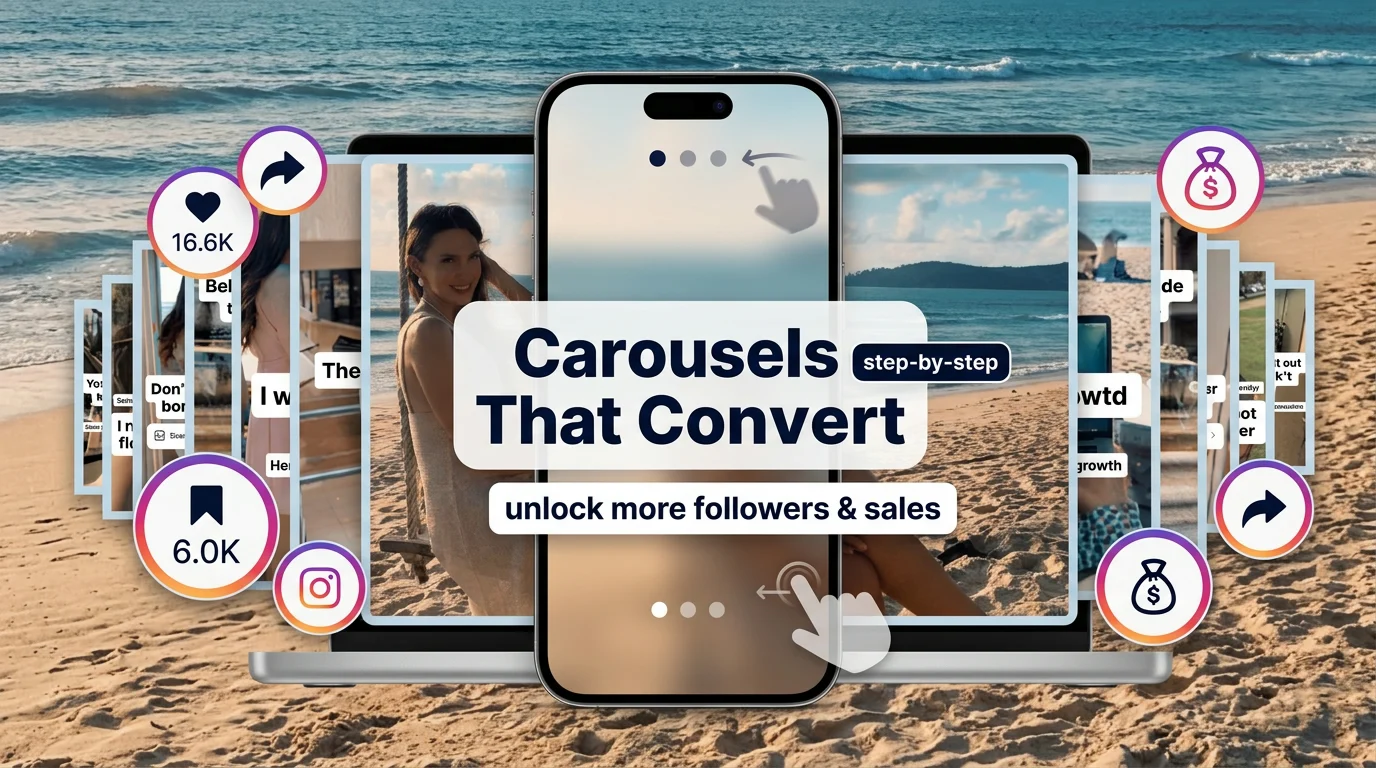
Carousels That Convert is a recorded Instagram carousel course by Maria Wendt for creators and small-business marketers who want to plan and build swipeable posts on a phone. It is aimed at people who need a repeatable route from hook and slide sequence to idea generation and repurposing, rather than advanced design software. Before judging any lesson, the useful question is whether each slide performs a distinct job.
A cover slide earns curiosity before it earns a swipe
A cover must identify the subject, make the benefit or tension concrete, and give the intended reader a reason to continue. Specificity beats inflated language. “Three places your tutorial loses beginners” establishes an audience and an information gap; “You need to see this” does neither. The cover also needs enough contrast and type size to remain legible on a small screen.
After the cover, each slide should answer one question while creating a natural reason for the next swipe. Remove repeated setup, keep one main point per frame, and use examples where an abstract claim would slow comprehension. The final slide should resolve the promise and present one call to action, such as saving the post, replying, or visiting a resource. Instagram’s official help page explains the mechanics of sharing multiple photos or videos, but it does not establish an algorithm formula or universal slide count.
Tutorials, stories, proof and promotion create different swipe expectations
Sequential teaching carousels break a task into ordered decisions. They suit processes and checklists, but become tedious when every slide merely restates the previous one.
Narrative carousels arrange a problem, complication, decision and consequence. They create momentum well, although a dramatic sequence without a useful conclusion can feel manipulative.
Proof-led case studies show an initial condition, intervention and observable change. They are useful for credibility, but require context and should not turn one example into a universal result.
Objection-handling carousels address misconceptions or buying resistance one point at a time. They work best when the objections come from real audience language rather than guesses.
Promotional carousels explain an offer, comparison or next step. Their weakness is premature pitching. Evidence is strongest for underlying practices such as clear hierarchy, coherent sequencing, concrete examples and matching a message to reader intent, not for branded formulas that claim automatic performance.
A rough slide sequence reveals more than polished screenshots
Before buying instruction, ask whether it teaches decisions or only supplies attractive examples. A useful program should demonstrate several cover alternatives, explain why slides appear in a particular order, distinguish carousel types by purpose, and show a complete build from blank screen to final call to action. It should also explain how ideas are captured from recurring audience questions, objections and mistakes instead of relying on inspiration.
Inspect the repurposing method carefully. Reusing one carousel should mean adapting its points into a reel outline, caption or email, not copying identical text everywhere. Check whether the teacher discusses editing, legibility and post-publication diagnosis. Treat unsupported performance language as promotion unless the seller supplies defined measures, baselines and time periods.
Maria Wendt’s phone-first sequence stops at curriculum evidence
Carousels That Convert follows a compact recorded route: phone-only tutorials inside the Instagram app, carousel packaging, two carousel types and guidance about when to use each, an idea-generation method, and repurposing. Maria Wendt also names a “Second Hook” and “Third Hook.” These are the course’s own terms, and the listing does not disclose enough to explain or independently assess them.
The bonus build-along shows her opening Instagram and constructing a carousel from scratch while the learner follows. That gives this Instagram carousel course a practical production component rather than leaving everything at theory. The other bonus presents a system for converting one carousel into content for additional formats. Nothing in the description indicates live teaching, personal feedback or community access.
The listing makes strong commercial performance claims, but provides no controlled comparison, defined baseline, attribution method or independent outcome data. Curriculum scope is visible; effectiveness is not. Any income or student-count figures encountered elsewhere would remain creator claims rather than verified facts. The product is also filed under AI and automation even though the description mentions no AI instruction.
The recorded build-along raises specific purchase questions
Is Carousels That Convert live or coached? The description presents recorded tutorials and a recorded follow-along build. It does not specify calls, critiques, private coaching or an active member group, so none should be assumed.
Do I need separate design software? The advertised workflow uses the Instagram app on a phone. The listing does not say whether it supplies editable templates, exported design assets or instruction for another design tool.
Does the course teach AI-assisted content creation? No AI component appears in the described curriculum, despite the category placement. Buy it for carousel planning and production, not for AI automation.
What exactly are the Second Hook and Third Hook? They are Maria Wendt’s labels for retention ideas taught inside the course. The public description does not define them, so any more detailed explanation would be speculation.
Publishing turns the build-along into a working practice
Results require more than completing the recording. You need a routine for collecting audience questions, drafting covers, checking whether every slide earns the next swipe, publishing consistently and comparing actual responses with the post’s intended job. Common failures include vague covers, interchangeable middle slides, several competing calls to action and repurposed material that ignores the new format.
If visual consistency is the main constraint, dedicated social-media design training may be a better choice.
If you do not yet understand your audience’s questions, compare a structured customer-research program instead.
If people consume posts but take no meaningful next step, landing-page copywriting training or email conversion training addresses a different bottleneck.
If your strategy depends mainly on spoken demonstrations, short-form video scripting training is more directly aligned. Choose Carousels That Convert when the phone-first workflow, proprietary hook concepts and recorded construction lesson match the precise skill you need to practise.