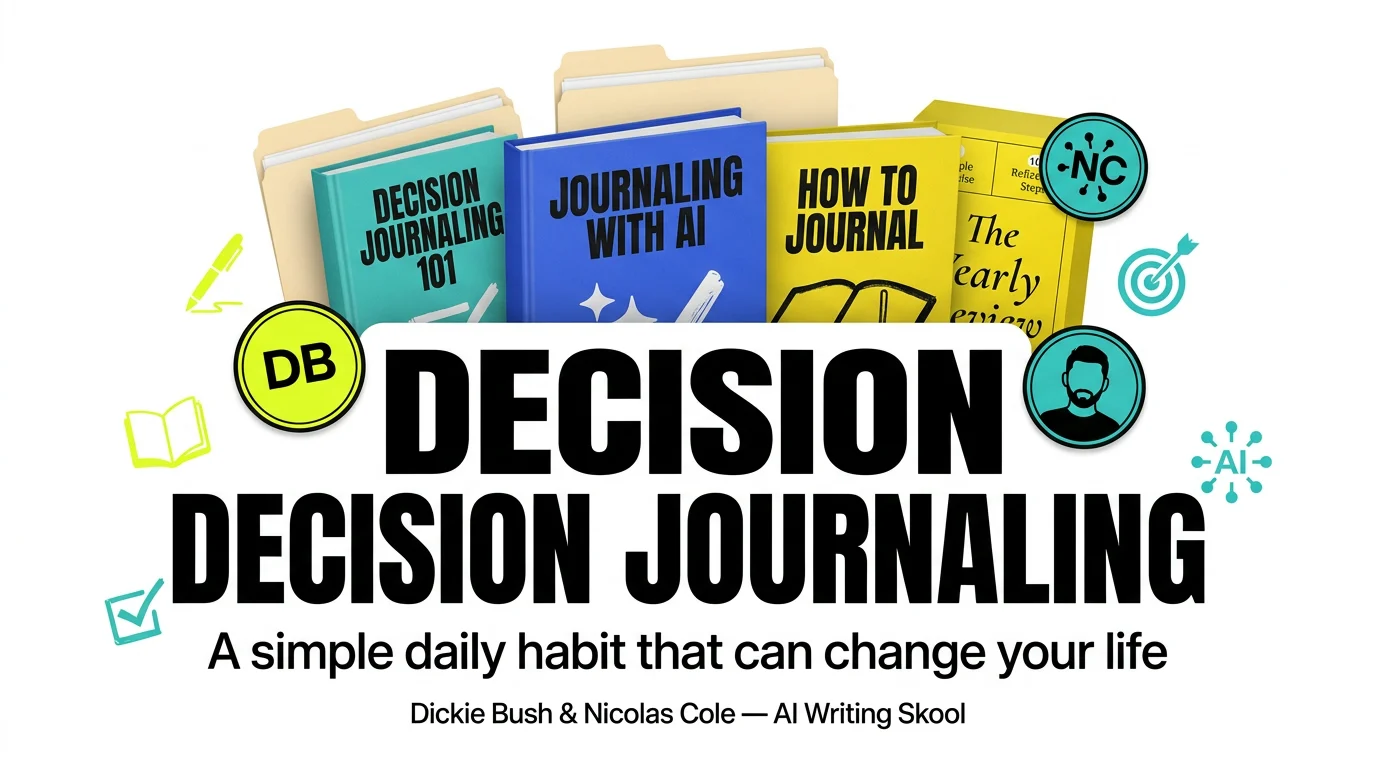
Decision Journaling + AI Writing Skool is a self-paced bundle of text and video lessons by Dickie Bush and Nicolas Cole for people who want a repeatable way to think through delayed or difficult choices. The supplied listing describes three mini-courses, two creator-process bonuses and a Skool discussion group; it does not describe a separate AI Writing Skool curriculum. That title gap matters before you buy.
The Decision Journaling Skool group is part of the delivery, but its activity depends on continued operation by the original provider. One-to-one access, weekly calls, community participation and personal feedback should not be assumed included. What clearly transfers is the recorded instruction, prompts, frameworks and examples named in the listing.
A written forecast survives the result
Before a decision, you know your assumptions, estimates and reasons for accepting one tradeoff over another. After the result, hindsight begins editing that memory. An outcome that worked can make weak reasoning look wise, while bad luck can make a sound process look foolish. A decision journaling entry preserves the information available at the time.
Write the choice, realistic alternatives, expected outcomes, confidence level, decisive assumptions, tolerable downside and review date. When that date arrives, compare the forecast with events before explaining the difference. The journal makes reasoning auditable. It cannot make a hard choice easy or ensure that the outcome will be good.
Reversibility changes how much analysis earns its keep
A two-way door is a choice that can be reversed at tolerable cost. It often deserves a small experiment, a deadline and an exit rule rather than prolonged analysis. A one-way door carries consequences that are difficult or expensive to undo, so it deserves stronger evidence, an explicit counterargument and safeguards.
The useful distinction is not between important and unimportant decisions. It is between recoverable error and durable exposure. Writing that distinction down prevents anxiety from giving every choice the same weight.
Free writing, premortems and scored forecasts solve different problems
Expressive writing helps people process experience and organize thoughts, although the APA coverage of expressive writing does not establish that writing reliably improves decision outcomes.
Structured decision journals preserve assumptions, forecasts and tradeoffs for later inspection. They create accountability, but only if entries are completed before outcomes are known.
Premortems and prospective hindsight ask how a proposed choice might fail. They expose neglected risks, though an undisciplined exercise can overweight vivid fears.
Decision matrices and multi-criteria decision analysis make competing criteria explicit. They help with complex comparisons, but arbitrary weights can create false precision.
Probabilistic forecasting and calibration practice attach confidence estimates to measurable events and score them later. Feedback can improve estimation, but many personal decisions do not produce clean, repeatable outcomes.
Red-team challenge and after-action review add opposing arguments and retrospective learning. Neither replaces a record created before the result.
A blank page exposes weak decision instruction
Before buying any program in this category, ask whether it gives you a reusable entry structure rather than inspiration alone. It should separate facts from assumptions, require alternatives, capture uncertainty and establish a review date. Look for worked examples that reveal imperfect reasoning, not just successful conclusions.
Check whether AI is used to question your thinking or merely produce confident answers. Confirm the delivery format, lesson depth, update policy and availability of feedback. Finally, test the method on a small reversible choice. If you cannot complete an entry and explain what will be reviewed later, the method is not yet operational.
Three mini-courses move from paper to an AI prompt
The bundle begins with Decision Journaling 101, covering six stated decision types, the one-way versus two-way-door distinction and a seven-step process. How To Journal then addresses the blank page, the creators’ preferred tool, decision-making as a skill and nine mental models associated in the listing with Jeff Bezos, Charlie Munger and others.
Journaling With AI presents AI as a thinking partner rather than a substitute for judgment. Its named components are a four-tool technology stack, two ways of using AI and a large reusable prompt. Separate bonuses show Bush’s morning routine, prompts and journal examples, plus Cole’s setup, frameworks and examples. The listing assigns the two different decision types: business, relationship and life for Bush, health, creative and business for Cole. This is a focused self-paced package, not evidence of a broader writing-school curriculum.
Clarity is supported more strongly than decision accuracy
The listing uses the creators’ phrases “Clarity Recession” and “self-trust” to frame the problem. Those are marketing concepts, not validated psychological measures. Research supports a narrower proposition: writing can help organize and process thought. Whether that produces better choices is harder to measure because luck, incomplete information and changing conditions affect outcomes.
The listing supplies curriculum claims and personal examples, not independent outcome evidence. Creator income, audience or student-count figures would remain seller claims rather than verification, and no such figure should determine the purchase.
The record improves only when the loop closes
Results require repeated entries, decisions made outside the lessons and scheduled comparisons between expectations and outcomes. Common failure points are writing after the fact, recording feelings without forecasts, asking AI to choose, and never revisiting the page. Pair the material with a calendar-based review habit and a simple log of recurring errors.
If your central problem is estimating uncertain events, you may be better served by dedicated probabilistic forecasting training.
If stakeholders keep discovering risks too late, compare structured premortem facilitation.
If the choice requires explicit tradeoffs across cost, time and risk, a a structured decision-making course may fit better.
High-stakes medical, legal, financial or mental-health decisions still require an appropriately qualified professional. A journal can organize the questions you bring to that person; it cannot replace their expertise.
Settle the delivery and community questions before you commit
Is a separate AI Writing Skool included? The supplied listing does not describe one, so request its curriculum and delivery terms rather than inferring them from the title.
How current is the AI section? The listing refers to a four-tool stack and a reusable prompt without naming the tools, and gives no update schedule for changing software.
Is the original group active? The value of peer discussion depends on present participation, moderation and continued access to the provider’s Skool space.
Can you inspect a complete entry before enrolling? A sample would show whether the seven-step process captures forecasts and tradeoffs or mainly supplies reflection prompts.
What support exists when the framework does not resolve a choice? The listing describes self-paced lessons and community discussions, not personal coaching. Get that boundary confirmed before treating community access as guided feedback.