
A small business becomes manageable when its recurring decisions stop living only in the owner’s head. A resource such as Business Blueprints should therefore be judged by whether it helps you connect strategy, execution, measurement, and improvement, not by how many diagrams or tactics it contains.
Why scattered tactics never become a business system
A useful operating system translates a goal into repeatable decisions: which customer to serve, what problem the offer solves, how prospects enter the pipeline, what moves them toward a purchase, and what content supports each stage. Those parts must share definitions and data. Otherwise, more activity simply creates more noise.
Start by mapping inputs, stages, owners, decision rules, outputs, and feedback loops. An offer needs evidence of demand and a clear promise of value. Lead flow needs defined sources and qualification criteria. A funnel needs measurable transitions rather than decorative pages. Content needs an audience, purpose, distribution route, and reuse process.
Documentation matters, but documents alone are not systems. A process becomes repeatable only when someone owns it, knows what triggers it, can see whether it worked, and can improve it without rebuilding everything. The US Small Business Administration’s planning guidance offers a useful baseline for connecting market analysis, organization, marketing, and financial planning.
The main ways businesses systemize offers, leads, funnels, and content
Process mapping and standard operating procedures turn recurring work into documented sequences with owners and quality checks. They are strong for consistency and delegation, but weak when teams document an untested process too early.
Customer discovery and lean experimentation use interviews, small tests, and observed behavior to refine an offer before scaling promotion. This family has strong support from established product development practice, although poor interview questions can produce flattering rather than useful answers.
Lifecycle funnel management defines stages from awareness through qualification, purchase, onboarding, and retention, then measures conversion and delay between stages. It exposes constraints well, but attribution can become misleading when several channels influence one decision.
Content operations and editorial systems connect customer questions to content briefs, production workflows, distribution, and repurposing. They improve consistency, yet publishing volume is not evidence that content reaches the right people or changes behavior.
CRM automation and lead nurturing use recorded interactions, segmentation, reminders, and triggered communication to reduce dropped follow-ups. Automation is valuable after the customer journey is understood; before that, it merely scales confusion.
Constraint management and continuous improvement focus attention on the current bottleneck, test one change, and compare results over time. Measurement and iterative testing have stronger foundations than platform-specific tricks, whose usefulness changes with algorithms and audience behavior.
How to recognize a program that can survive contact with reality
First, check whether the program defines its intended business stage, customer, assumptions, and required starting information. A universal roadmap often hides important differences between a local service, a consultancy, and a digital product.
Then inspect the path from instruction to output. Each module should help you produce something usable, such as an offer hypothesis, funnel map, qualification rule, content brief, operating procedure, or dashboard. Look for worked examples, decision criteria, dependencies between modules, and instructions for adapting the method. A rigid template is not automatically a system.
Finally, examine credibility and maintenance. Is the instructor named, and is relevant experience independently assessable? Are claims supported by transparent evidence? Does the material distinguish principles from temporary channel tactics? Check whether it teaches measurement, experimentation, ownership, and revision.
How Business Blueprints fits the operating-system landscape
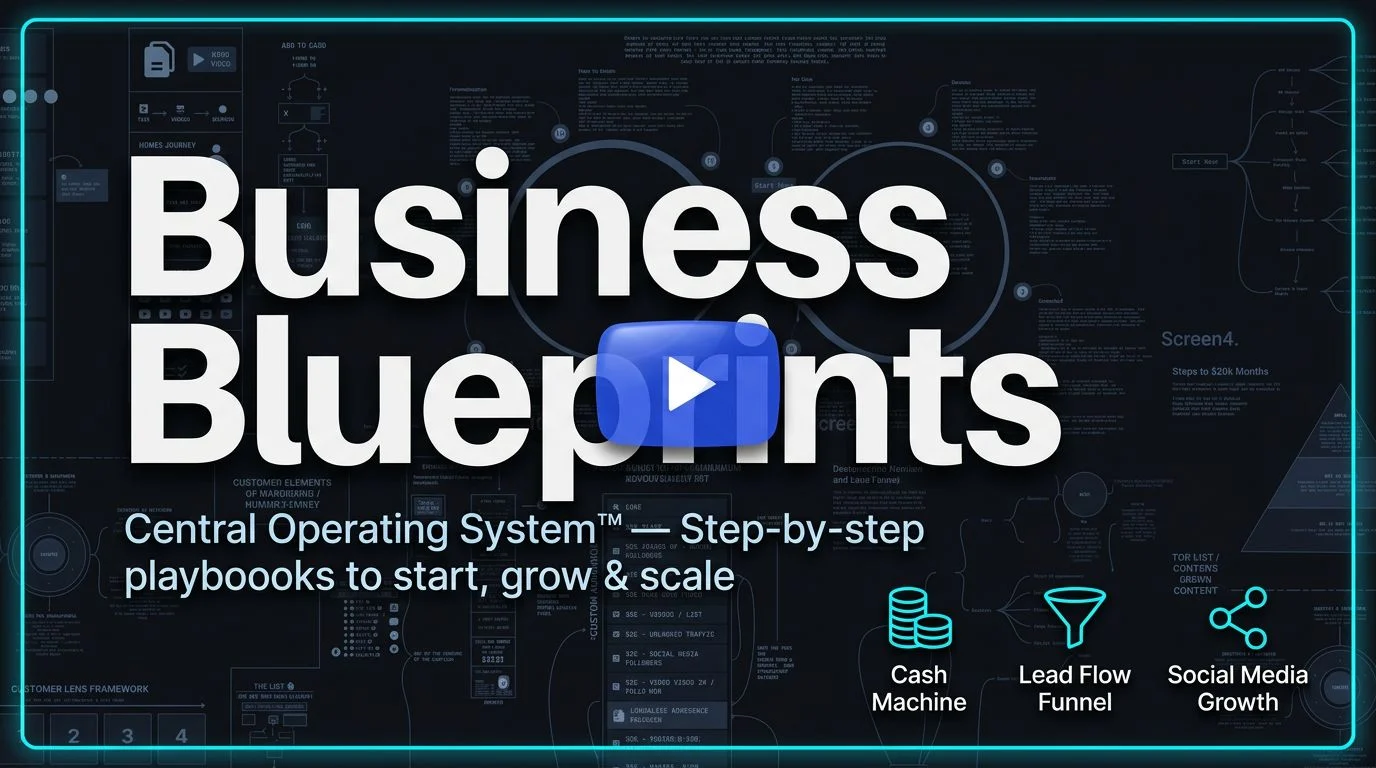
Business Blueprints is presented as a modular Central Operating System made from step-by-step guides. The named systems are Master Plan, Social Media Growth System, The Cash Machine, Lead Flow Funnel, Offer Stacking, The Sales Funnel, and The 10 Components of Content Creation. The source also refers to ten additional blueprint systems but does not specify their names or subjects.
That scope places the product in the broad business-planning, funnel-management, and content-operations family. Its apparent strength is coverage: the listed topics touch strategy, offers, acquisition, conversion, and publishing. The limitation is unknown depth.
It is therefore reasonable to view the collection as a potentially useful organizing map, not as demonstrated implementation support. Whether it creates a working operating system depends on the actual decision rules and feedback loops inside the guides, details the available listing does not establish.
Evidence, authorship, and the limits of the available claims
The source describes its strategies as proven, but it supplies no cited studies, transparent case evidence, comparison data, or measurable validation. Independent research found only file-sharing and download-forum listings, not an identifiable official product site.
For Business Blueprints, the central credibility problem is anonymity. No creator, instructor, or company is named, so there is no verifiable track record and no practical way to assess the authority behind the frameworks. That absence does not prove the material is ineffective, but it shifts the burden to the buyer to inspect samples and validate each recommendation independently.
The Cash Machine and Master Plan should be understood strictly as system names supplied by the source. They are not evidence of results or outcome forecasts.
What turns a blueprint into sustained execution
Expect to spend time mapping the current process, interviewing customers, defining stage criteria, assigning owners, configuring tools, and collecting enough consistent data to identify a bottleneck. A blueprint cannot supply your market knowledge.
If you still lack evidence that customers value the offer, choose customer discovery interviewing and value proposition testing before a broad operating-system course.
If qualified conversations are the immediate constraint, you may be better served by dedicated cold-outreach training.
If trust-based introductions fit your market, compare a structured referral system coaching program.
If leads already exist but records and follow-ups are unreliable, consider hands-on CRM implementation training.
If you cannot interpret conversion data confidently, pair any blueprint collection with practical marketing analytics training. Choose something else entirely when you need live diagnosis, industry-specific compliance, technical configuration, or accountable coaching rather than general frameworks.
Practical questions to answer before choosing a blueprint collection
What should you systemize first?
Choose the recurring process whose failure most directly restricts customer value or qualified demand. Fixing the bottleneck produces more insight than documenting every task at once.
How do you know whether a funnel is working?
Define each stage, its entry condition, its exit condition, conversion rate, elapsed time, and common loss reason. Traffic alone cannot reveal where the process breaks.
Can templates replace coaching or specialist help?
Templates accelerate structure, but they cannot observe your calls, diagnose positioning, configure tools, or interpret ambiguous customer evidence. Complex or regulated businesses may need expert support.
What evidence should you request from an anonymous program?
Ask for representative pages, worked examples, module relationships, publication dates, update practices, and the basis for major claims. If authorship remains undisclosed, assess every framework on its logic, sources, and testability rather than borrowed authority.