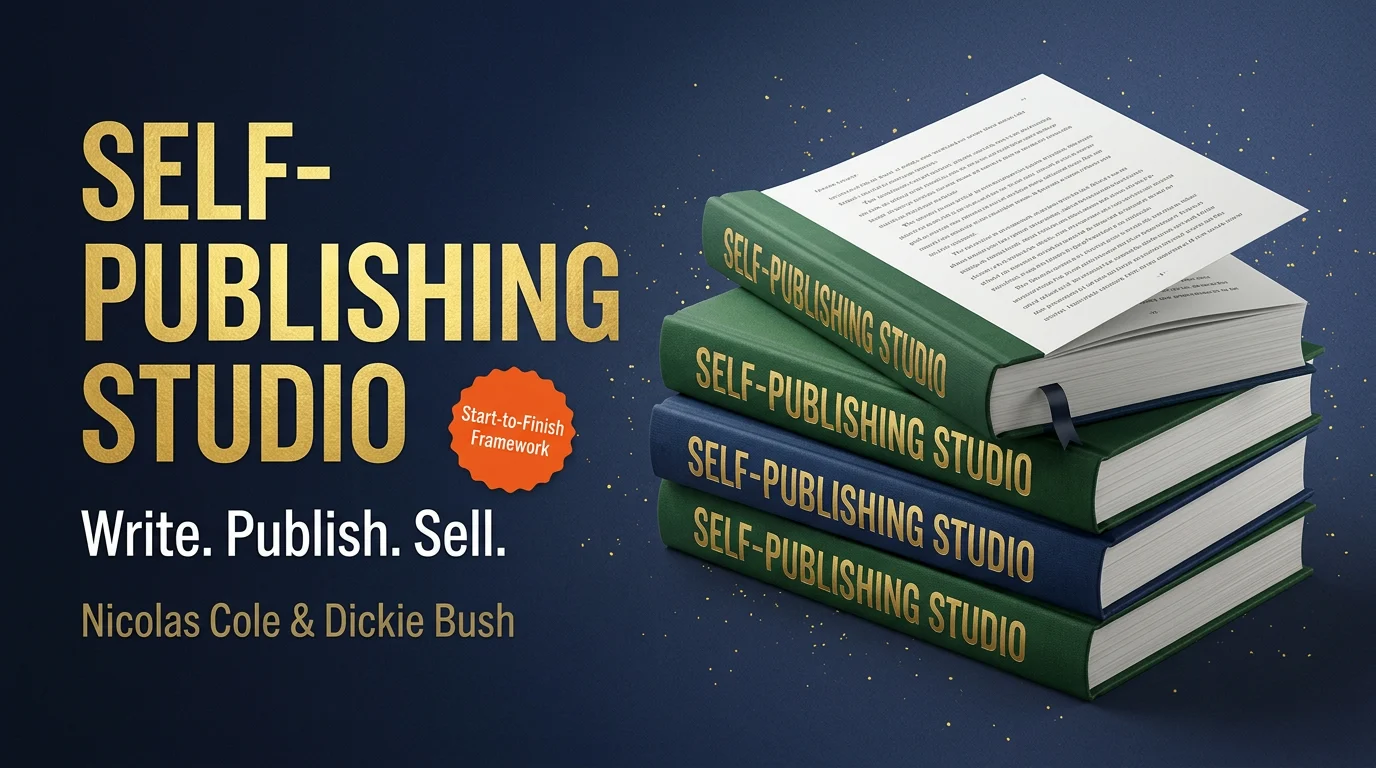
Self-Publishing Studio groups Nicolas Cole and Dickie Bush’s non-fiction book process into three mini-courses plus an indie-versus-traditional publishing lesson. It is for writers who want one route from manuscript planning through Amazon publication and post-launch marketing. The useful question is whether that route addresses your present bottleneck and supplies enough practice to move a real book forward.
A publishing route decides who carries the risk
A traditional deal usually transfers production costs and much operational responsibility to a publisher, but acquisition takes time and the author gives up some control over schedule, packaging and rights. In self-publishing, the author controls the timetable and creative decisions while paying for or personally managing editing, design, production and marketing. Neither path removes uncertainty. The choice should reflect the book’s purpose, the author’s audience, the value of speed and control, and the rights worth retaining.
A clear reader promise shapes the outline and the Amazon listing
A useful non-fiction title identifies a recognisable reader problem and signals the promised territory without claiming more than the manuscript delivers. The outline then turns that promise into a sequence: establish the problem, supply a model, demonstrate its use and help the reader act. Every chapter needs a distinct job. Repeated ideas disguised as extra chapters weaken the book.
On Amazon, categories and search language help the retailer understand where a book belongs, while the description helps an interested visitor decide whether it is relevant. Pricing must account for format, comparable books, positioning and the author’s broader objective. Platform rules change, so avoid building the entire plan around a temporary setting. Launch day creates attention, not durable demand. Evergreen marketing continues through useful excerpts, an email list, interviews, partnerships, reader recommendations and connections between the book and the author’s ongoing work.
Independent publication contains several different disciplines
Traditional publishing development is strongest when an author wants an acquiring team, bookstore distribution and institutional support, but selection is competitive and the timeline and creative decisions are shared.
Direct self-publishing gives the author control over production and release, but it also makes the author responsible for hiring, quality control and commercial decisions. Its evidence comes from finished samples, comparable-title research and observed reader response, not motivational claims.
Assisted self-publishing and hybrid publishing provide paid production support. They can reduce operational work, yet service quality, rights terms and distribution claims vary sharply, so contracts and previous books deserve close inspection.
Audience-first publishing develops ideas through newsletters, articles or serialised drafts before assembling a manuscript. Reader replies and engagement can expose confusing ideas, although popularity of a short post does not prove that a full book works.
Launch-centred marketing concentrates interviews, partnerships and email activity around release. Evergreen author-platform building uses searchable essays, newsletters, speaking and backlist connections over a longer period; it compounds slowly but is less dependent on one promotional week.
A sample chapter exposes more than a long syllabus
Before buying any book-publishing program, ask what you must produce while learning. A strong curriculum should lead to a reader definition, title options, an argument map, a chapter outline, revised pages, production specifications, metadata decisions and a marketing calendar. Inspect whether examples show the reasoning behind decisions or merely provide templates to copy.
Check how the program separates drafting from editing, and whether it addresses developmental editing, copyediting, proofreading and cover or interior quality. Determine whether Amazon instructions are dated and maintained. Ask who provides feedback, what qualifies that person, and whether feedback is included or merely implied. Confirm the delivery format, lesson length, update policy and any tools required. Finally, distinguish evidence that lessons exist from evidence that learners complete sound manuscripts; testimonials and creator results cannot make that substitution.
Three mini-courses define the Self-Publishing Studio sequence
The Self-Publishing Studio curriculum begins with Manuscript OS, described as a system for developing a non-fiction title, constructing an outline and writing clear, useful chapters. Self-Publishing Empire then covers formatting, uploading and publishing on Amazon, including category research, the book description and pricing for book, eBook and audiobook formats. Book Launch Blueprint addresses an evergreen launch and marketing strategy. The named bonus, Indie vs. Traditional Crash Course, compares the two publishing paths through money, timeline and creative control. That sequence is coherent: decision, manuscript, production and marketing.
Lesson format and creator claims are left undocumented
The sequence is not fully documented. The listing does not specify lesson length, video or text delivery, assignments, editorial feedback, publication date or update schedule. It names a bonus library but itemises only the crash course. Nothing listed establishes live coaching, community access or manuscript critique.
The listing also speaks in a singular first-person voice despite naming two creators. Its statement about experience across more than ten books therefore cannot be confidently assigned to either creator. Creator-reported experience and commercial results are promotional claims, not independent evidence of student outcomes. No official course page was found in the supplied research, so the available description establishes scope more clearly than effectiveness.
Format gaps change the purchasing decision
Is Self-Publishing Studio a live cohort? Nothing in the listing describes scheduled sessions, a cohort, personal coaching or ongoing community participation. Buy on the basis of the named curriculum only unless the original provider confirms otherwise.
Will someone critique my title, outline or manuscript? The description does not specify feedback or editing. Writers who need diagnosis rather than instruction should establish whether any human critique is included.
Does the course teach audiobook production? It explicitly mentions pricing an audiobook, but it does not claim to teach narration, recording, mastering or distribution. Do not expand one pricing topic into an assumed production module.
Is this an AI publishing course? No. The supplied draft’s AI and automation category conflicts with the stated curriculum, which concerns writing, Amazon publication, launch planning and the traditional-versus-independent decision.
A finished manuscript still needs specialists and repetition
Results require sustained drafting, revision, production checks and marketing after release. Common failures include choosing a title before identifying the reader, expanding a weak premise into too many chapters, treating formatting as editing, selecting categories without comparable-title research and abandoning promotion after launch week. A recorded framework cannot perform those decisions for you.
If the argument or chapter structure remains weak, a developmental editing workshop may be more useful than another publishing overview. If you primarily want an agent and publishing deal, compare traditional book proposal and query training. If discovery is the constraint, dedicated Amazon metadata and category research training offers a narrower intervention. If no audience exists yet, an author newsletter and platform-building program addresses the work that precedes evergreen marketing.
Pair the curriculum with independent editing, careful proofreading and current platform documentation. Set weekly manuscript and marketing outputs, then inspect what changed. Self-Publishing Studio appears best suited to a self-directed writer seeking a connected process; it is a weaker choice for someone expecting live accountability, detailed audiobook production or verified editorial supervision.