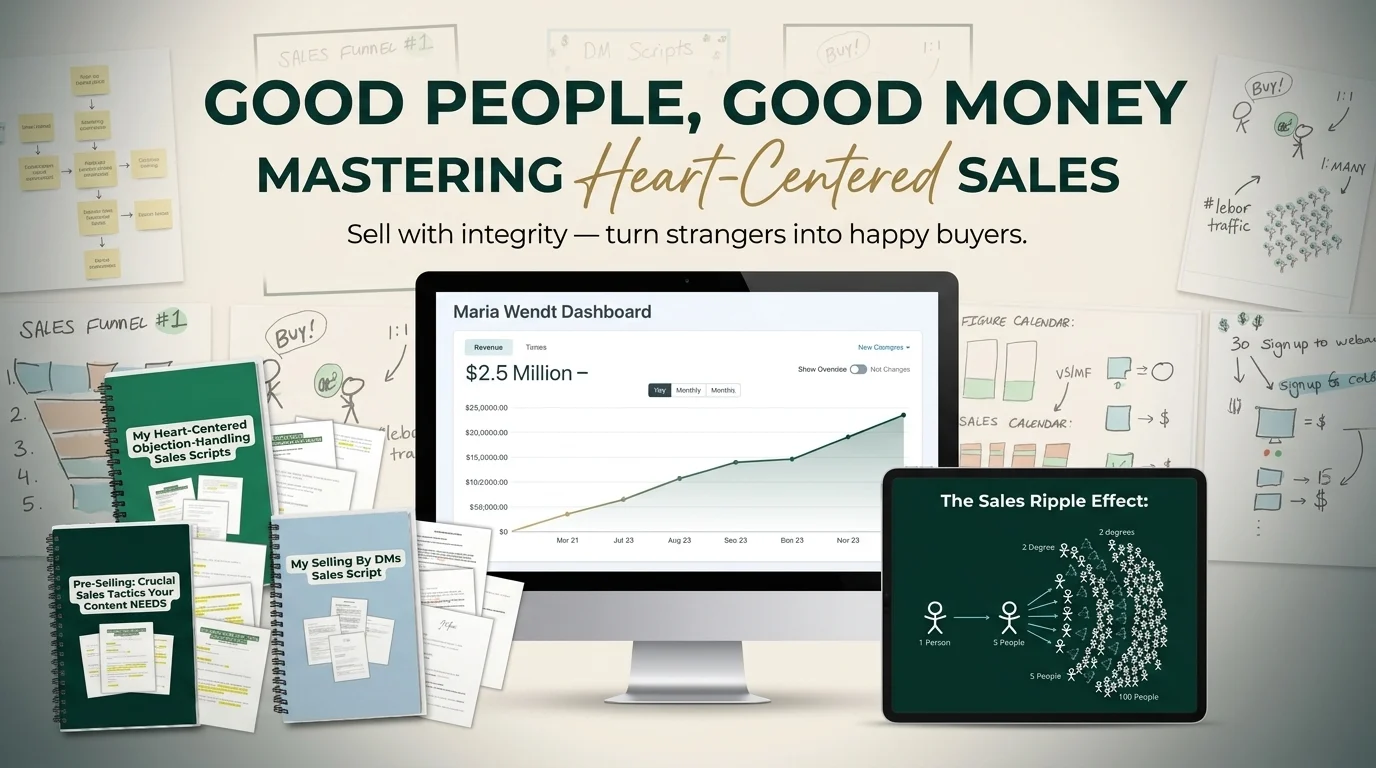
Good People, Good Money is a recorded sales training program from Maria Wendt about selling without feeling pushy, awkward or sleazy. The Maria Wendt sales course focuses on sales mindset, content-led pre-selling, objection handling and choosing a conversion channel. The useful starting point, however, is understanding what ethical selling requires before judging whether Heart-Centered Sales teaches it well.
When helping turns into pressure
People often feel pushy because they treat selling as an attempt to obtain a yes. A healthier frame is to diagnose a real problem, explain a suitable option and let the buyer retain control. Helping does not mean assuming everyone needs the offer. It means making the decision clearer, including when the answer should be no.
Content can pre-sell by answering questions that otherwise surface at the decision point. Useful examples clarify the problem, show who an approach suits, explain its limits and correct mistaken expectations. This lowers resistance through understanding, not manufactured excitement.
Money, timing, wanting to think, and believing you can do it alone are four recurring objections. Respond calmly by clarifying what the person means, answering the underlying uncertainty and allowing space. Honest urgency points to a real deadline, expiring bonus or genuine capacity limit. A fabricated countdown or invented shortage is a dark pattern, not ethical persuasion.
Calls, webinars, inbox conversations and pages solve different sales problems
Consultative sales calls suit complex or higher-priced offers where buyers need diagnosis and two-way clarification. They provide rich feedback but require time, listening skill and consistent follow-up.
Webinar selling combines teaching with a structured offer and can address many people at once. It works best with an established audience and a clear presentation, but weak attendance or an unfocused offer quickly undermines it.
Conversational selling through DMs supports personal questions and asynchronous follow-up. It can feel accessible, yet it becomes labor-intensive and intrusive when messages are unsolicited or scripted without regard for context.
Direct-response landing pages give every visitor the same explanation and suit offers that can be understood without a conversation. They scale efficiently, but only after the positioning, traffic quality and page testing are sound. Content-led pre-selling can support all four channels by resolving predictable uncertainty before the pitch.
A sales curriculum should survive a real buyer conversation
Before buying any ethical-sales program, inspect what it asks you to do when a prospect hesitates. Strong instruction teaches diagnosis, permission, truthful claims and a graceful no. Weak instruction merely supplies lines designed to overpower resistance.
Look for complete examples, practice exercises and decision criteria for choosing a channel. Check whether scripts explain their purpose, whether urgency depends on a genuine constraint, and whether the material distinguishes follow-up from pressure. Ask what happens when the offer is unsuitable.
Finally, separate teaching assets from outcome claims. A script, quiz or page framework can demonstrate scope, but it cannot establish that students will sell more. Credible training also identifies dependencies such as offer quality, audience trust, traffic, rehearsal and measurement.
Heart-Centered Sales connects mindset with four conversion mechanisms
The curriculum presents ten numbered modules, although the listing displays them out of order. Its instructional path moves from reframing pitching and rejection into pre-selling through content, then across the Core 4 Conversion Mechanisms: sales calls, webinars, DMs and landing pages. A later ethics module emphasizes reputation, truthful promises and remembering the person receiving the message.
Maria Wendt supplies call scripts, DM follow-up language and a Conversion Mechanism Decision Quiz for each channel. The DM material attributes the sell-by-chat strategy to her mentor, Taki Moore. The landing-page material introduces an 11-part structure and worked page breakdowns.
The listing separately identifies nine ethical urgency angles and three urgency angles for higher-consideration calls. Those should not be collapsed into one promise. Its strongest verifiable evidence is therefore curricular specificity: scripts, channel comparisons, objection lessons and examples. It does not establish improved sales performance.
The promotional language attached to Heart-Centered Sales includes creator results, but creator income and student-count claims remain the creator’s own claims rather than independently verified facts. No live teaching, personal feedback or active community is listed. Buyers should treat this as recorded instruction unless the original provider confirms otherwise.
The recorded format raises decisions the listing does not settle
Is Heart-Centered Sales a live coaching program? The description presents recorded modules and does not specify live calls, individual feedback or community support. Do not assume those services accompany the recordings.
Does it teach all four sales channels equally? Each mechanism receives dedicated material, but the listing gives landing pages and channel-specific tactics substantial detail. It does not provide lesson durations, so equal depth cannot be confirmed.
Are practical tools included? The description names sales-call scripts, DM scripts, follow-up approaches, voice-memo guidance and conversion-mechanism quizzes. It does not specify downloadable formats or whether templates are updated.
How current is the platform guidance? Recording dates and an update schedule are not stated. That matters most for Instagram automation, advertising-related landing-page tactics and other platform-dependent practices.
Execution begins after the script is chosen
This program is most plausible for someone with an existing offer and at least one audience channel who needs a calmer sales framework. Expect to rewrite scripts in your own voice, practice calls, audit old conversations, publish objection-answering content and test one mechanism long enough to learn from it.
If customers do not understand the offer itself, you may be better served by dedicated offer-positioning training. If warm introductions are the main source of business, compare a structured referral coaching program. If the immediate need is systematic prospecting beyond an existing audience, choose dedicated cold-outreach training. Someone who needs observed practice and correction should consider live sales role-play coaching instead of relying only on recordings.
Common failure points are copying Maria Wendt’s phrasing too literally, deploying every channel at once, or treating urgency as a substitute for relevance. Pair the lessons with customer interviews, a simple call-review routine and channel-level measurement. Ethical language helps, but the offer must still solve a problem people recognize.