
30MPC Leadership Course is a sales-management program built around systems the listing says Mark Kosoglow used to lead Outreach. It is for leaders who want one operating model for process definition, forecasting, rep coaching, hiring, and onboarding. The useful question is whether those parts can become a management routine your team will actually adopt.
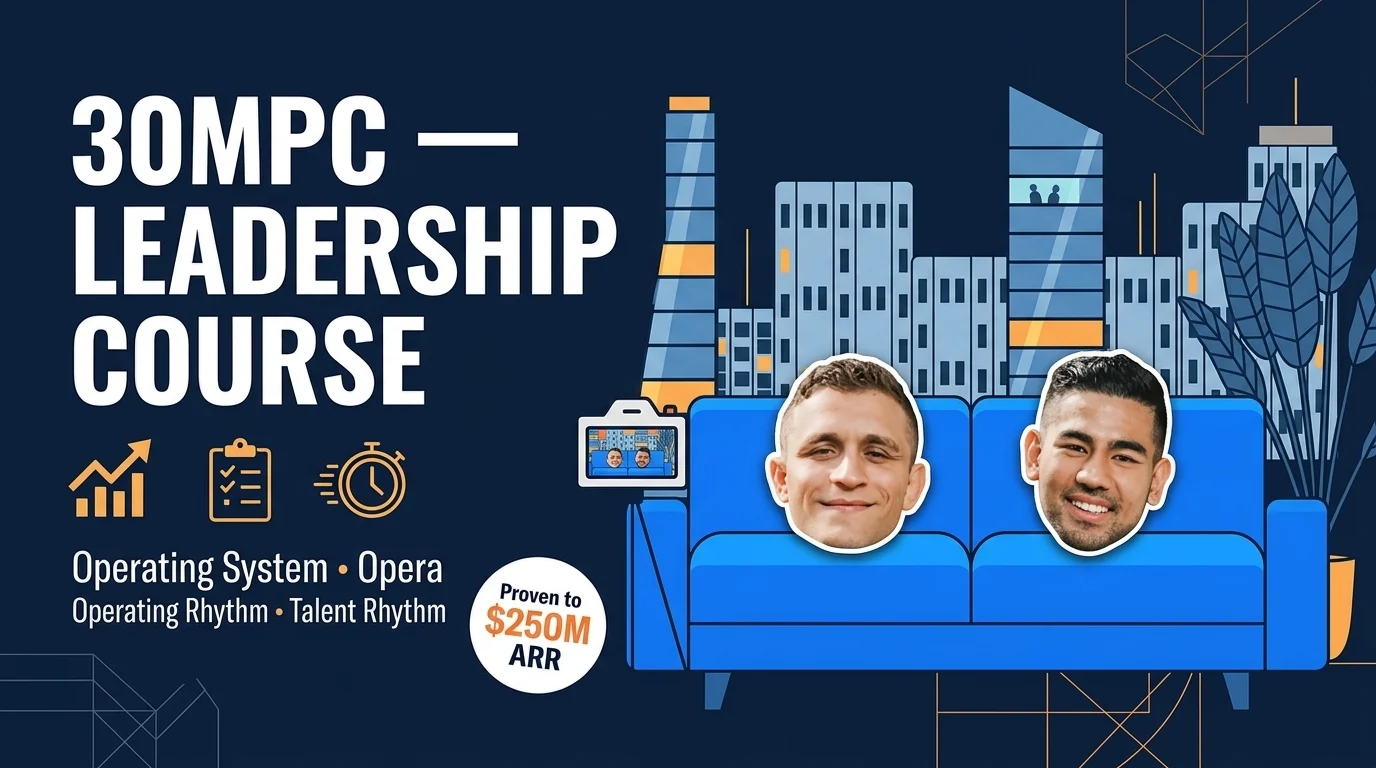
The listing names only two provider services: tailored playbooks spanning cold call scripts through discovery frameworks, and quarterly sprints focused on one skill plus coaching plans and scorecards. The portable layer is the disclosed frameworks and templates. Because the format is not identified as live, video, or self-paced, any additional access or support is unconfirmed and should not be assumed included.
Forecast confidence begins at the stage boundary
A forecast is not a manager’s opinion about whether a deal feels healthy. It is an aggregation of evidence. A documented sales process therefore needs observable entry and exit criteria for each stage, such as a confirmed problem, access to the decision process, or an agreed next action. Managers can then inspect stage age, conversion, deal movement, and missing evidence instead of negotiating confidence percentages with reps. The Baldrige performance excellence framework likewise treats measurement, workforce, operations, and results as a connected system. Definitions matter because ambiguous stages make both coaching and forecasting unreliable.
Weekly coaching turns the process into behavior
Documentation establishes the expected path, but repetition determines whether people follow it. A useful weekly coaching rhythm for sales team leaders separates pipeline inspection, deal diagnosis, skill practice, and performance support. Managers should diagnose one observable behavior, rehearse it, agree on an action, and inspect that action later. Team meetings can align priorities, while individual coaching addresses a rep’s specific gap. Adoption is the constraint: if managers tolerate different stage meanings or coach entirely from instinct, the written system quickly becomes administrative decoration.
Process, coaching, forecasting, and hiring solve different failures
Process-based sales management standardizes stages, required evidence, and handoffs; it improves consistency but can become bureaucracy when every exception needs approval. Methodology-led selling gives reps shared language for discovery, qualification, or negotiation; its value depends on fit with the sale and reinforcement after training. Forecast governance combines stage evidence, historical conversion, deal inspection, and data hygiene; it is stronger than intuition but only as reliable as CRM behavior. Performance coaching uses observation, practice, feedback, and follow-up; deliberate practice has better support than motivational meetings alone. Structured interviewing asks candidates consistent, job-relevant questions and scores evidence against defined traits; research generally favors this over unstructured conversation. Rep-profile hiring models successful behaviors from strong performers, but copying one star too literally can preserve accidental traits and reduce adaptability.
A serious program should expose its operating artifacts
Before buying, ask to see how the program defines stage exits, turns those definitions into a forecast, and connects deal inspection to coaching. Check whether it supplies editable scorecards, interview rubrics, meeting agendas, and onboarding checkpoints rather than explanations alone. Look for practice, feedback, and follow-up over several cycles. Confirm who updates the material, what delivery format is used, and which services are actually included. Finally, ask how the system handles exceptions: a framework that works only when every deal resembles the example is not an operating system.
Three rhythms organize the 30MPC curriculum
The 30MPC Leadership Course places its material under the Operating System, Operating Rhythm, and Talent Rhythm. The listing attributes the underlying systems to frameworks Mark Kosoglow used to lead Outreach; it does not establish that he authored every component or that Outreach produces or endorses the course. The operating material names the 5-Stage Sales Process, Forecasting System, Deal Review Framework, and Keep-It-Simple AE Prospecting. The coaching layer includes the Rep Enablement Matrix, 1:1s as a management practice, a 6-Part Team Meeting, and Metrics Machine. Hiring and ramping use the Ideal Rep Profile, Traits-Based Interview Framework, and an onboarding programme. This makes the Mark Kosoglow leadership course broad across the manager’s week, although the listing does not show how deeply each framework is taught.
Curriculum architecture is not outcome evidence
For the 30MPC Leadership Course, the listing establishes named frameworks and a coherent management model, not independent proof that another team will reproduce the seller’s results. It supplies no comparative study, audited learner outcomes, or sample showing improvement before and after adoption. Business-growth claims belong to the seller’s account of prior experience and should not be treated as predicted results. Any creator income or student-count figures associated with an offer are creator claims, not independent verification. The fairest evidence test is whether a buyer can inspect the artifacts, apply them consistently, and measure changed behavior over time.
Adoption fails when managers coach outside the system
Results require managers to define stages, clean existing pipeline data, run the same inspection rhythm, practice coaching, and revise hiring criteria as evidence accumulates. Common failure points include importing templates without adapting them to the sales motion, measuring activity without quality, and modeling a top rep whose territory or experience is unusual. The 30MPC sales leadership model also spans enough functions that ownership must be explicit.
A team whose immediate problem is insufficient prospecting may be better served by dedicated cold-outreach training. A company with inconsistent CRM records should choose sales-data hygiene and forecast-operations training first. A manager making costly hiring errors could compare a structured interviewing program instead. Teams lacking basic manager skills may need frontline management coaching before installing a full operating system.
Delivery details still control the purchase
Before buying the 30MPC Leadership Course, ask: Is the curriculum delivered live, by video, or through another format? The listing does not say. Who performs the tailored playbook work, what company inputs are required, and what final artifact is supplied? Those details are unstated. How are quarterly sprints scheduled, facilitated, and measured? Only their skill, coaching-plan, and scorecard focus is described. Are the named templates editable, and how long can participants use the materials? The listing leaves that open. Until the provider answers, evaluate this as a clearly named curriculum plus two disclosed services, not as an assumed coaching environment.