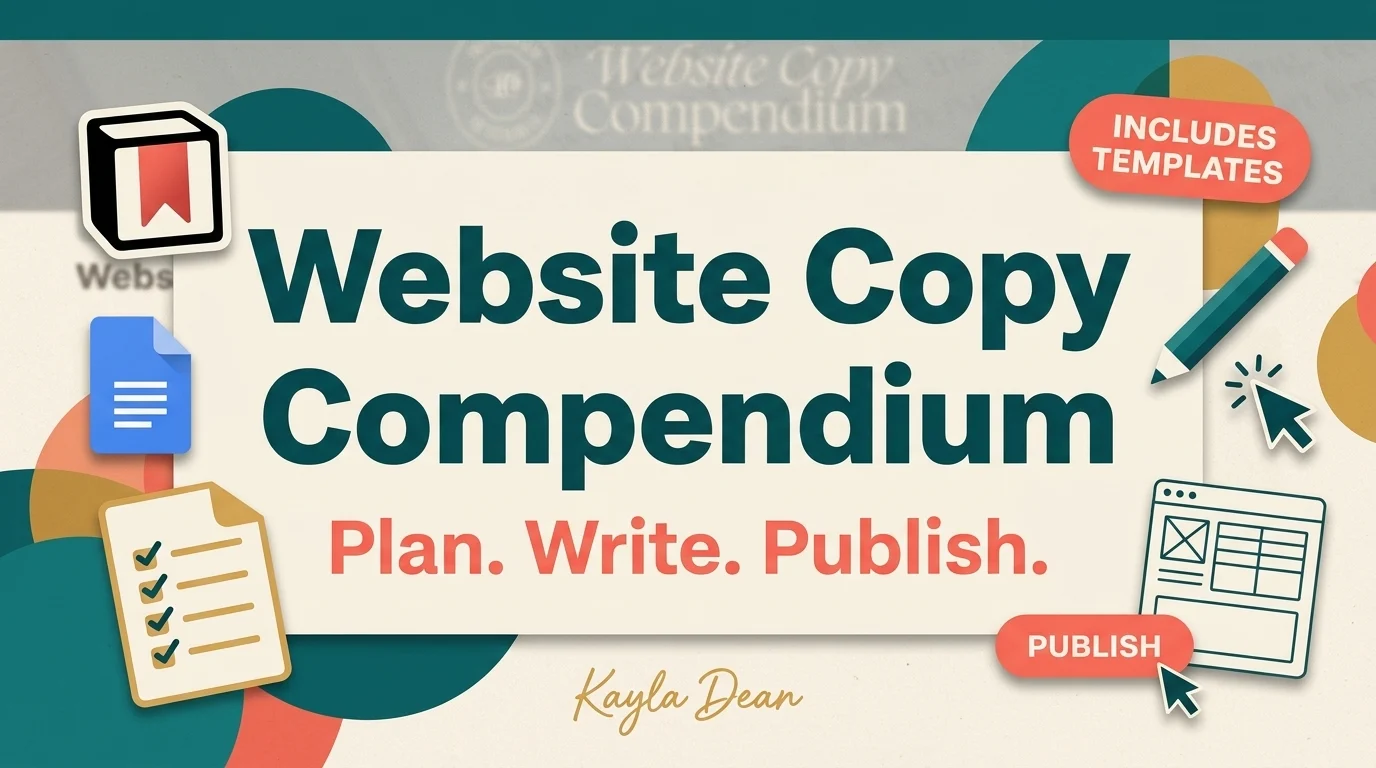
Website Copy Compendium is Kayla Dean’s guided workspace for drafting service-business website copy in Notion and an editable Google Docs template. It is aimed at owners and writers who know their offers but need help turning them into pages, proof, headlines and calls to action. Its value depends on whether that guidance matches the work a website actually requires.
Site maps follow visitor choices, not company departments
Start by asking what a visitor must understand and choose. A small service business commonly needs a home page that establishes relevance, an about page that builds trust, an offer page that explains the work, and a contact path. Separate service pages become useful when offers have distinct buyers, problems or buying processes. They create clutter when they merely repeat the same promise under new names. Sketch the route from arrival to next action, then give each page one primary responsibility. Navigation labels need to describe destinations plainly. A clever label that conceals an offer makes the visitor interpret the menu before considering the service.
An offer page needs settled facts before polished sentences
Writing becomes easier after you can state who the offer serves, the situation that brings that person to the page, the result being pursued, what the engagement includes and what happens next. Uncertainty about those facts cannot be repaired with lively adjectives. Frame the offer around the reader’s decision: establish the problem in recognisable language, explain the approach, define the scope, answer material objections and supply relevant proof. Keep claims proportional to what the business can demonstrate. A call to action then names a real next step, such as viewing availability or submitting a project brief, rather than applying pressure with vague urgency.
One testimonial earns one focused job
A long testimonial often mixes the client’s starting point, working experience, outcome and praise. Choose the part that supports the claim beside it. Preserve the speaker’s meaning, remove repetition and keep enough context to make the result intelligible. Do not combine fragments into a stronger claim than the client made. The finished soundbite might demonstrate a specific outcome, clarify how collaboration felt or answer an objection, but it rarely does all three well. Keep the original message and approval record. That makes later verification possible and guards against editing a warm compliment into an unsupported promise.
Voice, headings and calls to action survive separate editing passes
Set a few usable voice boundaries: preferred vocabulary, unwanted expressions, sentence rhythm and the degree of formality. Then draft for meaning before tuning the personality. Headings must tell readers what each section contains; the W3C headings tutorial explains their role in organising pages and supporting navigation. Header levels are structural and accessibility tools here, not a ranking tactic. Edit in passes so competing tasks do not blur together: first inspect the argument and order, then remove repetition, align the voice, and finally proofread. Check every button separately. Its label, surrounding sentence and destination must describe the same action.
Kayla Dean’s Notion dashboard mirrors the writing sequence
Website Copy Compendium follows five listed steps: page planning, offer structure, testimonial curation, a brand voice cheatsheet and writing. The Notion dashboard contains guides for offer messaging, page planning, brand voice, headlines, testimonials, examples from the creator’s client projects and copy editing. An editable website copy template in Google Docs adds section-by-section commentary, suggested CTA locations, destination guidance, header-tag placement and more than 108 writing prompts. Buyers therefore need usable Notion and Google accounts. The listing describes Dean as a copywriter and messaging strategist with more than seven years of experience, but it names no live calls, personal feedback or ongoing community.
Page planning and testimonial curation receive the clearest treatment
Within Website Copy Compendium, the early workflow is covered most concretely. The page planner recommends pages to include or omit, while the offer messaging guide supplies questions for each offer and discusses obtaining customer language. Testimonial curation directly addresses shortening a wordy statement into focused praise. Headline support is also unusually specific: more than 33 formats, seven dedicated prompts and four polishing filters. Brand voice receives dropdowns and prompts, which can establish a useful cheatsheet but cannot replace listening to real customers. A writer who wants more practice giving sentences a distinct personality can add focused training in writing with personality. The listing names four editing passes without identifying what each pass examines, so the depth of that final stage remains unclear. Eleven journaling prompts and advice about later updates extend the drafting process.
Templates stop at research, implementation and measurement
This is a writing system, not a complete website project. It does not specify customer interviews, usability testing, analytics, content migration, visual design or building pages inside a content-management platform. It also provides recommended header-tag locations without establishing broader accessibility or technical SEO instruction. A writer who wants a second, step-by-step treatment of the same page-by-page task can compare a website copywriting course.
If your offers are still based on assumptions, voice-of-customer interviewing training addresses the research gap more directly. If the copy is finished but the site remains unbuilt, WordPress or Webflow implementation training matches that next constraint. If organic search is the central acquisition goal, keyword research and search-intent training goes further than suggested header placement. No template can promise enquiries or bookings; the final wording, factual support, publication and testing remain the buyer’s responsibility.
Your first week turns one offer into a working page
Begin with one service rather than filling every resource. On the first day, map the visitor’s route and assign each page a job. Next, answer the offer questions in plain language, then select one testimonial excerpt that substantiates a nearby point. Draft the page without polishing each sentence as you go. Use the voice rules, headline filters and editing passes only after the argument is complete, then inspect every CTA destination and heading level.
With Website Copy Compendium, record those choices in its dashboard and move the draft into its Google Docs structure. Without it, a simple document with the same stages is enough. By week’s end, aim for one accurate page ready to build and test, plus a short list of unanswered claims that require customer research.