
AI CMO is a DTC AI community presented by Jordan Bazouzi for e-commerce brands, DTC marketers, media buyers and agency owners who want brand, creative production and conversion decisions treated as one workflow. It is most relevant when you already have a product, audience, campaign or client account on which to apply those decisions. The useful question is not how much content a model can make, but which commercial constraints make that content usable.
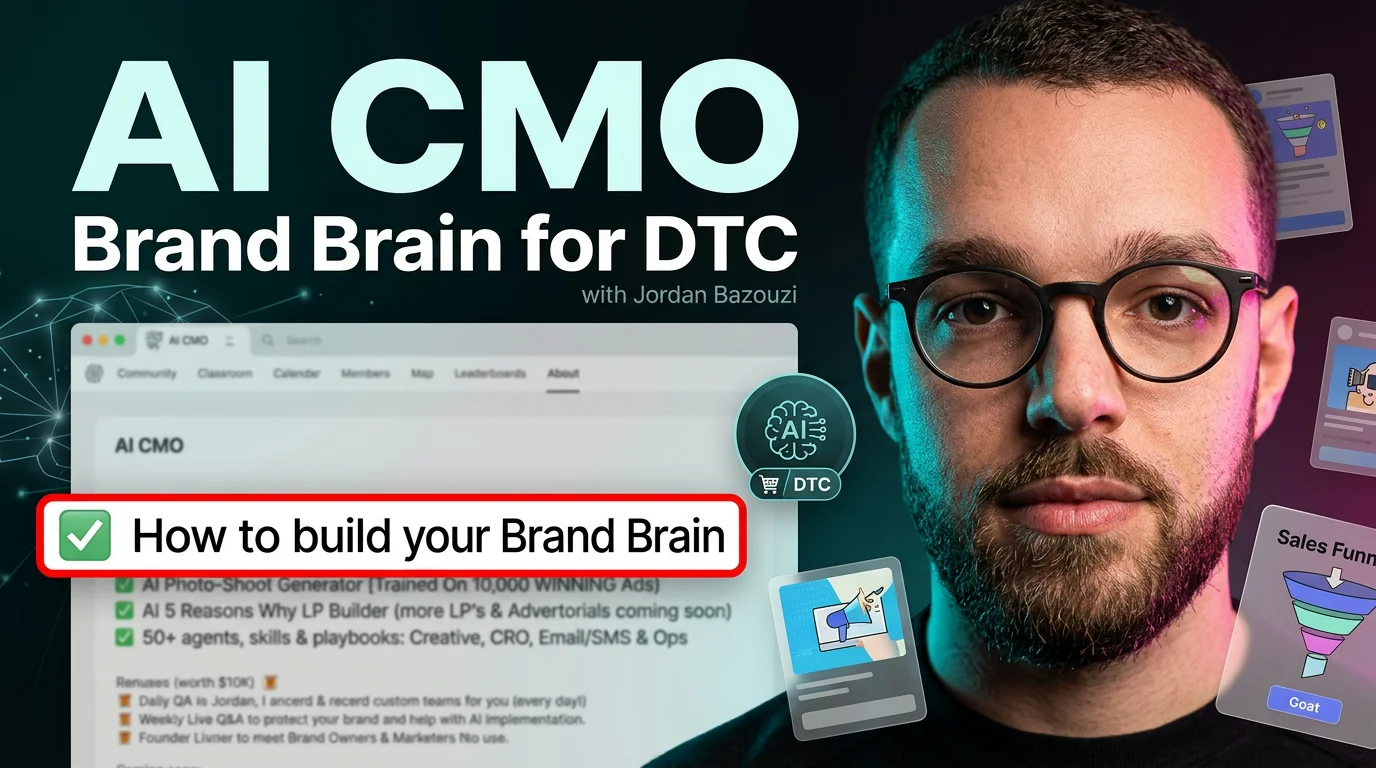
Brand constraints turn generation into commercial direction
Before a model receives a prompt, a usable brand constraint must define the buyer, buying situation, problem, permissible claim, available proof, tone, visual codes, fixed product details, forbidden shortcuts and desired action. Those decisions bound the search. Without them, a model can make endless competent variations that look plausible but interchangeable. Volume rises, while recognition and learning do not accumulate.
A feed advert, a product photo and a talking-head clip fail differently
A static advert, product photoshoot and user-style video are separate jobs. A static advert must communicate in a fraction of a second, so it can be beautiful yet unreadable in the feed. A photoshoot must represent the item customers will receive, so excessive enhancement creates expectation gaps. User-style video must resemble believable human communication, so awkward speech, gaze or timing can create an uncanny near-miss that costs trust. Each format therefore needs its own brief and quality test.
A synthetic performer is not a synthetic customer
There is a legal and ethical difference between generating a stylised advert and depicting an invented customer describing an experience. The FTC Endorsement Guides require an endorsement to reflect the endorser’s own honest opinion. The same guidance separately treats engagement from people who do not exist, or who have no experience of the product, as clearly deceptive. A generated character has no opinion of its own and no experience of anything, so presenting one as a real customer is deceptive rather than merely imaginative production. Generated performers and scenes are production choices; generated endorsements are advertising claims requiring different handling, clear disclosure, appropriate consent and respect for likeness rights.
The advert and the page have to promise the same thing
Conversion work supplies the next test. The advert and destination page must make the same promise. A weak advert loses attention or fails to communicate before the click. A broken promise may attract clicks, then produce sharp abandonment when the page changes the implication, evidence or offer. Compare click behaviour with landing-page engagement and checkout progression before blaming the image alone.
Different production systems place judgment in different hands
Prompt-only generation is fast for exploration but depends heavily on operator taste and produces little reusable knowledge.
Brand-system prompting encodes audience, voice, proof and visual boundaries. It improves consistency, although weak positioning remains weak when expressed consistently.
Reference-grounded production anchors output to approved products and brand assets. It reduces visual drift but still requires checks against the actual item.
Human-directed AI production uses models for drafts while people control selection, correction and final claims. It is slower than unattended generation but better suited to accountable commercial work.
Synthetic performance production creates presenters, voices or scenes. It expands production options while increasing disclosure, deception, consent and likeness risks.
Conversion experimentation compares defined variants against behaviour or sales outcomes. Controlled testing has stronger decision value than declaring one creative style universally effective.
A useful curriculum exposes its decision rules
Judge any program by whether it teaches inputs, decisions and evaluation rather than button sequences alone. It should show how an audience and claim become a brief, how product accuracy is preserved, how each format receives a distinct quality check, and who approves factual and legal claims. Worked examples should reveal rejected drafts and explain why they failed.
Then inspect measurement. Look for a method that records the hypothesis, isolates meaningful changes, defines the conversion event and distinguishes an attention problem from a page mismatch. Check whether disclosure, consent and likeness are addressed wherever synthetic people appear. Finally, establish the learning format, feedback route, update policy and amount of independent practice expected.
AI CMO connects five topics while leaving delivery open
AI CMO starts with Brand Brain, then names Static Ad Factory, Photoshoot Factory, creating AI UGC and using AI for conversion-rate optimization. Separating those creative jobs is a genuine strength, as is connecting them to conversion work. The listing also deserves credit for saying the value lies in the relationship between subjects and that different categories should not receive identical creative treatment.
Its stated fit is equally candid. It targets working marketers with an active commercial context, not buyers seeking general AI literacy, programming, software engineering, one fixed tool stack, assured production outputs or a universal style. Jordan Bazouzi is named as the presenter, but no biography or track record is supplied.
The named components are topic labels rather than documented lessons. The listing provides neither a lesson list nor module count, says nothing about duration or delivery format, and supplies no quantified outcomes, case studies, testimonials or member count. Its superiority claim is therefore unsubstantiated. Because AI CMO is described as a community, establish what membership includes and for how long; do not assume calls, coaching or feedback.
Membership value depends on work outside the community
Results require a real product, approved claims, source assets, campaign data and time for briefing, correction and testing. Common failures include generating before positioning, allowing product details to drift, treating synthetic speech as customer testimony, and changing both advert and page so extensively that the test teaches nothing.
If positioning is unresolved, settle it with dedicated brand and positioning training first.
If production software is the bottleneck, compare a specialist AI tool training course.
If measurement design is weak, structured conversion experimentation training may be the better purchase.
What does membership contain? Ask whether delivery uses recordings, written material, live sessions or feedback, and how long participation lasts.
Are the five named topics demonstrated together? Request a worked example connecting Brand Brain, creative production and a page test.
How are synthetic people handled? Confirm the rules for disclosure, consent, likeness and testimonial language.
Will it suit a beginner without an active campaign? Probably less well, because the listing frames AI CMO around decisions applied to an existing product, audience or client account.