TL;DR: The Mini-MBA for Designers by Future London Academy, curated by Ekaterina Solomeina, teaches senior creatives the business and leadership skills needed to move into management and strategic roles. It covers the language of business, leading creative teams, and talking to CEOs with confidence. Self-paced materials plus a cohort experience.
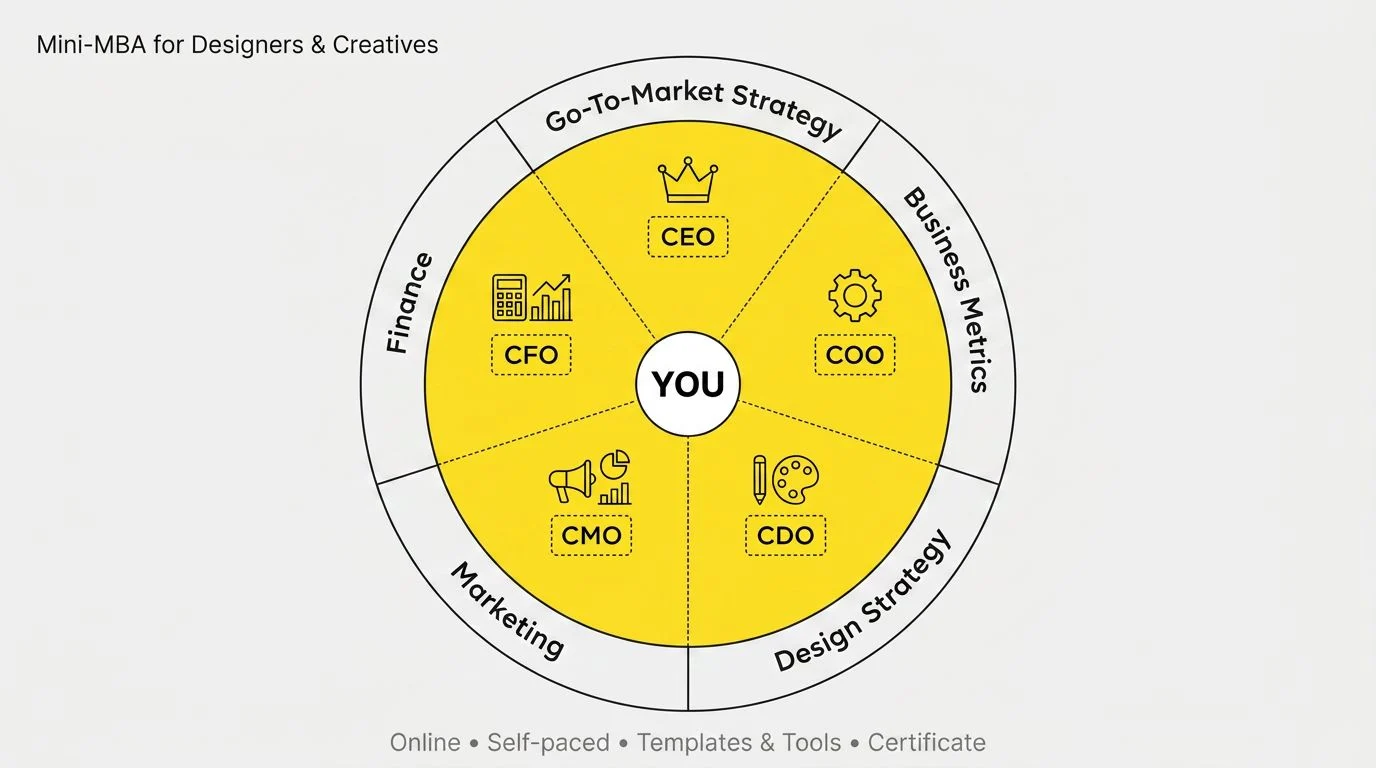
What the Mini-MBA for Designers Actually Teaches
Most design courses sharpen your craft. This one does something different. It works on the part of your career that craft alone cannot fix: the move from making the work to leading the people and decisions behind it. Future London Academy built the program for senior designers who keep hitting a ceiling because the room they want to be in speaks a different language. That language is business.
So the curriculum starts there. You learn how to connect design work to the things business leaders actually care about, like revenue, growth, and risk, much the way a broader program like Justin Welsh’s The Creator MBA teaches creators to think commercially. From there it moves into leadership style, motivating and hiring creative teams, and the tricky balance between giving people freedom and holding them responsible. The thread running through all of it is communication, specifically how to talk to CEOs and clients without shrinking or overselling.
Who Future London Academy Built This For
Be honest about your stage before you buy. This is not an entry-level program. If you are a junior or mid-level designer still building your portfolio, the material will sit above your day-to-day, and a craft-focused course gives you more right now. The Mini-MBA for Designers is aimed at people who already do strong work and are now expected to lead, or want to be.
That means senior designers, design leads, and creatives eyeing a head-of-design or strategic seat. If you have ever sat in a leadership meeting and felt like the only person not fluent in spreadsheets and roadmaps, this is built for you, in the same way White and Salt’s Brand Designer Master Training targets the business growth side of a design career. It is less about pixels and more about influence, and we think that framing is its biggest strength.
How the Program Is Delivered
The format mixes self-paced, on-demand material with a cohort experience, so you get structure without being chained to a fixed weekly schedule. Future London Academy leans on practitioners rather than career academics. The academy says its instructors include C-level professionals and product leaders from companies like Uber and Deel, which lines up with the program’s focus on real operating decisions over theory, the kind of leadership behavior the Harvard Business Review’s leadership research repeatedly ties to stronger team outcomes. Treat those company names as the academy’s framing, but the orientation toward working leaders is clear in the syllabus.
For curious designers comparing options in 2026, it helps to read this alongside a more general management program like Augment’s The Augment MBA we have reviewed. Each one weights craft, strategy, and people management differently.
Where the Mini-MBA for Designers Stands Among What We Review
Among the design-into-leadership programs we cover, this is one of the more focused. It does not try to teach you Figma, branding, or UX research. It assumes you already have those. What it adds is the connective tissue between good design and business outcomes, which is exactly the gap most talented designers stall in, similar to how Julian Cole’s Strategy Finishing School bridges craft and strategic leadership for planners. If you want a pure portfolio builder, look elsewhere. If your problem is being taken seriously by the executives who sign off your work, the Mini-MBA for Designers targets that directly.
One trade-off worth naming. Because the value here is leadership and communication, results depend heavily on what you do with the material afterward. There is no shortcut to authority. The program gives you the vocabulary and the mental models; applying them in your own org is on you.
The Mini-MBA for Designers: Common Questions Answered
Is the Mini-MBA for Designers worth it?
For a senior creative who keeps getting passed over for strategic roles, yes. The business language and leadership content fill a gap that craft courses ignore entirely. For a junior designer still building skills, the material will land too early, so wait until you are closer to a leadership step.
Is Future London Academy legit?
Yes. Future London Academy is an established London-based design education provider, and this program is curated by Ekaterina Solomeina with input from working industry leaders. It is a real, structured course, not a thin slide deck.
Do I need an MBA or business background first?
No. The whole point is to give designers business fluency without a traditional MBA. It starts from a creative’s perspective and translates business concepts into terms that make sense for design work.
What outcomes should I expect from the Mini-MBA for Designers?
Clearer communication with executives, a sharper read on how design ties to business goals, and more confidence leading and hiring creative teams. It is a positioning and leadership program, not an income promise, so it is educational rather than financial advice.
In our review, the Mini-MBA for Designers by Future London Academy earns its place for one clear reason: it treats the business and leadership side of design as a skill you can actually learn, not a personality trait. The strongest case for it is the curriculum’s focus on speaking the language of business and leading creative teams with confidence. If you are a senior designer ready to step up, this is a well-aimed program. If you are still early in your craft, save it for later and come back when leadership is the real bottleneck.