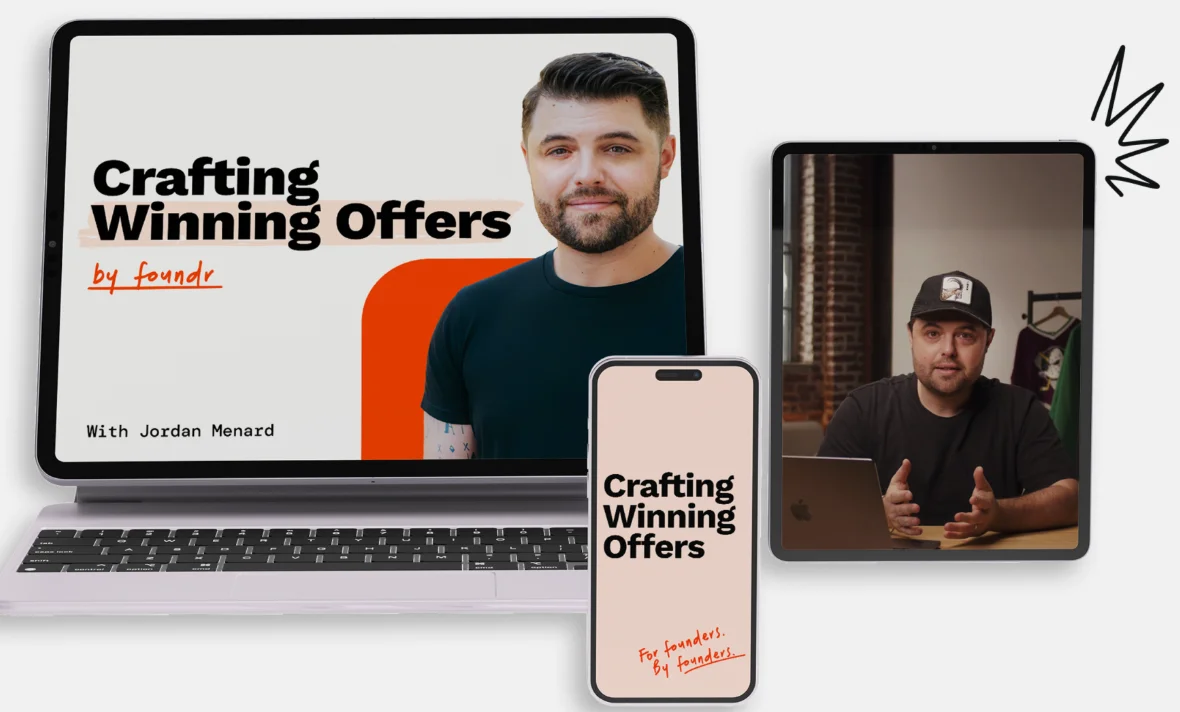
Crafting Winning Offers is a module-based Foundr ecommerce course led by Jordan Menard for founders who need stronger promotions without casually sacrificing margin. It is aimed at operators working across pricing, bundles, email, SMS, giveaways and advertising. The useful buying question is whether its frameworks and calculators will improve decisions you can measure in your own unit economics.
Discounts spend contribution margin before advertising begins
Start with net sales after discounts and expected returns, then subtract variable costs such as COGS, fulfilment, payment fees, shipping subsidies and order-linked service. The remainder is contribution margin, the amount available for advertising and fixed overhead. If revenue is indexed at 100 and variable costs are 60, the margin is 40. A ten percent discount lowers revenue to 90 while many costs remain unchanged, cutting margin to 30. The discount was ten percent of revenue but consumed one quarter of the original margin. This is why conversion rate alone can mislead.
AOV rises through quantity, mix and placement
Average order value can increase through multipacks, complementary bundles, quantity breaks, thresholds, post-purchase upsells or a shift toward higher-value products. Each lever has a different cost. A bundle may improve fulfilment efficiency, while a free gift can add product, handling and shipping expense. Calculate contribution per order and per acquired customer, not AOV in isolation. Welcome offers should create a sensible first purchase without training every shopper to wait. Email and SMS offers should then be judged by incremental margin, unsubscribe pressure and whether they merely pull demand forward.
Merchandising and promotion solve different offer failures
Unit-economics-first modelling protects margin and exposes unaffordable promotions, but spreadsheets cannot establish demand. Merchandising-led bundling joins products around a coherent use case; it raises basket size when the combination is genuinely useful, yet forced bundles add friction. Lifecycle offer design uses welcome flows, replenishment messages and post-purchase offers to match timing, although excessive contact damages trust. Giveaway-led acquisition can generate attention and audience participation, but entrant quality and fulfilment cost often weaken its value. Creative-led offer communication uses demonstrations, founder stories, creator scripts and landing-page continuity to make value legible; compelling presentation cannot rescue poor economics. Experimentation-led optimization uses controlled tests, holdouts and cohort analysis. It has the strongest basis for causal decisions, provided the test changes one meaningful variable and measures profit rather than clicks alone.
A worthwhile offer course should survive a margin worksheet
Before buying any program, ask whether it defines COGS, contribution margin and AOV precisely, and whether examples include returns, fulfilment and promotion costs. Check that bundles, upsells, gifts and giveaways receive separate decision rules instead of being treated as interchangeable conversion tricks. Look for editable calculators, worked examples, measurement windows and a method for comparing cohorts. Honest urgency follows a real constraint such as inventory, capacity or a scheduled event. A manufactured countdown that repeatedly resets is not operational scarcity. Finally, require a testing process with a baseline, hypothesis, success threshold and stopping rule. An offer is tested, not assumed.
Crafting Winning Offers connects economics to campaign execution
The Foundr Crafting Winning Offers course contains seven modules. Jordan Menard leads the program; Foundr’s page describes him as the founder and CEO of Motif Digital. Marketing psychology and offer creation lead into Jason Wong’s third module on COGS, contribution margin, AOV and measurement. Module four covers narrative, meme, UGC and creator-led advertising plus landing-page continuity. Thomas Lalas teaches email and SMS in module five, Van Oakes handles giveaways and advanced tactics in module six, and Colin McGuire closes with offer red flags and case studies.
The listed working assets include a contribution margin calculator, marketing promotion cost calculator, creator script template, narrative script template and creative exploration toolkit. That gives the syllabus a practical bridge from arithmetic to campaign execution. However, the listing does not show completed calculator examples, assessment criteria or evidence that learners receive individual feedback.
The enrolment page leaves delivery questions open
Is this primarily an economics course or a creative course? It spans both, but its sequence places unit economics between offer construction and advertising. Buyers should expect a broad operating framework rather than specialist financial modelling.
Does the Crafting Winning Offers course include live instruction? The listing identifies modules and tools but does not specify lesson delivery, update dates or instructor interaction. Foundr membership workshops and community features belong to the provider’s membership and should not be treated as course materials.
What does the AI Accelerator contain? It appears in the product name, but the listing describes none of its lessons, tools, instructors or delivery. Do not assign it value until the provider supplies a current outline.
Are the named experts present throughout? No such claim is supported. The listing ties Wong, Lalas, Oakes and McGuire to particular modules, while Menard leads the wider course.
Better promotions still depend on disciplined measurement
The seller’s business-scale statements and case studies are promotional claims, not independently verified learner outcomes. Case studies can illustrate a mechanism, but without baselines, selection rules and full cost data they do not establish what another store will achieve. Calculators are only as reliable as their inputs. None of this supports a sales, AOV or revenue forecast.
Useful implementation means gathering current cost data, building a baseline, launching one bounded experiment and waiting long enough to observe returns and repeat behaviour. Common failures include stacking several incentives at once, optimizing click-through rate, excluding fulfilment costs and presenting an offer differently in an ad and at checkout. Stores lacking reliable product costs are better served first by dedicated ecommerce unit-economics training. Teams with weak retention systems should compare a specialist lifecycle email and SMS program. Brands that already have sound offers but weak ads may get more from performance creative testing training. Choose this broader course when the actual gap is coordinating economics, promotion mechanics and campaign execution across one operating process.