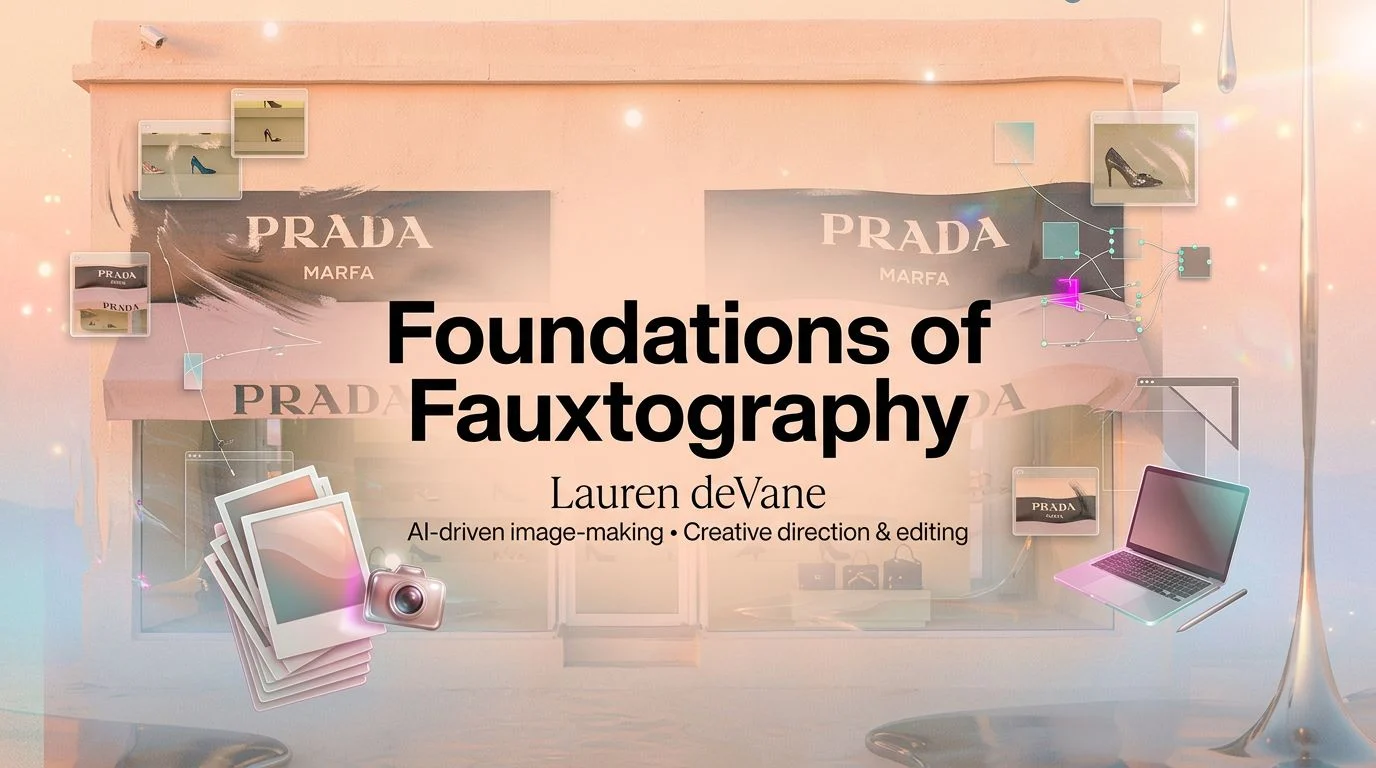
TL;DR: Foundations of Fauxtography is Lauren deVane’s course on building photographic-looking AI imagery, taught almost entirely inside Freepik. It covers model selection, prompting, upscaling and prompt-driven editing across six image categories, from beauty editorial to brand world building. Built for creatives who already have visual taste, not for beginners hunting a prompt list.
What Foundations of Fauxtography Actually Teaches
Fauxtography is the course’s own term, and it is deliberately tongue in cheek. It means imagery that reads as photography but was generated rather than captured. The course never pretends otherwise, which is a better starting point than most AI image training we look at.
The teaching is organised around image categories rather than around software menus. Beauty editorial, product photography, portrait work, fashion editorial, lifestyle imagery and brand world building each get their own treatment, because each one has different lighting logic, different framing conventions and different failure modes when a model guesses wrong.
Why Freepik Sits At The Centre Of This Course
This is the detail that defines the course. Lauren deVane teaches primarily inside Freepik, and she uses it as a single workbench rather than hopping between generators.
That last distinction is where a lot of self-taught AI work stalls. People generate, dislike one element, and regenerate the whole frame instead of directing a change. Teaching editing as a directed step is the most durable idea in the course.
How It Compares To Generic AI Image Courses
Most AI image training sold in 2026 is a prompt library with a video wrapper. You buy several hundred prompt strings, they work for a while, then a model updates and half of them produce something slightly off. The knowledge had no structure underneath it, so it does not survive the update.
Foundations of Fauxtography takes the opposite bet. It spends its time on art direction, on choosing a model deliberately, and on editing judgement. Those three skills survive version changes because they live in the operator, not in the prompt text. If you have shopped generic prompt-pack courses and felt the material go stale within a quarter, that contrast is the strongest argument for this one.
Who Lauren deVane Is
Lauren deVane is a former Creative Director at Ulta Beauty and the founder of Bemused Studio. Online she is known as the internet’s AI Auntie, and she speaks at marketing industry events about AI imagery. Her working focus is helping brands, business owners and marketers build custom on-brand visuals with current image models.
Limitations, And The Disclosure Question
Three honest caveats. The workflow is tied to one platform and its interface, so anyone committed to a different generator will spend time translating. It assumes you already have design judgement, so a true beginner with no visual eye will get less out of it. And image models move fast enough that any specific tool walkthrough has a limited shelf life.
There is also the disclosure side. Imagery that looks photographic but is synthetic raises real questions in commercial work, and anyone using this professionally should understand platform rules and the relevant standards, starting with the FTC’s guidance on advertising and marketing. This is image generation, not photography. It does not replace a real shoot when authenticity matters or when a client needs an accurate likeness of an actual product.
Foundations of Fauxtography: Common Questions Answered
Is Foundations of Fauxtography legit?
Yes. It is a real course from a named industry practitioner with a verifiable background at Ulta Beauty and her own studio, and the curriculum matches what she teaches publicly.
Do I need photography experience for Foundations of Fauxtography?
No, but you need visual taste. If you can tell why one image reads as premium and another does not, you will move quickly.
Does Foundations of Fauxtography work outside Freepik?
The thinking transfers. The button-level workflow does not. Expect to translate steps if you use another generator.
What image styles are covered?
Beauty editorial, product, portrait, fashion editorial, lifestyle and full brand world building.
Will this replace hiring a photographer?
No, and the course does not claim it. Real shoots still win when authenticity or accurate product likeness is the point.
Is Foundations of Fauxtography Worth It?
For working creatives and marketers who already art direct and want AI imagery that survives a client review, we judge it a strong pick. For absolute beginners, or for anyone who wants a portable prompt list rather than a way of working, look elsewhere.