SuperHuman Work is Callan Faulkner’s self-paced AI-work curriculum with project builds, playbooks and a quarterly coaching layer for founders and teams standardizing AI use. It suits knowledge workers who want repeatable operating habits rather than technical model development. The buying decision is therefore about whether its system improves real work, not how many tools it names.
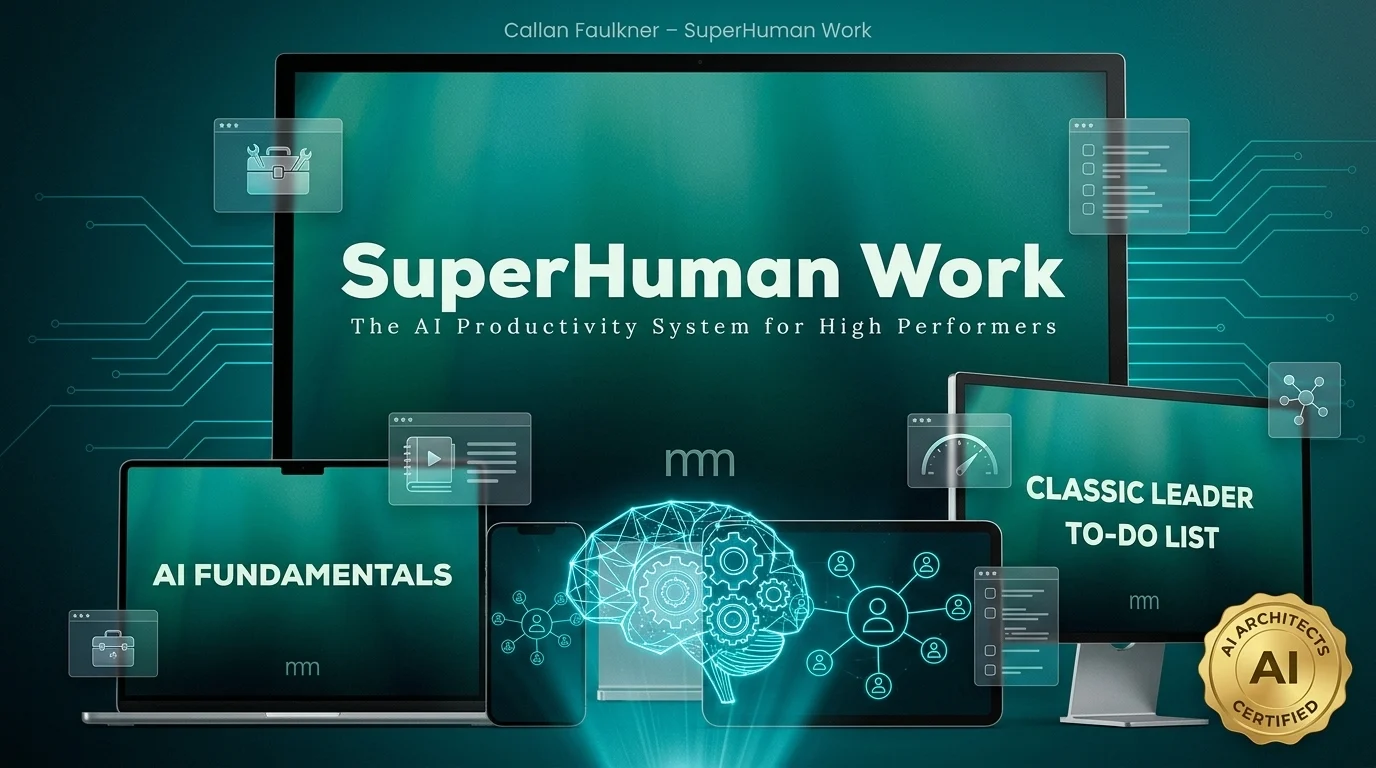
The SuperHuman Co-Pilot, 90-Day Content Refresh, Quarterly Power Plays, Quarterly Live Zoom Calls, SuperHuman Certification, public directory listing and team accountability view depend on active enrollment with the original provider and should not be assumed to accompany a standalone copy. The listing marks several of these as Plus only without identifying the supplied tier. What transfers reliably is the recorded curriculum, frameworks and playbooks.
Repeated tasks are where AI earns its place
Watch a normal working week before automating anything. Good candidates recur, consume attention, use recognizable inputs and end in an output you can inspect: summarizing meeting notes, reshaping a brief, classifying routine requests or drafting follow-ups. Keep ambiguous negotiations, consequential approvals and unfamiliar exceptions with a person. Frequency alone is insufficient. The task also needs boundaries and a clear test for success.
A usable prompt gives context, states the task and defines the output format. Add the intended reader, source boundaries, tone, examples and acceptance criteria when they matter. Ask for a first draft, not truth by declaration. Then check cited sources, names, calculations, omissions and whether the response followed the requested format. A polished answer can still be wrong.
AI tools overlap, so match each one to the task and its data
Match tools to work rather than treating them as a permanent league table. ChatGPT is a general drafting workspace; Claude is often selected for long documents and tone-sensitive revision; Perplexity emphasizes linked research; Gemini connects closely with the Google ecosystem. Capabilities overlap and change. Keep confidential client, employee and business data out unless your organization has approved the account, controls and data terms. The NIST AI Risk Management Framework provides a useful structure for governing and measuring these risks.
Drafting, research, memory and automation solve different problems
Prompt-library training standardizes recurring requests and is easy to adopt, but copied prompts decay when the context or desired output changes. Retrieval-grounded research connects answers to supplied documents or cited sources, improving traceability without removing the need to inspect those sources. Persistent project workspaces preserve instructions, reference material and examples across sessions, although stale context can quietly contaminate later work. Lightweight workflow automation moves information between defined steps and is valuable for stable, high-volume processes; it is brittle around exceptions. Team AI operating systems combine approved tools, shared prompts, owners and quality checks, trading individual freedom for consistency. Evidence is strongest when teams benchmark output against real examples and retain human verification, not when they rely on broad productivity claims.
A worthwhile lesson leaves behind an inspectable workflow
Before buying any program in this category, ask to see one task carried from raw input to checked output. Look for prompt rationale, failure examples, privacy guidance, revision steps and a named owner for final approval. Confirm whether demonstrations use ordinary accounts or paid features, whether reusable projects can be exported, and who maintains lessons as interfaces change. For team rollout, demand a method for selecting tasks, recording approved workflows, measuring error rates and handling exceptions. Tool tours age quickly. Decision rules and evaluation habits travel further.
Six pillars turn task awareness into shared playbooks
SuperHuman Work begins with the Can AI Help Me reflex and Never-Manual List, then moves through AI Fundamentals, the Pain, Problem, Prompt method and an AI Core Toolbox covering ChatGPT, Claude, Perplexity, Gemini, NotebookLM, CoPilot and agentic browsers. A further pillar discusses an unnamed productivity stack, so buyers cannot assess those subscriptions in advance. The project-building pillar demonstrates a Meeting Intelligence GPT, AI Bookkeeper, On-Demand Proposal Generator and learning system. The final vault provides Leader, Sales Rep, Marketer, Operator, Executive Assistant, Finance Admin and Life playbooks. Buyers need their own tool accounts.
This is substantial advertised scope, but scope is not proof of effectiveness. No independent product page was found, and the listing supplies no completion data, comparative testing or measured team outcomes. Any creator income or student-count figures would remain creator claims, not verified learner evidence. Rapid-adoption language should likewise be treated as marketing rather than a predictable result.
Coaching, refreshes and calls depend on the original enrolment
Is SuperHuman Work a live cohort? The core is described as self-paced, with quarterly calls layered on top. The listing does not describe a fixed cohort schedule, personal coaching allocation or feedback turnaround.
Which benefits are included in the available tier? Certification, Power Plays and live Zoom calls are marked Plus only, but the listing does not identify which tier this product represents. Confirm that before relying on them.
Does the SuperHuman Certification confer a recognized qualification? No accredited status is stated. It is the creator’s own credential, and the seller’s AI Architects wording should not be treated as a professional title or independent qualification.
Are the featured AI services included? The material teaches a collection of platforms, but the buyer must supply the necessary accounts. Plan limits, availability and business-data controls may differ between them.
Team adoption is won inside the weekly work queue
Real progress requires choosing a few recurring tasks, saving good examples, defining acceptance checks and inspecting errors every week. Common failures are automating a vague process, preserving bad context, skipping source checks and giving everyone tools without an agreed method. SuperHuman Work is a poor fit if you want software engineering depth or an independently recognized credential.
If dependable source synthesis is the bottleneck, compare retrieval-grounded research training.
If information must move between systems without manual copying, a lightweight workflow automation program may be more appropriate.
If confidential or regulated data is central, choose dedicated AI governance and data-handling training.
Teams without stable processes may be better served by business process mapping training before adding AI.