The Amazon Influencer Academy is a broad training offer bearing Tanner Clemens’s name for people already using, or preparing to join, the Amazon Influencer Program. It is presented as a 22-module collection for organizing content, links, sales, tools and platform-specific monetization, not as a narrowly defined workshop. Before judging that breadth, separate the storefront you control from the product-page distribution Amazon controls.
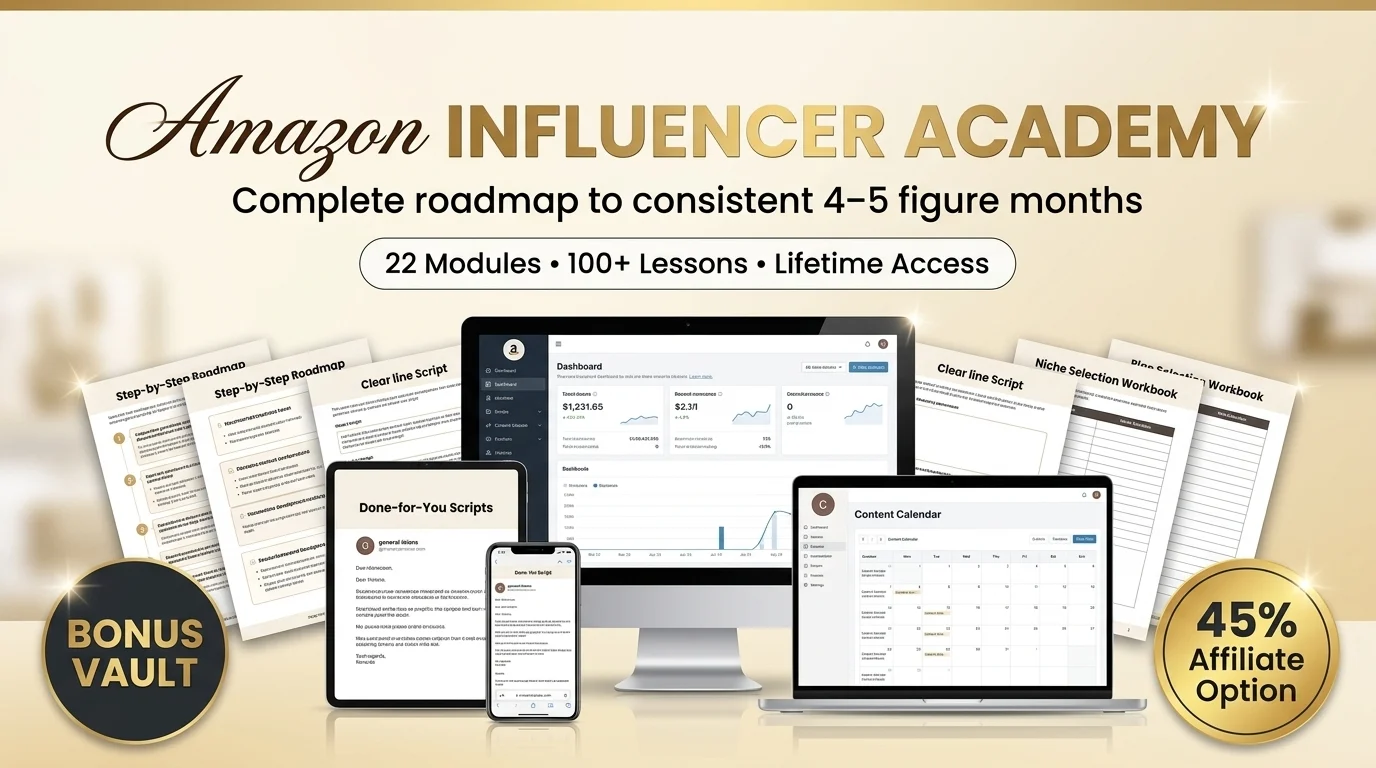
The listing names a Facebook group, a Past Mentorship Calls Library and promised updates, but those features depend on an active original provider. Do not assume 1:1 access, weekly calls, current feedback or an active community is included; the listing does not say so. What transfers is the material the listing names, including tools, scripts, spreadsheets and tech walkthroughs.
Your storefront is a destination, not automatic distribution
An approved participant can organize recommendations and published content on an Amazon storefront, then send an existing audience there or use eligible links that lead to individual products. The storefront provides a recognizable destination and a catalog of your work. It does not create shopper demand by itself.
Off-Amazon referral activity depends on traffic you bring from social posts, websites, email or other permitted channels. A storefront visit, a product click and a qualifying purchase are separate events. Opening a storefront neither places a video on a product page nor ensures that a shopper sees it.
Onsite commission begins behind a second gate
Acceptance as an influencer does not automatically approve onsite commission. Onsite approval is separate, and submitted videos must also clear Amazon’s moderation before Amazon may choose to surface them on product detail pages. The creator can improve relevance and production quality, but cannot command a placement.
When approved content is placed and an eligible shopper action produces a qualifying purchase, Amazon credits commission under its own program rules. Onsite content uses a separate, generally lower rate table. Adjustments, returns, account verification and Amazon’s disbursement schedule mean a reported amount is not an immediate payment.
Referral traffic, onsite video and catalog coverage solve different constraints
Audience-led referral publishing sends viewers from an established channel to a storefront or eligible affiliate product link. It offers control over the message, but depends on audience trust and compliant attribution.
Onsite demonstration publishing creates concise product videos for possible placement near high-intent shoppers. It can answer practical buying questions, yet approval and distribution remain outside the creator’s control.
Catalog-coverage production builds repeatable research, scripting and filming routines across products already available to the creator. It increases testing opportunities, but shallow or repetitive coverage can sacrifice usefulness.
Analytics-led selection and maintenance uses reporting, rejection reasons and catalog changes to decide what to update. This is an operating habit built on top of the program, as are batching and production spreadsheets. Only the storefront and product-page placement are Amazon program features. Amazon documentation supports those features; the surrounding habits are general publishing practice, not a promised outcome.
A sample upload exposes whether instruction survives Amazon’s rules
Before buying any program in this category, ask to see one complete assignment from product selection through publication, moderation and reporting. Check whether it distinguishes influencer acceptance from onsite approval, explains what Amazon controls, shows how rejected content is revised and dates every policy-dependent lesson. A large lesson count cannot substitute for that chain.
Inspect the delivery format, prerequisites, sample teaching, feedback process and update record. Confirm whether community access and coaching are active services or merely referenced assets. Look for country-specific limits, a realistic production workload and a process for checking current rules. Be cautious if placement is presented as controllable, a follower threshold is stated as universal or bonus volume replaces evidence of a usable workflow.
Twenty-two modules create breadth, but the route through them is hidden
The Amazon Influencer Academy listing counts over 100 lessons, 22 modules and an Advanced Vault. It also names a complete system for content, links, sales, bonuses and scaling, plus tools, scripts, spreadsheets, tech walkthroughs, international and platform-specific monetization strategies. The Influencer Toolkit and Past Mentorship Calls Library sit beside the main material.
That inventory suggests operational breadth. It does not reveal a learning sequence. No module is named, no lesson sample is supplied, and the format, prerequisites and Tanner Clemens biography are not specified. The listing also promises updates without giving dates, a change log or a maintenance process. You therefore cannot verify whether beginners receive a clear starting path or experienced publishers can skip familiar material.
Conflicting placement thresholds make update quality decisive
Amazon’s own surfaces have presented conflicting thresholds for possible product-page video placement: Associates Central has cited ten cleared videos, while Influencer FAQ pages have cited three, with neither statement dated. The conflict should not be resolved by guesswork. Amazon also publishes no universal follower minimum, so fixed-number claims need a current source.
Secondary reporting describes an April 2026 tightening toward direct qualifying purchases of the same ASIN variant and away from paid or boosted traffic. Treat that as secondary reporting and verify current requirements against Amazon’s operating policies. This volatility makes the Amazon Influencer Academy update process materially important, yet the listing does not document it. No independently verified performance evidence is supplied. Any creator performance or student-count figure would remain the seller’s claim unless independently substantiated.
A publishing routine must continue after the vault
Useful progress requires recurring product research, scripting, filming, editing, uploading, policy checks and reporting analysis. Common failure points include treating the storefront as a traffic source, producing interchangeable clips, ignoring rejection reasons and assuming yesterday’s placement rule still applies. The material may organize that work, but the listing does not establish individualized critique or policy support.
Someone without an audience may be better served first by audience-building and short-form video fundamentals. If camera delivery is the constraint, compare product demonstration scripting and mobile video production training. If eligibility or policy interpretation is unresolved, choose Amazon Associates compliance training or obtain qualified legal advice. International publishers should also consider country-specific affiliate compliance education. Buyers who need named projects, assessed submissions or confirmed live coaching should choose a program that documents those features before enrollment.
The decisive unknown is who maintains the academy
Before choosing the Amazon Influencer Academy, ask five product-specific questions. Is the material delivered through video, text, live sessions or a mixture? Which unnamed modules cover storefront publishing, onsite approval, reporting and international differences? Is the Facebook group currently active, and does Tanner Clemens participate? Are the Past Mentorship Calls dated and searchable? What policy change triggers an update, and where can buyers inspect the update history?
Those answers determine whether this is a navigable operating system or primarily a large inventory of material. Until they are supplied, the lesson count measures volume, not guidance quality.