
Decision point: This semantic keyword research and entity SEO course is for practitioners who need to connect what a query means with how a brand is represented through entities, schema, and knowledge graphs. Its two-track structure is more relevant than a narrow keyword tutorial when research findings must inform a live-site implementation.
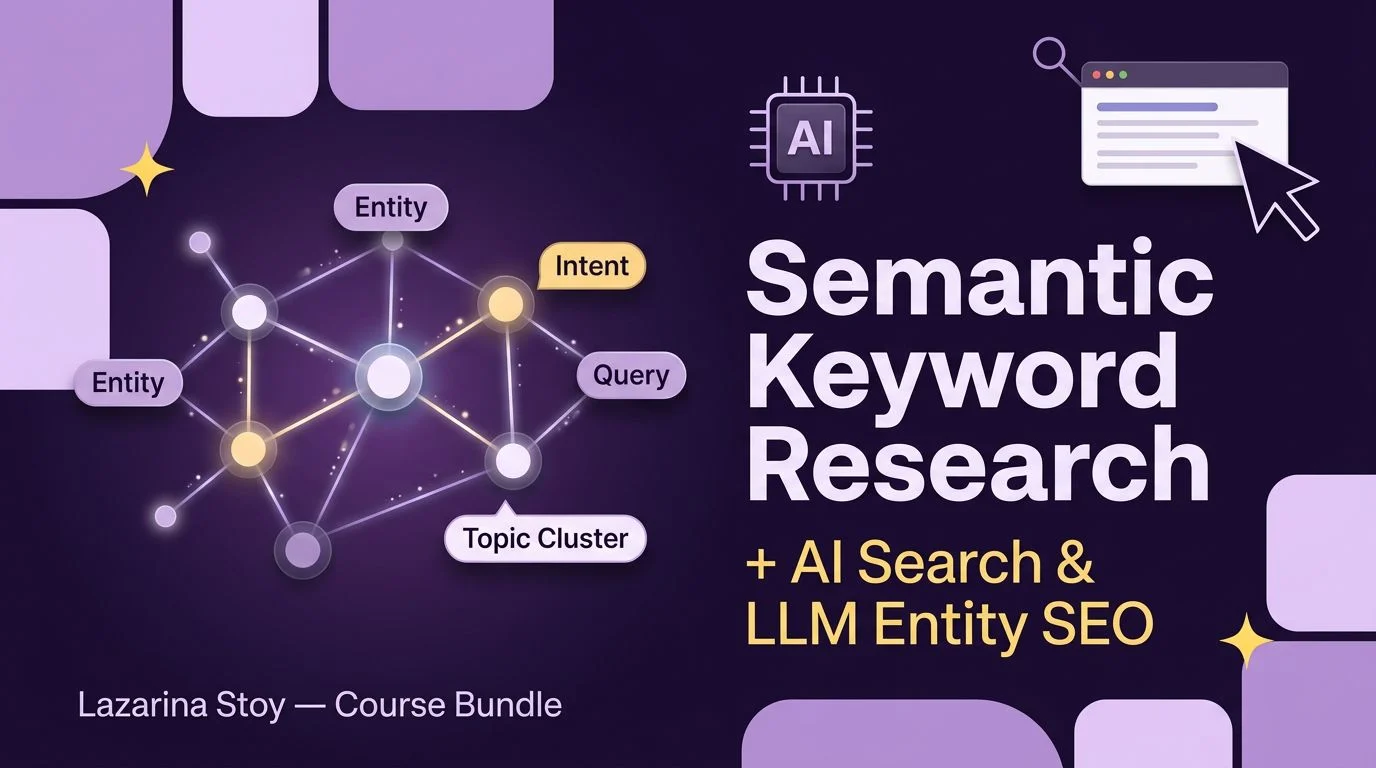
From semantic keyword research to entity SEO: why this bundle has two tracks
The visible library divides its material into Semantic AI-powered SEO Keyword Research and AI Search LLMs- Entity SEO and Knowledge Graph. That is a useful distinction rather than a cosmetic split: the first track is about interpreting search behaviour and query relationships, while the second concerns the site and brand signals that put those findings into practice.
MLforSEO describes Lazarina Stoy’s course around entities, intent, query processing, data analysis, visualization, and building a semantic keyword universe. It describes the separate entity course led by Beatrice Gamba, with Lazarina as guest instructor, around entity recognition, schema, knowledge graphs, APIs, and audit-to-execution work. The bundle therefore makes most sense when a buyer needs both parts of that handoff, not when they only need basic term selection.
Questions about moving from query research to entity work
Are the research and entity lessons separate tracks?
Yes. The visible Course Content tree has separate top-level folders for semantic keyword research and for AI Search, entity SEO, and knowledge graphs. Their official component descriptions also cover different stages of SEO work.
Who leads the entity SEO component?
MLforSEO identifies Beatrice Gamba as the lead instructor for the entity SEO component and Lazarina Stoy as guest instructor. That distinction matters because the bundle should not be treated as a single-instructor course.
What formats are visible in the bundle?
The listing reports 220 files in 22 folders, totaling 27.36 GB, across video, PDF, spreadsheet, and document formats. It verifies a mixed-format library, not the detailed quality or completeness of every unopened asset.
Do I need advanced data-science experience?
The official entity course says advanced data-science experience is not required. However, the visible listing includes technical resource types and API-related material, so buyers should still confirm the expected tools and setup for their own work.
Which purchase details still need verification?
Verify UDCourse-specific access conditions, support, updates, captions, software needs, and file completeness before purchasing. No individual course file was opened for this assessment, so those details cannot be inferred from the listing alone.
Reading the SERP as a system of queries, intent and relationships
The semantic track appears designed to push research beyond collecting phrases. Its visible materials name query understanding, SERP theory, search-intent practice, semantic analysis, and a semantic keyword universe; MLforSEO’s course description adds query processing, user behaviour, machine-learning APIs, data analysis, and visualization. Those are creator-stated curriculum areas, while the listing independently confirms only the named library structure.
The editorial value is in the connection between those stages. A search marketer can use semantic keyword research to decide which questions, entities, and relationships deserve a place in a plan before selecting pages or briefs. A buyer who only wants a tool walkthrough may find a focused semantic keyword research course more efficient; this track is oriented toward a wider research model.
Turning brand entities into schema and knowledge-graph decisions
The entity side gives the bundle an implementation layer. The visible inventory includes entity extraction, API, audit, schema-template, and knowledge-graph resources, while MLforSEO describes the related course as covering entity recognition, schema, knowledge-graph integration, Google NLP and Knowledge Graph APIs, and audit-to-execution work. That combination suggests a process for diagnosing how a brand is represented, not merely learning AI-search vocabulary.
For a team with a live site, technical SEO schema and structured-data training becomes relevant after the research has identified the concepts the site needs to express. MLforSEO’s entity SEO course description supports the stated scope, but neither it nor the visible inventory is proof of rankings, traffic, citations, or a required coding level.
Choose the larger library when you can apply both sides of the workflow
The verified inventory is substantial: 22 folders, 220 files, and several formats rather than a video-only sequence. That breadth can be valuable for an in-house or agency practitioner who will move from query research into an entity or structured-data project. It also creates a trade-off: a buyer looking for one short, non-technical lesson may need to filter the library before finding the parts that match their immediate task.
That makes this semantic keyword research and entity SEO course a stronger fit when query research must shape implementation on a real site. It is less suitable for a buyer who wants generic keyword advice, a guaranteed AI-search result, or a fully verified delivery setup. If the immediate need is applying findings after the research phase, separate SEO auditing or content-planning training may be the more direct next step.