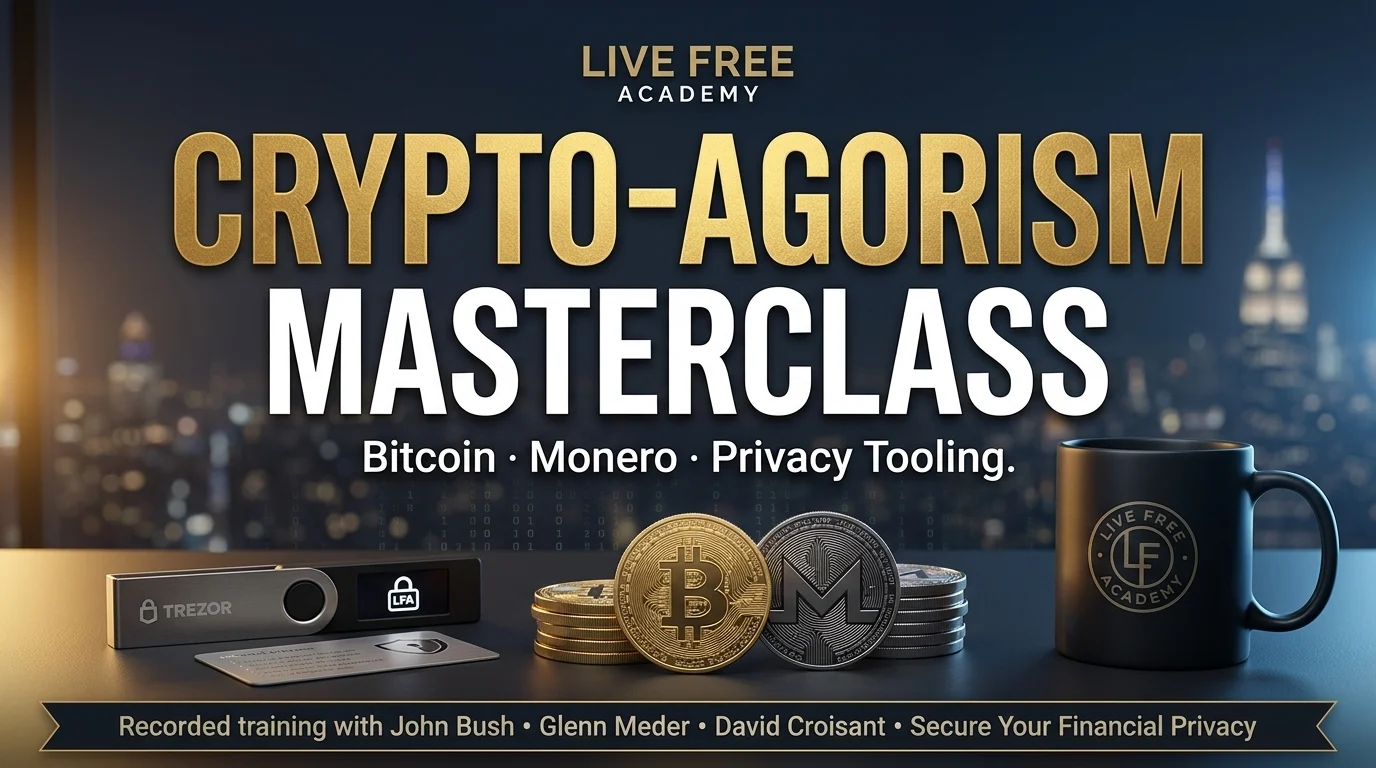
Crypto-Agorism Masterclass is a recorded virtual seminar from Live Free Academy, hosted by John Bush with guest segments from Glenn Meder and David Croisant. It is for people seeking an introduction to Bitcoin, Monero, transaction privacy and the agorist ideas surrounding them, provided they are comfortable with an openly libertarian frame. Using a privacy tool, coin or wallet removes no legal obligation: tax, income-reporting and applicable financial-regulation duties still apply. For US readers, the IRS digital-assets guidance says digital-asset income is taxable and transactions must be reported even without a taxable gain or loss. Readers elsewhere must check their own current tax authority. This page is education only, not legal, tax, financial or investment advice; consult a qualified, regulated professional about your situation.
A public address is a label, not an identity shield
A transparent blockchain does not hide a transaction. It separates a visible address from a civil identity. Bitcoin records addresses and amounts in a ledger anyone can inspect, and that history does not expire. It is pseudonymous rather than anonymous. Reusing an address, or transferring funds through a service that holds identity documents, can associate a person with a permanent chain of entries long after the original payment.
A shielded design changes what the ledger publishes. Cryptographic proofs can validate transaction rules while concealing sender, recipient or amount by default, rather than merely placing unfamiliar labels on transparent history. That structural privacy can make public auditing, proving a payment and diagnosing mistakes harder. It cannot retract information exposed elsewhere.
Holding your own keys moves the whole risk onto you
Self-custody is a transfer of risk. There is no institution to reverse a mistaken transfer, restore an account or recover a lost key, so lost keys can mean permanently unrecoverable funds. Cryptocurrency is volatile and its value can fall as well as rise. None of these technical choices changes tax, reporting or regulatory duties.
Privacy can live in the ledger, the network or the custodian
Transparent-ledger pseudonymity makes verification straightforward but leaves transaction relationships public. It can support ordinary payments, yet its privacy weakens when addresses become associated with real people.
Shielded-ledger cryptography conceals selected transaction information at protocol level. Its foundations include published cryptographic techniques, but sound mathematics does not eliminate software defects, poor defaults or information leaked outside the ledger.
Custodial privacy keeps activity away from a public address while placing records and control with an intermediary. It is simpler for the user but replaces public visibility with institutional trust and account-access risk.
Self-custody operational security gives the holder direct control of keys. It avoids intermediary dependence but concentrates backup, device and human-error risk on one person. Network-layer privacy limits metadata exposure during communication, although it cannot turn a transparent ledger into a shielded one.
A threat model belongs ahead of any privacy syllabus
Start by asking which information is hidden, from whom, at what layer and under which defaults. A worthwhile program distinguishes ledger privacy from network privacy, account security and legal compliance. It should explain permanent public records, key-loss consequences, volatility and the limits of pseudonymity without implying that privacy creates anonymity or an exemption from reporting.
Then inspect the teaching evidence. Look for dated references, clear instructor identity, disclosed guest roles, exercises, knowledge checks and a stated update policy. Recorded material needs especially clear dates because software, service availability and local regulation move faster than cryptographic fundamentals. Claims of competence should be supported by practice, not merely runtime or confident presentation.
The seminar combines a protocol contrast with a declared philosophy
The Crypto-Agorism Masterclass runs for roughly four hours as a recorded virtual session. Its stated technical core contrasts Bitcoin’s public ledger with Monero’s privacy model, explains why transaction visibility differs, and places Monero privacy tools alongside ordinary security practice. The remaining material is conceptual. John Bush presents agorism and counter-economics as a libertarian tradition concerned with voluntary exchange outside centralised systems, reflecting his stated perspective as a twenty-year agorist rather than a neutral consensus position.
Live Free Academy also sells an alternative investing bundle, which its listing describes as covering protection of money from devaluation and investments outside the traditional banking system; that is an investing subject with its own risk of loss, separate from the privacy mechanics taught here.
Glenn Meder and David Croisant appear as listing-named guest presenters, but the listing establishes no further background or qualifications for either. It also provides no module-by-module curriculum, exercises, case studies, testimonials or quantified learning outcomes. That makes this an orientation with a working vocabulary, not evidence of mastery. The listing deserves credit for admitting that limit and for naming its ideological framing.
Nothing presented supports a financial outcome promise. Privacy-focused coins have been delisted by some exchanges and restricted in some jurisdictions. Legality and availability vary by jurisdiction and change, so you must check current local rules instead of relying on a recording.
A working vocabulary still needs outside practice
The Crypto-Agorism Masterclass makes most sense when you take notes, separate technical statements from philosophical arguments and independently verify every time-sensitive reference. Common failure points include treating pseudonymity as anonymity, assuming self-custody is automatically safer, or mistaking the presenter’s political position for legal guidance.
If you want the mechanics without the worldview, blockchain development training teaches building on Ethereum with Solidity and smart contracts.
If the market rather than transaction privacy is your real interest, that is a different subject: crypto trading education from Investopedia Academy covers assessing crypto markets and technical analysis, and trading carries a risk of loss.
If your main concern is protecting keys and backups, you may be better served by dedicated cryptocurrency security training, and if the decision turns on reporting obligations, by jurisdiction-specific digital asset tax education alongside advice from a regulated professional.
A deeper learner should pair the seminar with a hands-on cryptography course that includes exercises and assessment. Whatever you study, none of it licenses using a privacy technique to conceal income or avoid reporting.
The questions a fixed recording cannot answer for you
Is this a live cohort with feedback? No. The described product is a recording, and the listing does not promise live teaching, community access or individual support.
Will the Crypto-Agorism Masterclass make transactions anonymous? No. The subject is the structural difference between transparent and shielded designs, not a promise of invisibility.
Are the guest segments independently evidenced? The listing names Glenn Meder and David Croisant, but supplies no credentials, segment lengths or learning checks.
Can you rely on its availability statements later? No. Rules and exchange access shift, while recordings remain fixed. Confirm your current local position before acting, and judge this purchase as a concise, viewpoint-led seminar rather than a complete technical or compliance curriculum.