
TL;DR: Krysten Conner Enterprise Sales Accelerator is a large, implementation-heavy archive for account executives working on complex B2B opportunities or moving into enterprise roles. The verified files span prospecting, discovery, qualification, stakeholder work, negotiation, executive engagement, pipeline management, and career development. Its breadth is useful when applied to a current deal, but it requires self-direction and does not establish active membership services.
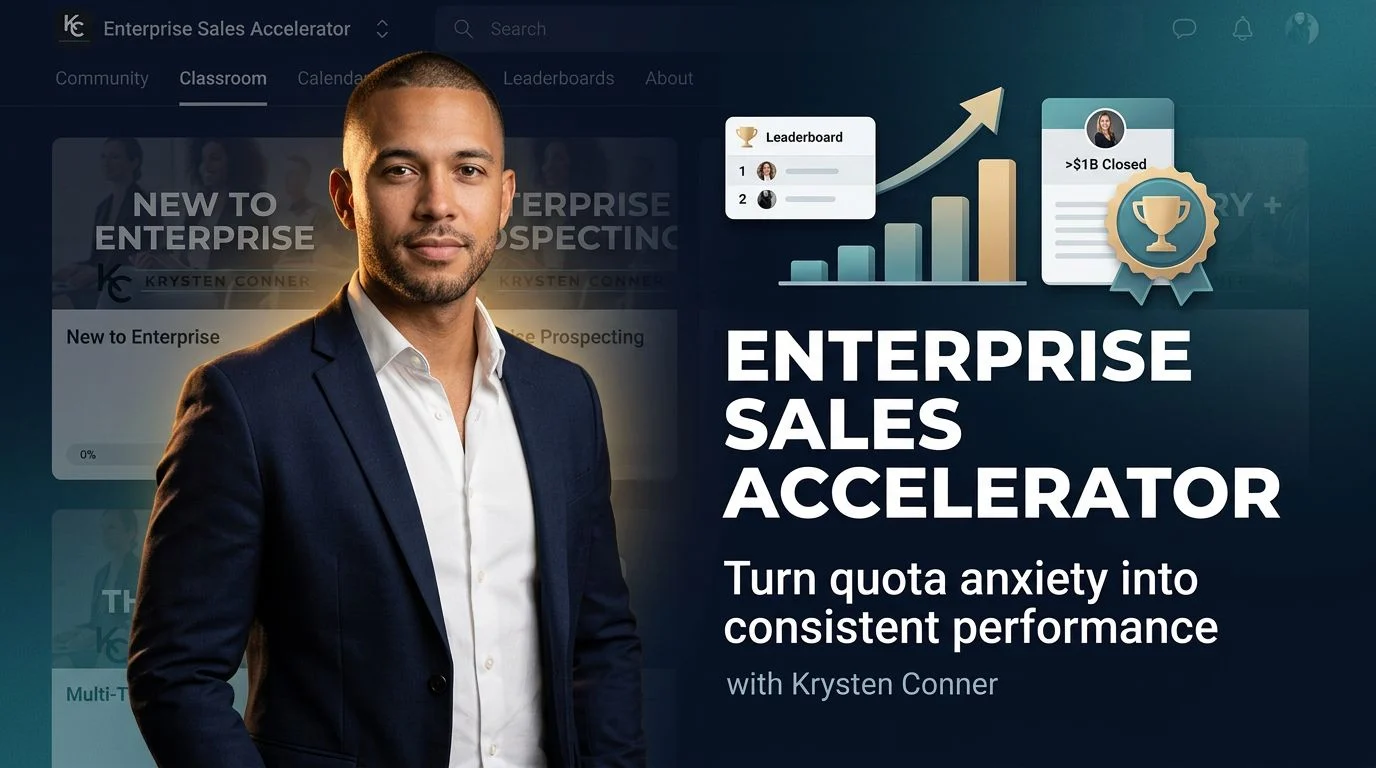
What the Enterprise Sales Accelerator archive contains
The frozen inventory records 602 files across 39 folders totaling 29.60 GB. It includes 109 videos, 215 PDFs, 10 images, 37 slide files, 55 spreadsheets, and 171 document files, plus audio and other reference material. The weekly-recordings section alone contains 328 files totaling 22.75 GB and runs from March 2025 through July 2026.
Its scale makes it a searchable working library rather than a short, linear syllabus; repeated titles and copied working files also inflate its file total.
The complex B2B sales work it covers
The topics span account research, prospecting, buyer psychology, point-of-view development, discovery, qualification, cost of inaction, de-risking, champions, urgency, multi-threading, pipeline management, negotiation, procurement, and executive work. Career resources address moving into enterprise roles alongside deal execution. AI-assisted research and messaging appear as supporting techniques, not the archive’s main subject. For virtual selling and objection handling, a focused virtual-selling program extends a different part of the sales workflow.
The library’s strongest case is deal continuity: account selection and outreach shape discovery, qualification, stakeholder mapping, urgency, negotiation, and executive alignment. That matters because enterprise problems often occur at handoffs between stages.
How to use the templates and recordings
The archive includes account-planning spreadsheets, qualification worksheets, cost-of-inaction prompts, buyer-journey slides, discovery templates, negotiation resources, executive-email examples, pipeline calculators, and career-positioning documents. These assets are most valuable when attached to a live territory, target account, opportunity, or job search.
A learner without those inputs can study the frameworks but cannot pressure-test the deal-specific tools in the same way. A sensible path is to identify the current bottleneck—prospecting, discovery, champion development, deal momentum, negotiation, or career transition—and assemble a small working set of recordings and templates around it. The trade-off for depth is navigation effort and some redundancy. A discovery-and-pipeline program fits sellers who want a narrower focus.
Archive versus the current membership
The official Enterprise Sales Accelerator membership page describes weekly live group training, on-demand courses, templates, prompts, a private community, recordings, office hours, and KrystenAI. Those are creator-stated features of the official service. The frozen UDCourse snapshot establishes a downloadable file archive, not an active service relationship.
Recorded sessions can preserve valuable instruction, but they are not interchangeable with current coaching, feedback, community participation, office hours, or a functioning external service. Buyers should also avoid assuming that scheduling links, tool links, or service instructions found inside historical files remain current or transferable.
Who should consider this enterprise sales library
Good fit: enterprise account executives, sellers moving from smaller segments into complex opportunities, and self-directed practitioners who want reusable materials across several deal stages. It especially suits someone able to bring a territory, target-account list, live opportunity, or concrete career move to the exercises. Earlier-stage prospecting is the practical prerequisite for a seller who lacks a repeatable pipeline-creation baseline; a prospecting foundation program addresses that starting point.
Poor fit: absolute beginners needing a general introduction to selling, people focused on consumer or transactional sales, and buyers who want a brief linear course. It is also a poor match when live coaching, community support, current AI service use, or a particular commercial result is essential to the decision. Sales execution still depends on context beyond any archive.
Krysten Conner Enterprise Sales Accelerator FAQs
What formats are included in the archive?
The files span video, audio, PDFs, documents, spreadsheets, slides, and images. The inventory records 602 files totaling 29.60 GB, including a large monthly-recordings section.
Who is this training best suited to?
It best fits account executives managing complex B2B opportunities and sellers moving into enterprise roles. It is not structured as a first introduction to general selling.
What is needed to apply the templates?
A live territory, target-account list, opportunity, or job-search context makes the working files more useful. Familiarity with pipeline, discovery, stakeholders, and account planning also helps.
Does it include current coaching or KrystenAI?
That is not verified for this purchase. The official membership describes active services, while the frozen snapshot establishes historical recordings and downloadable files rather than current service entitlement.
Which deal stages can the archive support?
The materials cover prospecting, account planning, discovery, qualification, champions, multi-threading, urgency, pipeline work, executive engagement, procurement, negotiation, and career development.
Editorial verdict
This archive is a strong fit for a practicing or aspiring enterprise seller who can select resources by the problem in front of them. The mix of recordings and editable working assets supports real preparation better than a lecture-only library. Its size, overlap, and lack of verified active services are meaningful costs. Choose it for self-directed deal-stage work; skip it for a concise beginner path or ongoing coaching relationship.