
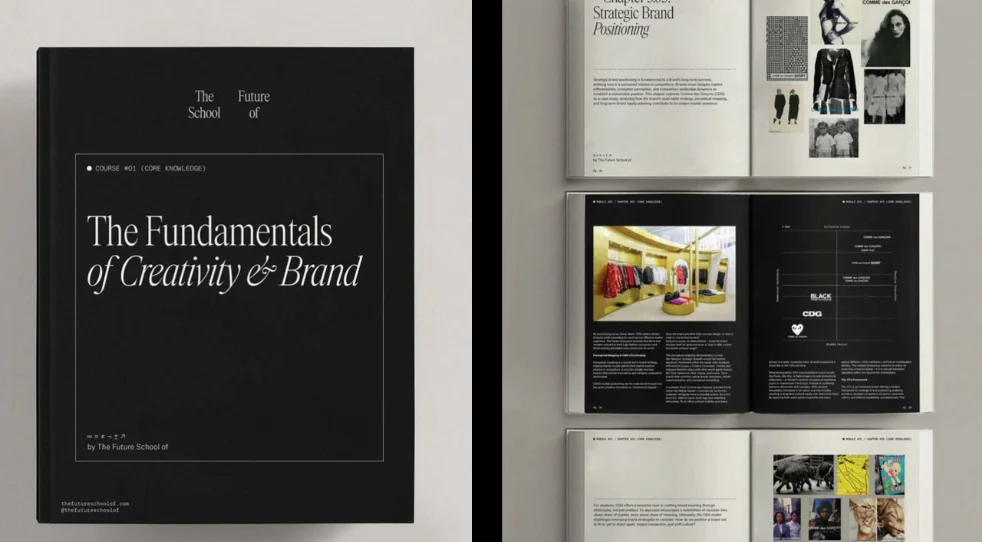
The Fundamentals of Creativity and Branding is a 16-hour self-paced digital course from The Future School of, built around six teaching modules, 14 exercises, a closing question-and-answer component and an interactive Brand Book. It is aimed at founders, creatives and marketers trying to understand why some brands become distinctive across visual, verbal and customer touchpoints. Before judging this specific offer, it helps to separate the parts of creativity and branding that weak courses often blur.
Identity, position and voice answer different questions
Distinctiveness is not decoration. Brand identity defines the recognizable system of meanings, symbols and behaviours a business uses. Positioning identifies the place the brand should occupy relative to alternatives in a chosen audience’s mind. Brand voice governs how that identity sounds in language. A visual system translates the identity into repeatable typography, colour, imagery, grids and marks, while creative direction decides how those elements serve a particular campaign or moment. Narrative connects actions over time. The total brand ecosystem then tests whether the same strategic idea survives packaging, websites, stores, service and customer experience without becoming mechanically identical.
Strategy lenses expose different kinds of distinctiveness
Identity-system design codifies visual and verbal assets; it is strong at consistency but weak when the underlying market choice is vague. Positioning-led strategy uses audience research, competitive frames and perceptual mapping to show where brands cluster and where a credible opening may exist.
The Three Cs framework asks what the company can deliver, what customers value and how competitors already answer that demand. Its value comes from forcing comparison, although its conclusions are only as reliable as the research supplied.
Semiotic and cultural analysis examines signs, codes and changing meanings; it is useful in fashion and culture but can become speculative without behavioural evidence. Customer-journey mapping follows encounters across channels and exposes operational gaps that style guides miss. Comparative case-study analysis develops pattern recognition, yet a luxury fashion case may not transfer to a small service business with different margins, buying cycles and distribution. Case studies generate hypotheses, not causal proof.
A serious syllabus produces decisions you can inspect
Any creativity and branding program should leave behind more than attractive references. Check whether you must create a positioning choice, perceptual map, identity logic, voice rules, narrative structure and cross-channel application. Look for exercises that reveal assumptions, examples from more than one business model and criteria for critiquing the work. Confirm who teaches, whether feedback comes from a person, how questions are answered and whether revisions are required. A polished case study is not enough: you should be able to explain which Three Cs evidence supports the proposed direction and what would cause you to change it.
Six teaching modules connect concept to ecosystem
This creativity and branding course moves from brand identity into visual systems, targeting and positioning, creative direction and narrative, brand voice, then the total brand ecosystem. The listing describes typography, grids, colour palettes, logos, perceptual mapping, the Three Cs, semiotics, message mapping, customer journeys and modular branding. Learning is delivered through video lessons, written analysis, diagrams, visual references, guided reflection and 14 exercises, with the downloadable Brand Book supporting notes and development.
A seventh named module provides question-and-answer knowledge integration after the six teaching modules. Case studies include Loewe, Bottega Veneta, 032c and Rick Owens, among others. These fashion houses are subjects of analysis; the listing does not establish their endorsement or participation. The structure is broad and logically sequenced, but the description does not show completed student projects or explain how exercises are evaluated.
Fashion references illustrate method rather than results
The examples can demonstrate how identity, visual language and cultural codes interact, but they do not prove that taking the course improves commercial performance. The listing identifies no instructor, gives no instructor credentials and has no cited independent evidence for learning or business outcomes. It also names no accrediting body, so the completion certificate should be treated as a private course credential associated with this course, not an accredited qualification. No creator income or student-count figures appear in the supplied listing; any such figures encountered elsewhere would remain promotional claims rather than verified results.
The portal details that still need an answer
Is the closing question-and-answer module live? The course is described as self-paced, and the listing does not say that a person answers newly submitted questions. Treat it as integrated course material unless the provider confirms otherwise.
Does the Brand Book become a finished brand guide? It is described as an interactive digital workbook for reflection, notes and development. The listing does not promise a professionally assessed final identity manual.
Will somebody critique the 14 exercises? Feedback, marking and revision rounds are not specified. Buyers who need coached practice should clarify this before enrolling.
What does completing the course establish? Completion can document participation and lead to the portal certificate, but the absence of named accreditation means it should not be presented as a regulated or academic qualification.
Transfer begins when the reference board closes
Results require translating each framework into decisions for one real brand, testing those decisions with customers and revising the system after observing use. The common failure is collecting fashionable references without defining the audience, competitive frame or operational constraints. If your gap is production craft, dedicated graphic design training may be more useful. If language is the bottleneck, compare specialist brand copywriting practice. If your assumptions about buyers are weak, choose structured customer-research training. Founders needing direct critique may be better served by portfolio-based brand strategy mentorship.
This program suits an independent learner who wants a broad conceptual sequence and will create additional project work. It is a weaker choice when you need named expert instruction, live feedback, assessed deliverables or sector-specific application. Creativity and branding knowledge becomes useful only when the system survives contact with a real audience and a real operating environment.