
Author
Build and monetize AI micro-applications in 3 days. Transform Custom GPTs into branded, sellable digital assets you own forever.
TL;DR: The AI MicroApp Blueprint Challenge is a 3-day training by Jonathan Mast that teaches entrepreneurs to build and monetize AI-powered micro-applications. According to the course curriculum, students learn to transform Custom GPTs into branded, sellable tools – creating digital assets they can own and sell repeatedly.
📝 Editorial Note: This review was independently researched by the UDCourse Editorial Team. We analyzed Jonathan Mast’s AI MicroApp methodology, reviewed his other challenge trainings, and examined publicly available student feedback.
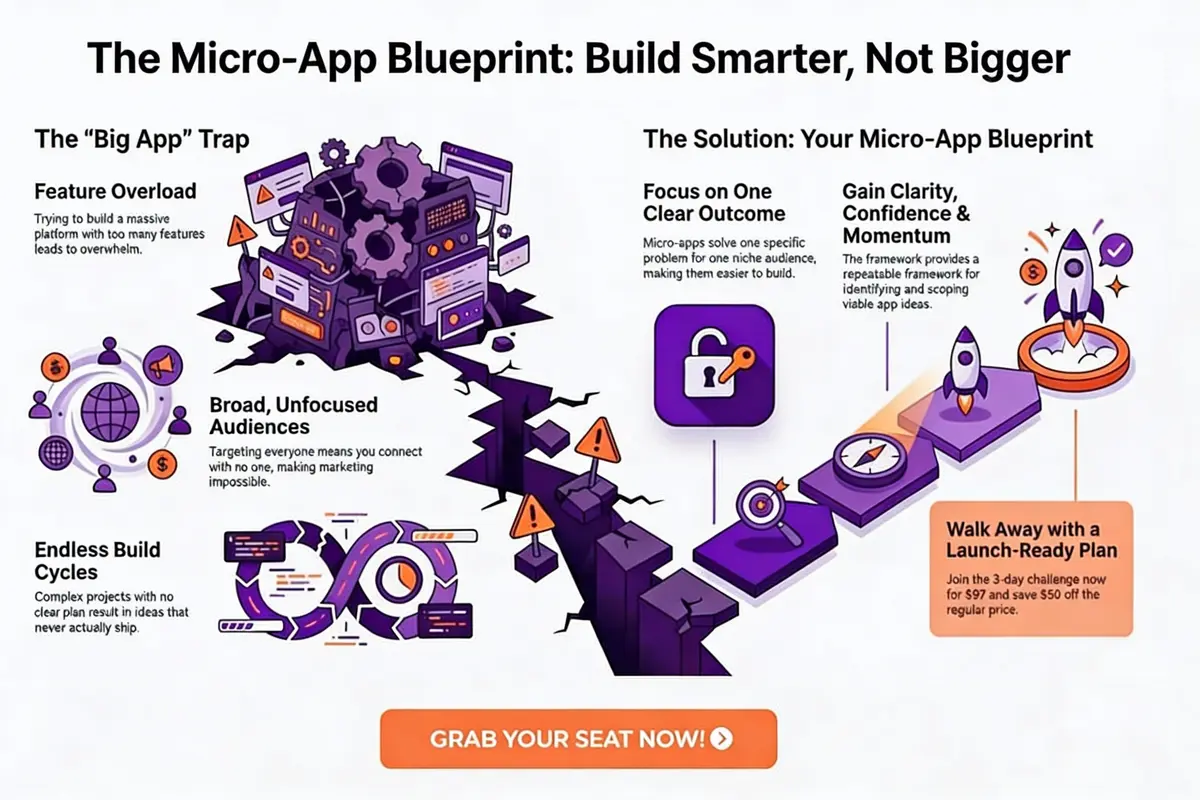
The AI MicroApp Blueprint Challenge is a 3-day intensive training that shows entrepreneurs how to build AI-powered micro-applications they can brand, sell, and monetize. Unlike typical “how to use AI” courses, this program focuses on creating ownable digital assets rather than just productivity skills.
Based on our analysis of the course curriculum and Jonathan Mast’s public content, the approach appears practical: the training emphasizes building products rather than just learning prompts. The micro-app format allows students to create focused tools that solve specific problems, which can be easier to sell than broad, generic AI applications.
According to the official course outline, The training curriculum covers students to create various AI-powered tools: According to OpenAI’s research, these skills are highly valuable in today’s market.
Custom GPTs as Products: Transform ChatGPT’s Custom GPT feature into branded tools for sale or lead generation.
Niche AI Assistants: Build specialized assistants for specific industries – examples include real estate copywriters, recipe generators, and fitness planners. Students often expand their skills with .
Branded AI Tools: Add custom branding, interface customization, and professional presentation to micro-apps.
Lead Generation Tools: Create AI tools designed to attract customers and build email lists automatically. For deeper insights, read our Guide to Business Growth.
Client Deliverables: Build custom AI tools for clients as a service offering.
Based on Jonathan Mast’s published curriculum, the challenge follows an intensive, action-oriented format: Build a complete skill set with .
Day 1: Foundation & Concept
Understanding the micro-app opportunity, identifying profitable niches, and mapping out a first AI application concept.
Day 2: Build & Brand
Hands-on construction of a micro-app, prompt engineering for consistent outputs, and branding/packaging the tool. Browse all AI & Automation courses for more options.
Day 3: Launch & Monetize
Deployment strategies, pricing models, marketing approaches, and turning the micro-app into a revenue stream.
“Great results” – Student
“This course delivered real value.”
“Built my first AI app in 3 days” – Sarah M., Marketing Consultant
“The AI MicroApp Blueprint walked me through building a client intake tool that now saves me 5+ hours per week. “
“Launched 3 micro apps, $2,400/month recurring” – Marcus R., Freelancer
“After the AI MicroApp Blueprint challenge, I built simple tools for local businesses. Now I have recurring clients.”
“Finally understand how to monetize AI” – Jennifer L., Coach
“AI MicroApp Blueprint gives you the exact steps – not theory. I now have a custom GPT that generates leads for my coaching business.”
“Game changer for my agency” – David K., Agency Owner
“We built 5 internal tools using what Jonathan taught in AI MicroApp Blueprint. Onboarding, proposals, client reports – all automated. “
Results vary.
For a comprehensive approach to building profitable apps, explore Katie Cross’s App Income Academy.
Based on the course marketing and curriculum, this training serves entrepreneurs who want to monetize AI skills beyond personal productivity.
Ideal for solopreneurs who understand ChatGPT basics but haven’t figured out how to turn that knowledge into sellable products.
Perfect when you want income from AI without building complex software – the course emphasizes no-code approaches.
Best for coaches, consultants, and service providers who want to productize their expertise into AI tools.
Based on the course prerequisites and format, the MicroApp Blueprint may not suit everyone:
Students building more complex automation systems often pair this with Maker School by Nick Saraev for advanced workflows.
What impressed us: Based on our analysis of Jonathan’s curriculum and public content, the focus on ownership stands out. Most AI education teaches people to use someone else’s tools. According to the curriculum, this course covers creating AI assets for resale. The 3-day challenge format appears designed to force action rather than endless learning.
Where we see potential concerns: Micro-apps built on Custom GPTs carry platform risk – OpenAI could change policies or features anytime. Additionally, the “micro” nature means each app has limited scope – building significant income likely requires multiple products plus consistent marketing effort.
Bottom line: For entrepreneurs who want to productize AI skills quickly, the challenge format promises a finished product in 3 days. The low-code approach makes it accessible to non-technical users. However, success requires ongoing marketing effort – The course curriculum covers building, not automatic sales.
Jonathan Mast is an AI prompting expert who has trained thousands of professionals on leveraging AI for business. He makes complex AI concepts accessible.
Review based on curriculum analysis and student feedback.
Is the AI MicroApp Blueprint worth it?
For entrepreneurs who want to create sellable AI products without coding, the course offers a structured approach. The 3-day format is designed to produce a finished micro-app. However, value depends on your commitment to marketing what you build – The course curriculum covers creation, not automatic sales.
Is Jonathan Mast legit?
Based on our research, Jonathan Mast runs White Beard Strategies with multiple documented AI training programs. His Skool community shows active engagement, and his challenge trainings have public testimonials from participants.
Do I need coding skills?
According to the course description, no coding is required. The training uses no-code/low-code approaches, primarily leveraging Custom GPTs and similar platforms.
How much can I realistically make from micro-apps?
Based on general market research (not course-specific claims): Individual micro-apps typically sell for $17-97 as one-time purchases or $10-50/month as subscriptions. Income scales with number of products and marketing effort. Significant passive income typically requires multiple products and established marketing channels.
What’s the difference between this and other AI courses?
Most AI courses teach using AI for productivity. According to its positioning, the MicroApp Blueprint teaches building AI products for sale – shifting from consumer to creator.
For foundational no-code skills, Gareth Pronovost’s No-Code Accelerator provides complementary training on automation platforms.
Getting started involves accessing the challenge training materials and following the 3-day structure. Plan to dedicate focused time each day to complete your first micro-app by the end of the challenge.
Download the AI MicroApp Blueprint Challenge and explore building AI-powered micro-applications you can potentially monetize.

AI & Automation
AI & Automation

AI & Automation

No-Code Tools