Master Learning Path Development for Skill Growth



Most people only tap into a fraction of their true potential at work because they never take time to pinpoint their skill gaps. Nearly 60 per cent of employees admit they lack a clear plan for professional growth. Focusing on where you stand and where you aim to go can turn uncertainty into a clear, step-by-step roadmap for success. This guide shows how to identify your skills, set meaningful goals, and build a personal path to real career advancement.
Quick Summary
| Key Point | Explanation |
|---|---|
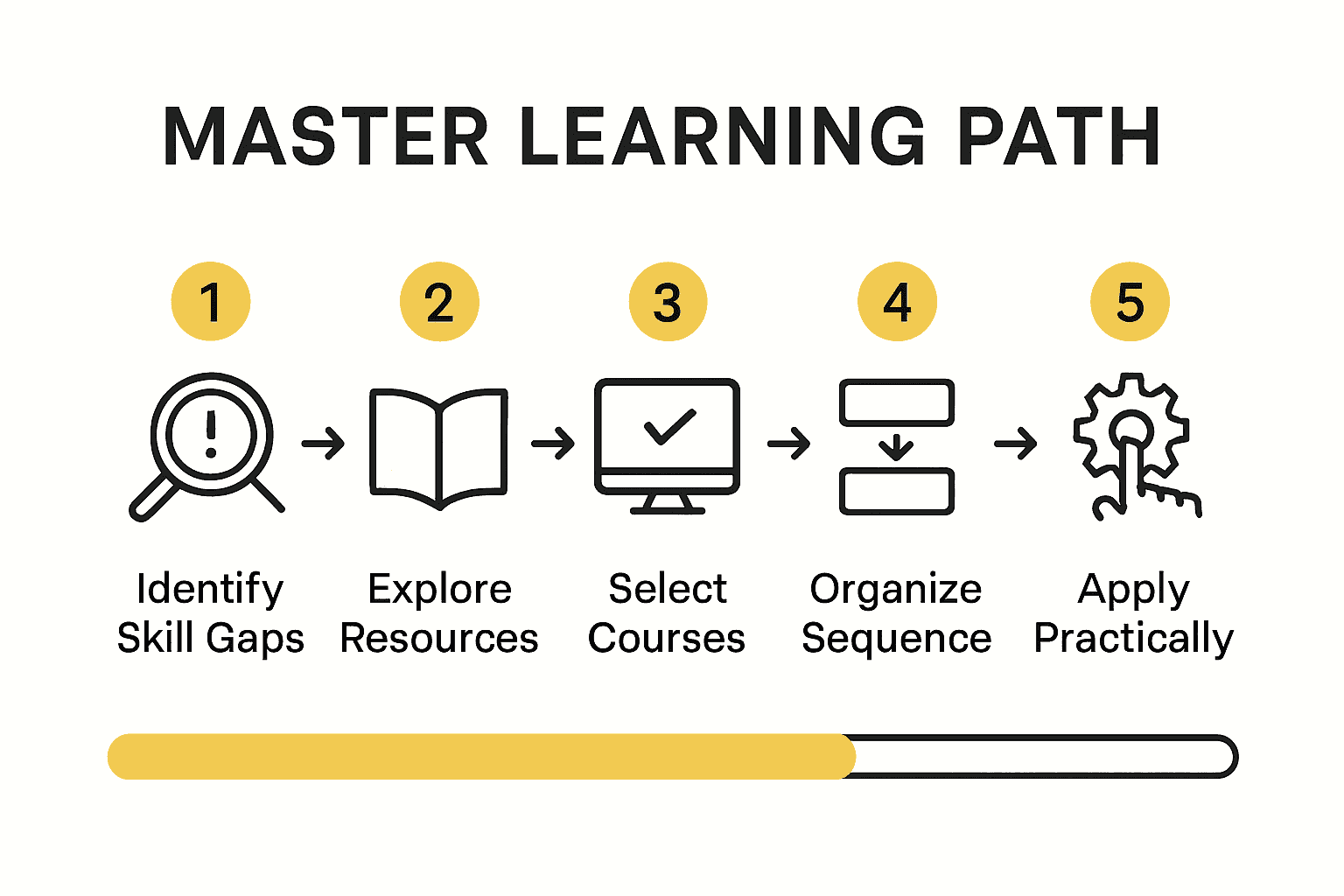
| 1. Assess current and desired skills | Identify your existing skills and the skills you aspire to develop to create a personalized learning roadmap. |
| 2. Focus on specific skill gaps | Limit your initial learning objectives to two or three key skill gaps to ensure effective mastery without overwhelm. |
| 3. Research diverse learning resources | Explore multiple educational platforms offering various resources to align with your specific skill development goals. |
| 4. Organize courses for progressive learning | Create a learning path that logically sequences courses, ensuring each builds on the previous knowledge gained. |
| 5. Apply skills through practical projects | Engage in real-world projects that challenge you to implement new skills, reinforcing your learning through practical application. |
 |
|
Step 1: Identify your skill gaps and learning goals
Unlocking your potential starts with understanding exactly where you are and where you want to go. This step involves creating a personal skill roadmap that turns vague aspirations into concrete learning objectives. By systematically analysing your current capabilities and future ambitions, you can design a targeted learning strategy that propels your professional growth. Start by conducting a thorough self-assessment. Pull out a notebook or open a digital document and create three distinct columns: current skills, desired skills, and skill gaps. In the first column, list everything you currently know how to do professionally. Be honest and comprehensive. For the desired skills column, imagine your ideal professional self three to five years from now. What abilities would you need to achieve your career vision? Compare these two columns to identify precise skill gaps.

To make this process more structured, consider using a skills matrix approach. Rate your existing skills on a scale from 1 to 5 (1 being beginner, 5 being expert). For each skill gap you identify, create a specific learning objective. Instead of saying “I want to get better at marketing,” write “Complete an advanced digital marketing certification and execute three successful social media campaigns by Q4.” This level of precision transforms abstract goals into actionable learning paths. Warning: Avoid the common trap of trying to learn everything at once. Select two or three skill gaps to focus on initially. Spreading yourself too thin guarantees mediocre results. Your learning journey is a marathon, not a sprint. The next step in your skill development journey is researching specific learning resources to help you bridge the identified skill gaps. Get ready to explore targeted educational pathways that align perfectly with your professional goals.
Step 2: Explore curated educational resources and platforms
Now that you’ve identified your skill gaps, it’s time to discover the right learning platforms that can transform your knowledge journey. The digital education landscape offers an incredible array of resources designed to meet diverse learning needs and preferences. Our goal is to help you navigate these options strategically and find platforms that align perfectly with your specific skill development objectives. Begin your exploration by leveraging comprehensive educational resource libraries. OER Commons stands out as an excellent starting point a freely accessible online library that allows learners to search and discover open educational resources across multiple subjects. When evaluating platforms, consider factors like course structure, instructor credentials, user reviews, and alignment with your identified skill gaps. Some platforms specialize in specific domains like technology, while others offer broad multidisciplinary content. Look for resources that provide practical learning experiences interactive courses, project based assignments, and real world skill application opportunities. Expand your search beyond traditional online course platforms. Government educational portals like SWAYAM offer free online courses across diverse disciplines providing high quality content from centrally funded institutions. Consider mixing different types of learning resources podcasts, video tutorials, webinars, and structured online courses to create a comprehensive and engaging learning experience. Remember that diversity in learning materials can help reinforce concepts and keep your educational journey dynamic and interesting. Warning: Not all online resources are created equal. Always verify the credibility of the platform and the expertise of course instructors. Check for user reviews, course completion rates, and whether the platform offers certificates or verifiable credentials that can enhance your professional profile. As you compile your list of potential learning resources, you’ll be ready to move on to the next critical step developing a structured learning strategy that transforms these resources into actionable skill development.
Step 3: Select relevant courses for your targeted outcomes
Selecting the right courses is a critical step in transforming your skill gaps into professional strengths. Your goal is to find learning experiences that not only match your objectives but also provide practical pathways to real world application. This strategic selection process will ensure you invest your time and energy in courses that truly propel your career forward. Look for platforms that offer project based learning approaches. Hyperskill exemplifies this strategy with its online educational platform that enables learners to select courses aligned with specific skill development goals. When evaluating potential courses, create a detailed checklist. Assess the curriculum for depth of content, instructor expertise, practical assignments, and alignment with your identified skill gaps. Prioritize courses that offer hands on projects, case studies, and opportunities to build a portfolio that demonstrates your newly acquired skills. Beyond traditional course platforms, explore comprehensive educational resources like Curriki, an open education service providing diverse curricula and instructional materials. This approach allows you to mix and match learning resources creating a customized educational experience. Consider combining structured online courses with supplementary materials like industry whitepapers, webinars, and professional conference recordings to create a multidimensional learning strategy. Warning: Resist the temptation to enroll in too many courses simultaneously. Spread your focus across no more than two to three courses to maintain quality learning and prevent overwhelming yourself. With your carefully selected courses in hand, you are now prepared to design a structured learning implementation strategy that transforms educational content into tangible professional skills.
Step 4: Organize your course sequence for effective progress
Organizing your learning journey requires strategic planning and intentional sequencing of courses to maximize skill development and knowledge retention. Your goal is to create a systematic approach that builds skills progressively, ensuring each new course enhances and complements your previous learning experiences. Kendall Hunt emphasizes the critical importance of mapping out your learning path and setting clear goals. Begin by creating a visual learning roadmap that demonstrates the progression of your courses. Start with foundational courses that establish baseline knowledge and gradually move towards more advanced and specialized content. Arrange your courses in a logical sequence that allows skills to build upon each other. For instance, if you are learning digital marketing, begin with fundamental marketing principles before advancing to specialized areas like social media marketing or data analytics. Consider the interdependencies between your selected courses and create a flexible yet structured timeline. Assess the time commitment required for each course and plan your learning schedule to prevent burnout. Allocate buffer periods between courses to consolidate learning, reflect on acquired skills, and apply practical knowledge. Some courses might have prerequisites or recommended prior learning paths, so review these carefully to ensure a smooth progression. Warning: Avoid creating an overly rigid learning plan. While structure is essential, leave room for adaptability. Your interests and career goals might evolve, so design a learning sequence that can be adjusted as you grow professionally. With a well organized course sequence, you are now prepared to implement a dynamic and effective learning strategy that will systematically transform your professional capabilities.
Step 5: Evaluate your mastery through practical application
True skill mastery goes beyond theoretical knowledge. It requires translating learned concepts into real-world performance through deliberate practice and tangible project execution. This step is about transforming academic understanding into professional competence by creating opportunities to apply your newly acquired skills in meaningful contexts. Platforms like Globaloria demonstrate the power of project based learning by teaching students to design and code educational web and mobile games. Similarly, you should seek out practical application opportunities that challenge you to implement your skills in authentic scenarios. Start by identifying complex projects that require integrating multiple skills from your learning journey. For instance, if you are learning digital marketing, develop a comprehensive marketing campaign for a fictional or real small business that requires you to apply strategic planning, content creation, social media management, and analytics skills. The OSSCAR platform offers an excellent model of an open collaborative environment for skill application. Look for similar platforms or create your own learning opportunities. This might involve volunteering for nonprofit projects, participating in online hackathons, contributing to open source initiatives, or creating personal passion projects that push the boundaries of your current skill set. Document your progress meticulously track the challenges you encounter, solutions you develop, and skills you demonstrate through these practical experiences. Warning: Avoid the trap of perfection. Practical application is about learning through doing not achieving flawless execution. Embrace mistakes as valuable learning opportunities that accelerate your skill development. With a portfolio of practical projects demonstrating your skills, you are now prepared to showcase your professional growth and transition from learner to practitioner.
Accelerate Your Skill Growth with Affordable Premium Courses
Identifying your skill gaps and crafting a clear learning path can feel overwhelming. You want to focus on targeted goals, select practical courses, and organize your studies effectively — but premium education often comes with a heavy price tag. This is where UDCourse steps in to transform your learning journey. With access to discounted, high-quality courses across essential fields like marketing, IT, and business growth, you can master your learning roadmap without breaking the bank. 
Frequently Asked Questions
How do I identify my skill gaps for effective learning path development?
Start by conducting a thorough self-assessment. Create three columns: current skills, desired skills, and skill gaps, then compare them to pinpoint areas where you need improvement.
What types of educational resources should I explore for skill growth?
Explore comprehensive educational resource libraries, project-based learning platforms, and diverse media like podcasts and webinars. Aim to create a varied mix that aligns directly with your specific skill development goals.
How can I select relevant courses to fill my skill gaps?
Choose courses that offer hands-on projects and align with your identified skill gaps. Focus on platforms that allow you to build a portfolio of your work and validate your newly acquired skills through practical assignments.
What is the best way to organize my learning sequence for thorough understanding?
Create a visual learning roadmap outlining foundational courses that lead to advanced topics. Arrange your courses logically, ensuring that each one builds on the previous skills, and allow for short breaks to consolidate learning.
How can I evaluate my mastery of new skills through practice?
Translate your theoretical knowledge into real-world applications by working on complex projects that integrate multiple skills. Document your progress and seek opportunities, like volunteering or personal projects, to apply what you’ve learned in contexts that stretch your abilities.